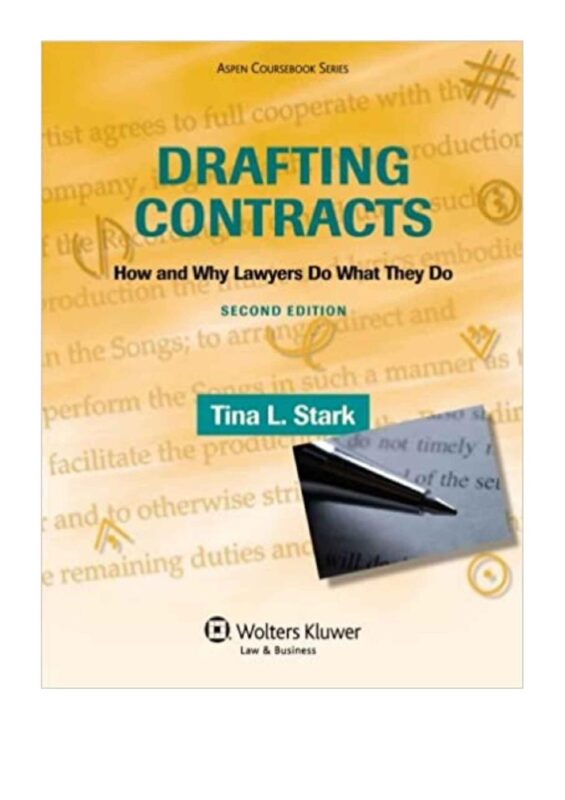
Drafting Contractsv How & Why Lawyers Do What They Do 2nd Edition By Tina L Stark
$25.00
Secure checkout
Instant digital download
PDF document
Document details
- Pages
- 432
- File size
- 8.11 MB
- Format
- Digital PDF
- Course
- Business
- Category
- eBook[PDF]
Sign in or create a free account to continue. Your purchase will be saved in My Downloads.
About this ebook
Drafting Contracts: How & Why Lawyers Do What They Do (2nd Edition) by Tina L. Stark is a foundational legal textbook structured to teach the conceptual framework, structural anatomy, and stylistic principles of business contract drafting. [1, 2]
🧱 Part 1: Translating the Business Deal into Contract Concepts
This section teaches the analytical framework or "building blocks" that deal lawyers use to translate a client's real-world business objectives into precise legal frameworks. [1, 2]
- The Seven Contract Concepts: The primary vehicles for expressing deal terms (Representations, Warranties, Covenants, Rights, Conditions, Discretionary Authority, and Declarations). [1, 2]
- Translating the Business Deal (Part 1): Focuses heavily on drafting representations and warranties (past/present facts) as well as covenants and rights (future obligations). [1, 2]
- Translating the Business Deal (Part 2): Covers conditions precedent, discretionary authority (permissions), and declarations (policies/definitions). [1, 2]
📑 Part 2: A Contract's Parts (The Anatomy of an Agreement)
This segment walks through the standard structure of a contract from beginning to end, analyzing the specific legal and business implications of each part. [1, 2]
- Introductory Provisions: Drafting the preamble, recitals ("whereas" clauses), and the formal words of agreement.
- Definitions and Defined Terms: Guidelines for crafting precise definitions to maintain consistency across the entire document.
- Action Sections: The core of the deal, including the transaction statement, consideration, purchase price mechanics, and closing details.
- Individual Concept Sections: Dedicated deep-dives into drafting provisions for representations, warranties, covenants, rights, conditions to an obligation, and discretionary authority.
- The Use of "Will" and "Shall": Strict rules on linguistic precision, detailing exactly when to use "shall" (for mandatory duties) versus other verbs.
- Endgame Provisions: Sections handling contract termination, defaults, remedies, and what happens when the relationship breaks down.
- General (Boilerplate) Provisions & Signatures: Standard boilerplate clauses (governing law, notices, severability, etc.) and proper execution formatting. [1, 2]
✍️ Part 3: Drafting for Clarity and Avoiding Ambiguity
This section targets the mechanics of clear, plain-English legal writing and formatting. [1]
- Eliminating Legalese: Cutting through unnecessary archaic legal jargon to improve user readability.
- Clarity Through Format & Sentence Structure: Designing clean visual layouts and using active, short sentences.
- Preventing Ambiguity: Catching syntactic, semantic, or contextual ambiguity before a contract is finalized.
- Numbers and Financial Provisions: Precise methods for stating currency, calculations, interest rates, and accounting metrics. [1]
🤝 Part 4: Looking at the Contract From the Client's Perspective
This part transitions from basic drafting to advanced strategy, helping lawyers maximize utility for their clients. [1]
- Deconstructing Complex Provisions: Breaking down dense or convoluted multi-part clauses.
- Adding Value to the Deal: Identifying hidden business risks, spotting operational issues, and resolving them via tactical drafting. [1, 2]
⚙️ Part 5: Organizing and the Drafting Process
This part details the practical, day-to-day logistics of being a transaction lawyer. [1]
- Organizing a Contract: Establishing structural hierarchy at the macro and micro levels.
- The Drafting Process: Step-by-step guidance on communicating with clients, working with or without templates (precedents), and handling initial drafts.
- Reviewing and Commenting on Contracts: Best practices for evaluating someone else’s draft, making markup revisions, and providing feedback via legal memoranda.
- Amendments, Consents, and Waivers: How to safely modify an active contract or temporarily waive a client's contractual breaches. [1]
⚖️ Part 6: Drafting Ethically
- Ethical Issues in Drafting: Navigating professional responsibility limits, the ethical boundaries of negotiation, and the role of the drafter in avoiding deceptive provisions. [1]
File included
tmpphpv1f7SJ
8.11 MB
Related ebooks