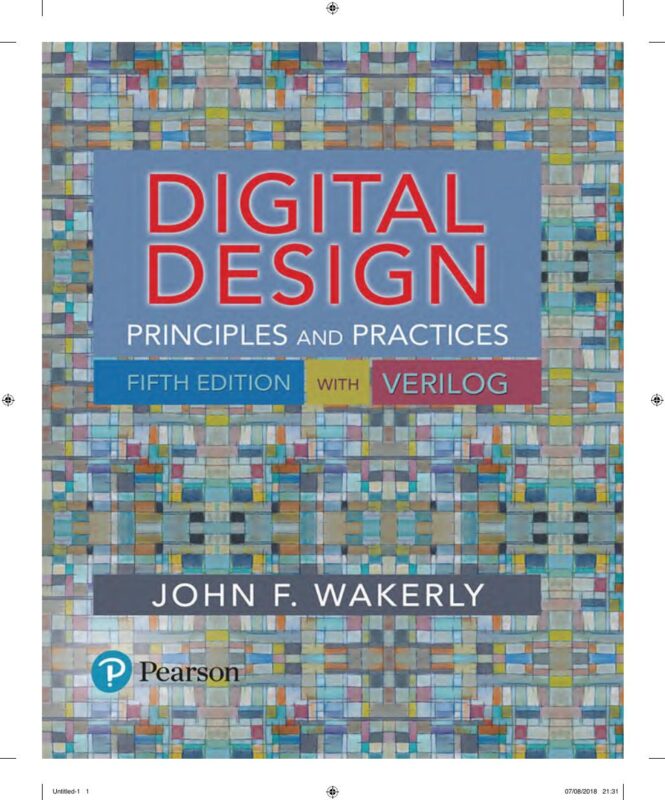
Digital Design Principles and Practices 5th Edition By John Wakerly
$30.00
Secure checkout
Instant digital download
PDF document
Document details
- Pages
- 912
- File size
- 15.6 MB
- Format
- Digital PDF
- Course
- Digital Marketing
- Category
- eBook[PDF]
Sign in or create a free account to continue. Your purchase will be saved in My Downloads.
About this ebook
"Digital Design: Principles and Practices" (5th Edition) by John F. Wakerly bridges the gap between high-level hardware description languages (HDLs), low-level electrical circuits, and the foundational logic gates in between. The 5th edition leans significantly into modern engineering standards, heavily featuring Verilog alongside classic logic design. [1, 2]
The complete list of topics covered in the textbook, organized by their official chapter structure, includes: [1]
Foundations & Logic Fundamentals
- Introduction: Core concepts of digital systems, analog vs. digital characteristics, and engineering design workflows.
- Number Systems and Codes: Binary, octal, hexadecimal conversion, representation of signed numbers, and error-detecting codes.
- Switching Algebra and Combinational Logic: Boolean algebra principles, minimization techniques, Karnaugh maps, and logic gate theory. [1, 2]
Combinational Logic Design
- Digital Design Practices: Real-world documentation standards, structural design methodologies, and implementation rules.
- Verilog Hardware Description Language: Synthesizable Verilog syntax, structural and behavioral modeling for hardware.
- Basic Combinational Logic Elements: Standard gates (AND, OR, NOT, NAND, NOR) and basic circuit behavior.
- More Combinational Building Blocks: Decoders, encoders, multiplexers, demultiplexers, and comparators.
- Combinational Arithmetic Elements: Adders, subtractors, multipliers, and Arithmetic Logic Units (ALUs). [1, 2, 3]
Sequential Logic Design
- State Machines: Introduction to finite state automata, clocked synchronous state machines, Mealy and Moore models.
- Sequential Logic Elements: Latches, flip-flops (D, T, JK), and their timing characteristics.
- Counters and Shift Registers: Multi-bit registers, serial-to-parallel/parallel-to-serial conversion, counters, and sequence generators.
- State Machines in Verilog: Writing behavioral sequential circuits and hardware controllers using Verilog.
- Sequential-Circuit Design Practices: Clock distribution, dealing with meta-stability, synchronous design constraints, and managing asynchronous interfaces. [1, 2, 3, 4]
Circuit Electronics & Memory Devices
File included
tmpphpFHRItP
15.6 MB
Related ebooks