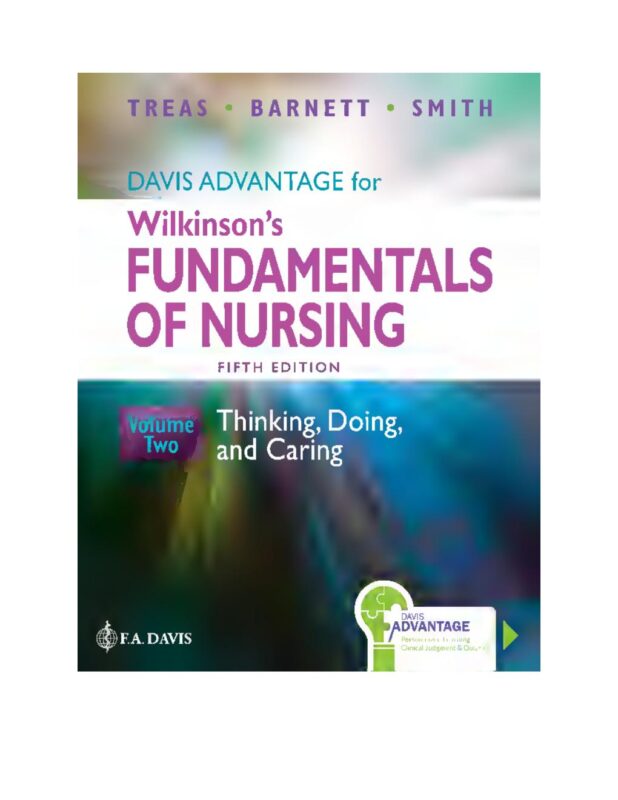
Davis Advantage for Wilkinson’s Fundamentals of Nursing (Volume 2) 5th Edition By Leslie Treas, Karen Barnett, Mable Smith
$30.00
Secure checkout
Instant digital download
PDF document
Document details
- Pages
- 1,519
- File size
- 8.66 MB
- Format
- Digital PDF
- Course
- NURSING
- Category
- eBook[PDF]
Sign in or create a free account to continue. Your purchase will be saved in My Downloads.
About this ebook
Davis Advantage for Wilkinson’s Fundamentals of Nursing (5th Edition) uses a two-volume structure where Volume 2 focuses specifically on the practical knowledge, clinical procedures, and lab skills required to implement the theoretical concepts taught in class. [1]
The curriculum tracks across five core units, organizing step-by-step procedures, clinical judgment frameworks, and practical application tasks. []
Unit 1: How Nurses Think (Clinical Applications)
- Clinical Judgment: Translating the NCSBN Clinical Judgment Measurement Model into bedside care.
- The Steps of the Nursing Process: Practical application of assessment, nursing diagnosis, planning outcomes, planning interventions, implementation, and evaluation.
- Evidence-Based Practice: Applying research and clinical theories to direct patient care activities.
- Ethics & Values: Navigating ethical dilemmas in daily clinical scenarios. [1, 2]
Unit 2: Factors Affecting Health in Practice
- Life Span Care: Practical milestones and specialized interventions for infancy through older adulthood.
- Stress & Adaptation: Identifying and addressing physiological and psychological stressors.
- Multicultural Healthcare: Providing culturally competent bedside care.
- Loss & Spirituality: Practical guidance for spiritual support and end-of-life care. [, 2]
Unit 3: Essential Nursing Interventions & Core Skills
- Communicating & Therapeutic Relationships: Interviewing techniques and nurse-patient interactions.
- Patient Education: Developing and implementing bedside teaching plans.
- Interprofessional Documenting & Reporting: Hand-off reporting and electronic health record documentation rules.
- Measuring Vital Signs: Step-by-step procedures for temperature, pulse, respiration, and blood pressure.
- Health Assessment: Physical examination techniques and systemic assessments.
- Asepsis & Preventing Infection: Hand hygiene, PPE, sterile fields, and isolation precautions.
- Patient Safety: Fall prevention, restraint alternatives, and environmental hazard reduction.
- Facilitating Hygiene: Procedures for bed baths, oral care, and grooming.
- Administering Medications: Oral, topical, and parenteral medication administration techniques. [, 2]
Unit 4: Supporting Physiological Functioning (Lab & Skills)
- Nutrition & Hydration: Feeding techniques, enteral nutrition, fluid balance tracking, and homeostasis.
- Elimination: Urinary catheterization, specimen collection, and bowel care interventions.
- Sensation, Perception, & Response: Safety modifications for sensory deficits.
- Pain Management: Non-pharmacological interventions and patient-controlled analgesia (PCA) monitoring.
- Physical Activity & Immobility: Patient safe-handling, positioning, turning, and range-of-motion exercises.
- Sleep, Rest, & Sexual Health: Practical bedside strategies to promote rest.
- Skin Integrity & Wound Healing: Dressing changes, wound irrigation, and pressure injury prevention.
- Oxygenation & Perfusion: Oxygen therapy setup, suctioning, and deep breathing exercises.
- Perioperative Patient Care: Pre-operative checklists, intra-operative safety, and post-operative recovery monitoring. []
Unit 5: Nursing Functions & Leadership
- Community & Home Health Nursing: Adapting practical clinical procedures to home and community settings.
- Nursing Informatics: Safe utilization of healthcare technologies.
- Legal Accountability: Operating safely within the nursing scope of practice.
- Leading & Managing: Prioritizing care, delegating tasks, and team collaboration. []
File included
tmpphpCOOKEI
8.66 MB
Related ebooks