
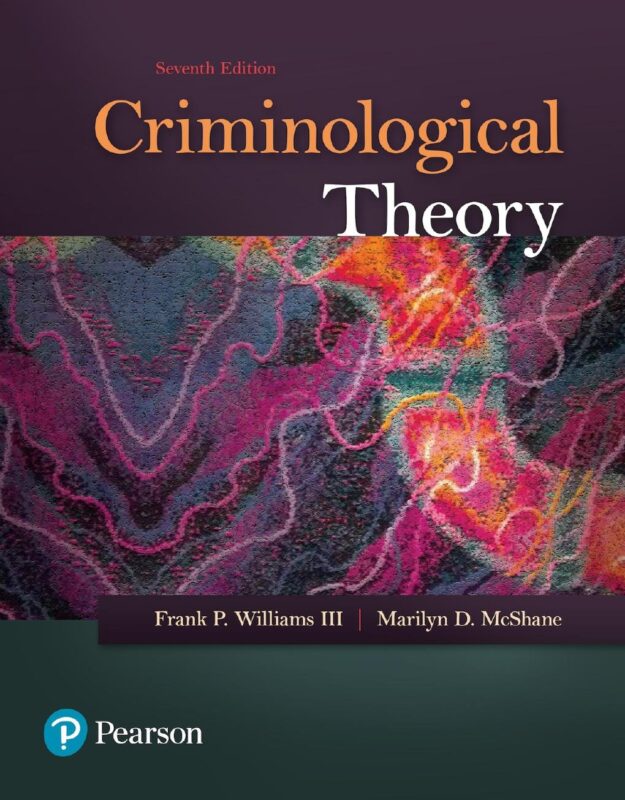
Criminological Theory 7th Edition By Franklin Williams, III, Marilyn McShane
$30.00
Secure checkout
Instant digital download
PDF document
Document details
- Pages
- 235
- File size
- 4.65 MB
- Format
- Digital PDF
- Course
- Education
- Category
- eBook[PDF]
Sign in or create a free account to continue. Your purchase will be saved in My Downloads.
About this ebook
The 7th edition of Criminological Theory by Franklin P. Williams III and Marilyn D. McShane, published by Pearson, organizes major sociological and criminological schools of thought chronologically across five distinct thematic sections. Each section addresses the social, cultural, and political contexts that gave rise to those theories. [1, 2]
Chapter and Topic Breakdown
Introduction
- Chapter 1: Introduction – Exploring what constitutes a "good theory," the different classifications of theories, and how research connects directly to criminal justice policy. [1]
Section I: The Roots of Criminology
- Chapter 2: The Classical School – Focuses on 18th-century foundational concepts like free will, utilitarianism, deterrence, and the contributions of Cesare Beccaria and Jeremy Bentham. [1]
- Chapter 3: The Positive School – Examines the shift toward scientific determinism, early biological/psychological perspectives, and Cesare Lombroso's theories of the "born criminal."
Section II: The Foundations of American Criminology
- Chapter 4: The Chicago School – Covers social disorganization theory, human ecology, and mapping crime across urban zones.
- Chapter 5: Differential Association Theory – Details Edwin Sutherland's premise that criminal behavior is learned through social interaction and communication.
- Chapter 6: Anomie Theory – Looks at Robert K. Merton's adaptation of Émile Durkheim's structural strain concept and how the gap between cultural goals and institutional means leads to deviance.
Section III: Building on the Foundation
- Chapter 7: Subculture Theories – Evaluates delinquent subcultures, gang behavior, and differential opportunity structures (e.g., Cohen, Cloward, and Ohlin).
- Chapter 8: Labeling Theory – Investigates societal reactions to crime, primary versus secondary deviance, and how official intervention can institutionalize criminal identities.
Section IV: Modern Criminology
- Chapter 9: Conflict Theory – Evaluates power dynamics, how laws are created to protect dominant social classes, and Marxist or radical criminology paradigms.
- Chapter 10: Gender-Based Theories – Explores feminist criminology, patriarchy, and the structural variations in how females are treated by the justice system.
- Chapter 11: Social Control Theory – Centers on why people don't commit crime, exploring Travis Hirschi's social bonds (attachment, commitment, involvement, belief).
- Chapter 12: Social Learning Theory – Bridges psychology and sociology, covering behavioral reinforcement and Ronald Akers' extensions of differential association.
- Chapter 13: Rational Theories – Explores modern choice frameworks including routine activities theory, lifestyle theory, and situational crime prevention. [1]
Section V: Contemporary Perspectives
- Chapter 14: Contemporary Theories of Process – Investigates micro-level progressions of crime over time, including developmental and life-course criminology.
- Chapter 15: Contemporary Integrative and Critical Theories – Analyzes modern frameworks that blend multiple traditional theories (e.g., Elliot's integrated model) alongside peacemaking, postmodern, and newer critical perspectives.
File included
ScholarFriends.com-criminological-theory-7th-edition-by-franklin-williams-iii-marilyn-mcshane.pdf
4.65 MB
Related ebooks



