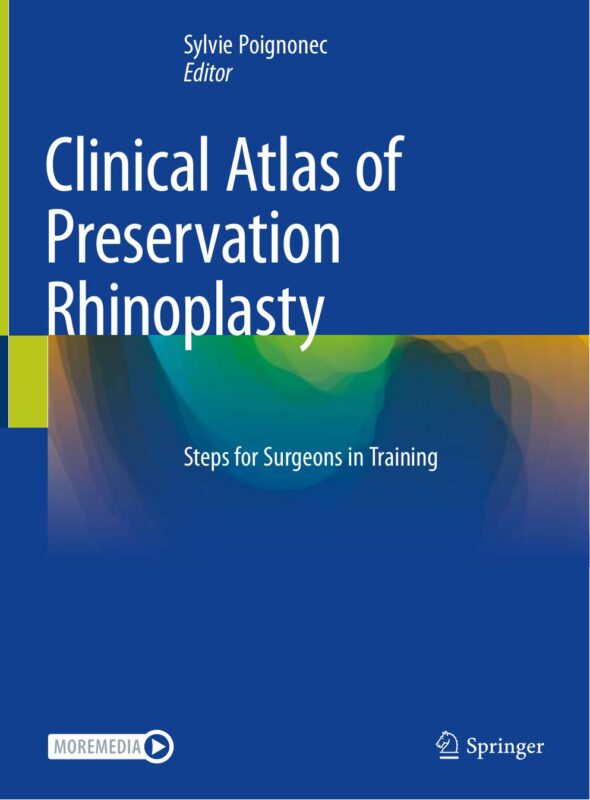
Clinical Atlas of Preservation Rhinoplasty 1st edition
$43.00
Secure checkout
Instant digital download
PDF document
Document details
- Pages
- 4,756
- File size
- 23.55 MB
- Format
- Digital PDF
- Course
- Medical Studies
- Category
- eBook[PDF]
Sign in or create a free account to continue. Your purchase will be saved in My Downloads.
About this ebook
The Clinical Atlas of Preservation Rhinoplasty: Steps for Surgeons in Training (1st Edition), published by Springer Nature and authored by Sylvie Poignonec, is a comprehensive clinical reference geared toward plastic surgery residents and ENT specialists. [1, 2]
The atlas covers a progression of topics designed to help clinicians correctly classify nasal malformations, plan reproducible interventions, and master specific surgical approaches. [1]
Preoperative Planning & Diagnosis
- Clinical Examination: Methods for initial patient evaluation, nasal airway mapping, and anatomical classification.
- Medical Photography: Standardized photographic techniques essential for facial analysis and documentation.
- 3D Topography and Deformation Measurement (TDM): Advanced three-dimensional planning and imaging technologies to quantify structural deformities.
- Computer Simulations: Utilizing morphing software to create surgical predictions and manage patient expectations.
- Preoperative Checklist: Setting up a structured safety and planning framework to ensure predictable outcomes. [1]
Surgical Techniques & Approaches
- Closed Techniques: The primary focus of the atlas, emphasizing endonasal preservation methods to maintain the nasal dorsum without disrupting the skin envelope.
- Transcolumellar (Open) Approaches: Transitioning from simpler anatomical variations to highly complex structural reconstructions.
- Combination Strategies: A step-by-step breakdown combining structural and preservation concepts for complex cases. [1]
Complications & Advanced Concepts
- Functional Considerations: Navigating the relationship between internal nasal valves, septal integrity, and airway preservation.
- Problem Prevention and Correction: Strategies to prevent common preservation pitfalls, such as dorsal hump recurrence or progressive asymmetry. [1]
File included
tmpphpW4lV9I
23.55 MB
Related ebooks