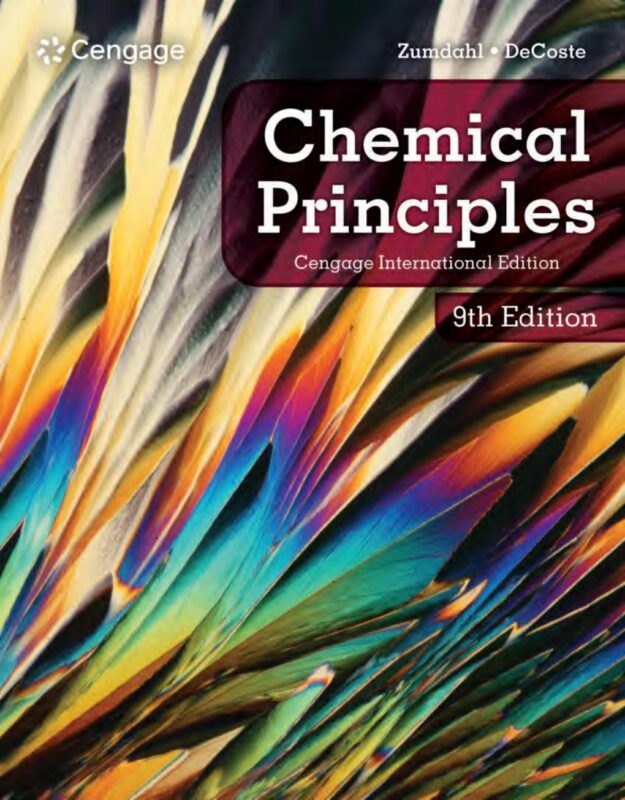
Chemical Principles 9th Cengage International Edition By Steven Zumdahl, Donald DeCoste
$30.00
Secure checkout
Instant digital download
PDF document
Document details
- Pages
- 1,283
- File size
- 39.67 MB
- Format
- Digital PDF
- Course
- Chemistry
- Category
- eBook[PDF]
Sign in or create a free account to continue. Your purchase will be saved in My Downloads.
About this ebook
The Chemical Principles, Cengage International Edition (9th Edition) by Steven S. Zumdahl and Donald J. DeCoste provides a mathematically rigorous introduction to chemistry tailored for highly motivated students. [1, 2]
Foundations & Stoichiometry
- Chapter 1: Chemists and Chemistry / Chemical Foundations – Introduction to chemical modeling, measurements, and unit conversions.
- Chapter 2: Atoms, Molecules, and Ions – Atomic structure, the periodic table, and early chemical history.
- Chapter 3: Stoichiometry – Atomic masses, mole concepts, chemical formulas, equations, and limiting reactants.
- Chapter 4: Types of Chemical Reactions and Solution Stoichiometry – Aqueous solutions, precipitation reactions, acid-base chemistry, and oxidation-reduction. [1, 2]
States of Matter & Thermodynamics
- Chapter 5: Gases – Gas laws, ideal gas behavior, kinetic molecular theory, effusion, diffusion, and real gases.
- Chapter 6: Chemical Equilibrium – Equilibrium constants, the equilibrium condition, and Le Chatelier's principle.
- Chapter 7: Acids and Bases – Acid strength, pH, calculating pH of weak/strong solutions, and polyprotic acids.
- Chapter 8: Aqueous Solution Equilibria – Buffer solutions, titrations, solubility equilibria, and complex ion chemistry.
- Chapter 9: Thermochemistry – Enthalpy, calorimetry, Hess's law, and standard enthalpies of formation.
- Chapter 10: Entropy, Gibbs Energy, and Spontaneity – The laws of thermodynamics, free energy change, and the relationship between free energy and equilibrium.
- Chapter 11: Electrochemistry – Galvanic cells, cell potential, the Nernst equation, batteries, and electrolysis. [1, 2]
Atomic Structure & Bonding
- Chapter 12: Quantum Mechanics and Atomic Theory – The wave-particle duality, Bohr model, orbital shapes, quantum numbers, and periodic trends.
- Chapter 13: Bonding: General Concepts – Ionic and covalent bonding models, electronegativity, Lewis structures, and resonance.
- Chapter 14: Covalent Bonding: Orbitals – Valence bond theory, hybridization of orbitals, and molecular orbital theory. [1, 2]
Kinetics & Condensed Phases
- Chapter 15: Chemical Kinetics – Reaction rates, rate laws, reaction mechanisms, catalysis, and temperature dependency.
- Chapter 16: Liquids and Solids – Intermolecular forces, phase changes, crystal structures, vapor pressure, and phase diagrams.
- Chapter 17: Properties of Solutions – Solubilities, colligative properties (vapor pressure lowering, boiling point elevation, osmotic pressure), and ideal solutions. [1, 2]
Descriptive & Nuclear Chemistry
- Chapter 18: The Representative Elements – Groups 1A through 8A chemistry, molecular structures, and chemical properties.
- Chapter 19: Transition Metals and Coordination Chemistry – Bonding in complex ions, coordination compounds, and crystal field theory.
- Chapter 20: The Nucleus: A Chemist's View – Nuclear stability, radioactive decay, nuclear fission, fusion, and thermodynamic effects.
- Chapter 21: Organic and Biological Chemistry / Molecules – Naming hydrocarbons, functional groups, polymers, and macromolecules (proteins, carbohydrates, nucleic acids). [1, 2, 3]
File included
tmpphpWV7QTN
39.67 MB
Related ebooks