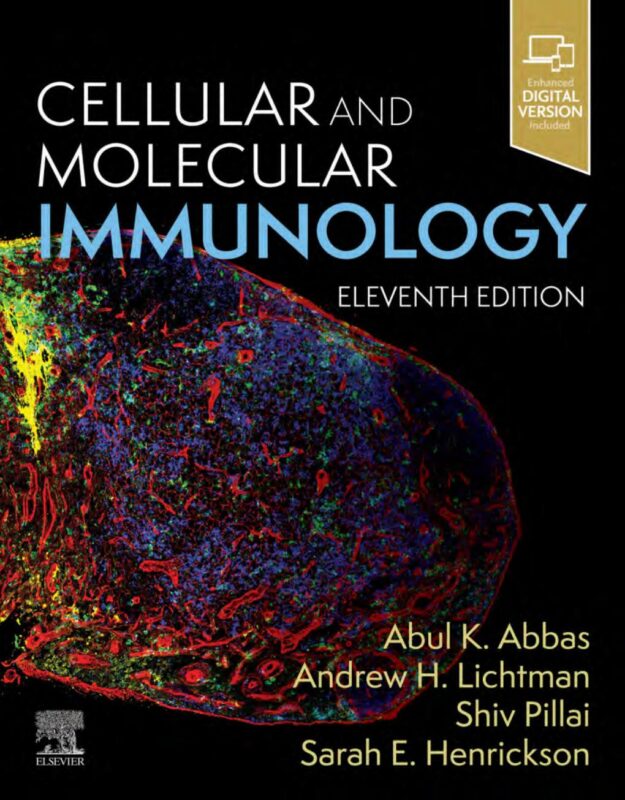
Cellular and Molecular Immunology 11th Edition By Abul Abbas, Andrew Lichtman, Shiv Pillai, Sarah Henrickson
$30.00
Secure checkout
Instant digital download
PDF document
Document details
- Pages
- 668
- File size
- 13.13 MB
- Format
- Digital PDF
- Course
- Clinical Medicine
- Category
- eBook[PDF]
Sign in or create a free account to continue. Your purchase will be saved in My Downloads.
About this ebook
The 11th edition of Cellular and Molecular Immunology by Abul K. Abbas, Andrew H. Lichtman, and Shiv Pillai (with new co-author Sarah Henrickson) covers 21 chapters. The topics span the fundamental principles of basic immunology to the mechanisms of clinical immunologic diseases. [1, 2]
The specific chapter topics covered in this edition include:
Introduction and System Architecture
- Overview of the Immune System: Core principles and properties of immune responses.
- Cells and Tissues of the Immune System: Anatomical structures, primary and secondary lymphoid organs.
- Leukocyte Circulation and Migration into Tissues: How immune cells travel throughout the body to sites of infection. [1, 2]
Innate Responses and Antigen Recognition
- Innate Immunity: The body's immediate, non-specific defense mechanisms and pathogen recognition.
- Antibodies and Antigens: Structural properties of immunoglobulins and how they bind to foreign targets.
- Antigen Presentation to T Lymphocytes: The role of Major Histocompatibility Complex (MHC) molecules in displaying antigens. [1]
Receptor Signaling and Lymphocyte Development
- Immune Receptors and Signal Transduction: The molecular pathways that trigger cellular action upon antigen binding.
- Lymphocyte Development and Antigen Receptor Gene Rearrangement: The genetic processes behind T and B cell maturation and receptor diversity. [1]
T Cell-Mediated Immunity
- Activation and Regulation of T Lymphocytes: Early events in T cell activation and control mechanisms.
- Differentiation and Functions of CD4+ Effector T Cells: Helper T cell subsets (such as Th1, Th2, and Th17) and their specific roles.
- Differentiation and Functions of CD8+ Effector T Cells: Cytotoxic T cell mechanisms used to kill infected or mutated cells. [1]
Humoral Immunity and Barrier Defense
- B-Cell Activation and Antibody Production: The stimulation of B cells and subsequent antibody manufacturing.
- Effector Mechanisms of Humoral Immunity: How antibodies neutralize and eliminate pathogens (e.g., complement system, opsonization).
- Specialized Immunity at Epithelial Barriers and in Immune-Privileged Tissues: Mucosal immunity, skin defense networks, and restricted locations like the brain or eyes. [1]
Immune Regulation and Pathology
- Immunologic Tolerance and Autoimmunity: Mechanisms preventing the body from attacking itself and what happens when they fail.
- Immunity to Microbes: Targeted defense strategies against bacteria, viruses, fungi, and parasites.
- Transplantation Immunology: The immune barriers to organ and tissue grafts.
- Tumor Immunology: The body's response to cancer cells and modern immunotherapy principles.
- Hypersensitivity Disorders: Unwanted immune reactions causing tissue injury.
- Allergy: IgE-mediated immune responses and mast cell triggers.
- Congenital and Acquired Immunodeficiencies: Primary genetic immune failures alongside acquired disorders such as HIV/AIDS. [1]
File included
tmpphpKJatmH
13.13 MB
Related ebooks