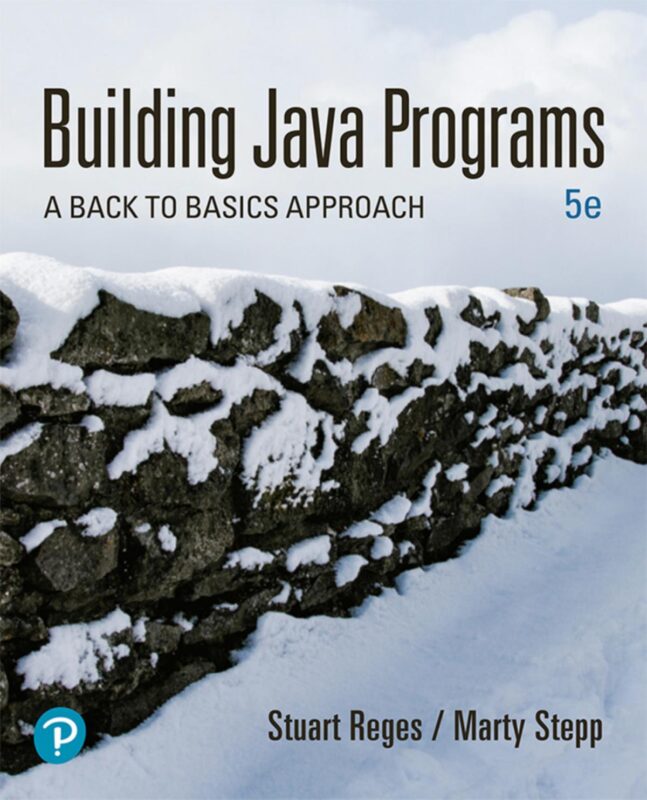
Building Java Programs: A Back to Basics Approach 5th Edition By Stuart Reges, Marty Stepp
$30.00
Secure checkout
Instant digital download
PDF document
Document details
- Pages
- 1,233
- File size
- 38.97 MB
- Format
- Digital PDF
- Course
- Education
- Category
- eBook[PDF]
Sign in or create a free account to continue. Your purchase will be saved in My Downloads.
About this ebook
The textbook Building Java Programs: A Back to Basics Approach (5th Edition) by Stuart Reges and Marty Stepp uses a layered, "objects later" strategy. It introduces basic programming fundamentals and procedural decomposition before diving into object-oriented concepts and advanced data structures. [1, 2]
The book is structured into 19 chapters plus an optional graphics supplement: [1]
Part 1: Procedural Programming & Fundamentals (CS1 Core)
- Chapter 1: Introduction to Java Programming – Basic computing concepts, structure of a Java program,
System.out.println, string literals, and procedural decomposition using static methods. [1, 2] - Chapter 2: Primitive Data and Definite Loops – Primitive types (int, double, etc.), expressions, variables, mixing types/casting, and
forloops. New to this edition: JShell integration and pattern discovery in nested loops. [1, 2, 3] - Chapter 3: Introduction to Parameters and Objects – Method parameters, return values, using objects (like
StringandScanner), and console input. [1, 2] - Supplement 3G: Graphics (Optional) – Intro to 2D graphics using
DrawingPanel, drawing lines/shapes, colors, and loops with graphics. [1, 2] - Chapter 4: Conditional Execution –
if/elsestatements, relational/logical operators, pre/post-conditions, and throwing exceptions. [1] - Chapter 5: Program Logic and Indefinite Loops –
whileloops,do/whileloops, boolean logic, assertions, and robust programming. [1] - Chapter 6: File Processing – Token-based and line-based processing with a scanner, file input/output using
PrintStream, and error handling. [1] - Chapter 7: Arrays – Array basics, array traversal algorithms, shifting elements, multidimensional arrays, and reference semantics. [1, 2]
Part 2: Object-Oriented Programming (OOP)
- Chapter 8: Classes – Defining custom classes, object state and behavior, constructors, encapsulation, and the
thiskeyword. - Chapter 9: Inheritance and Interfaces – Subclasses, overriding methods, polymorphism, interface types, and code reuse.
- Chapter 10: ArrayLists – Using Java's built-in
ArrayListclass, type parameters (generics), wrapper classes, and collection processing. - Chapter 11: Java Collections Framework – Lists, Sets, Maps, and iterators. [1, 2]
Part 3: Data Structures & Advanced Concepts (CS2 Core)
- Chapter 12: Recursion – Thinking recursively, mechanics of recursive methods, and advanced recursive backtracking (e.g., solving the 8 Queens problem).
- Chapter 13: Searching and Sorting – Binary search, sequential search, sorting algorithms (such as Selection Sort and Merge Sort), and intro to runtime efficiency (Big-O notation).
- Chapter 14: Stacks and Queues – Abstract Data Types (ADTs), stack/queue operations, and structure mix-and-matching.
- Chapter 15: Implementing a Collection Class – Building a custom
ArrayIntListfrom scratch, handling array growth, and managing preconditions. - Chapter 16: Linked Lists – Reference nodes, list manipulation algorithms, and building a custom
LinkedIntList. - Chapter 17: Binary Trees – Binary tree architecture, traversals (pre-order, in-order, post-order), and Binary Search Trees (BST).
- Chapter 18: Advanced Data Structures – Hash tables, hashing strategies, priority queues, and heaps.
- Chapter 19: Functional Programming – Introduction to Java 8 features including lambda expressions and streams. [1, 2, 3, 4, 5, 6]
File included
tmpphpXnkF3e
38.97 MB
Related ebooks