
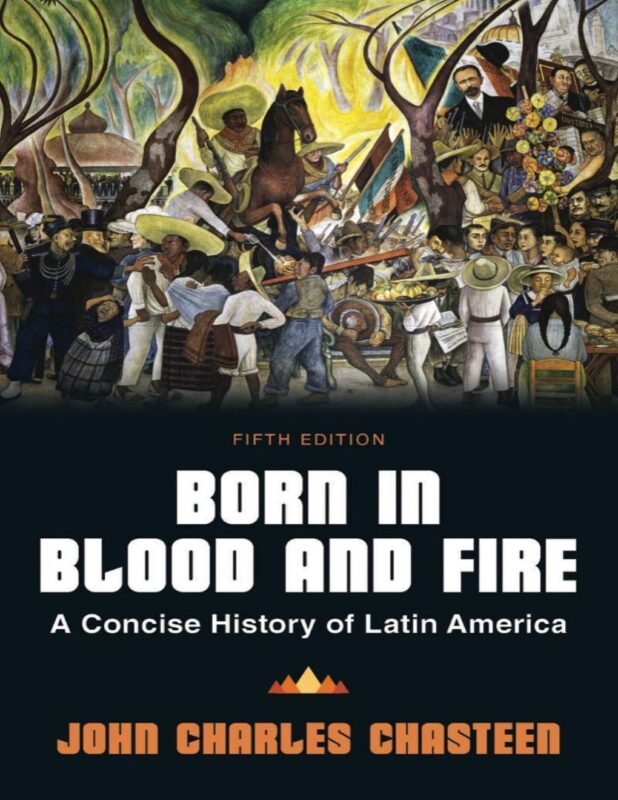
Born in Blood and Fire: A Concise History of Latin America 5th Edition By John Charles Chasteen
$30.00
Secure checkout
Instant digital download
PDF document
Document details
- Pages
- 712
- File size
- 7.74 MB
- Format
- Digital PDF
- Course
- History
- Category
- eBook[PDF]
Sign in or create a free account to continue. Your purchase will be saved in My Downloads.
About this ebook
Born in Blood and Fire: A Concise History of Latin America (5th Edition) by John Charles Chasteen covers over six centuries of history across twenty countries using a chronological and thematic framework. [1, 2]
The textbook explores the region's core struggle with inequality, conquest, and the quest for political and economic stability. Below is a detailed breakdown of the major historical periods, themes, and 5th-edition updates covered in the book. [1]
📅 Chronological Chapters & Historical Periods
- Welcome to the Present (Introduction): Sets up the central conflicts of Latin American history, focusing on the disparities between the "winners and losers" and comparing historical patterns (like slavery) to the United States.
- Encounter & Conquest (1492–1600): Details the arrival of Iberians (Spanish and Portuguese), the fall of the Aztec and Inca empires, and the beginning of indigenous resistance and spiritual conquest.
- Colonial Crucible (1600–1800): Examines the consolidation of colonial rule, the economics of silver and sugar, the transatlantic slave trade, and race mixing (mestizaje).
- Independence (1800–1830): Traces the breakdown of colonial control and the revolutionary movements led by key figures like Simón Bolívar and Father Miguel Hidalgo.
- Postcolonial Blues (1830–1850): Explores the chaotic aftermath of independence, the failure to implement liberal constitutions, and the rise of conservative military dictators (caudillos).
- Progress (1850–1880): Focuses on the mid-nineteenth-century liberal surge, infrastructure modernization, and the reduction of Church power.
- Neocolonialism (1880–1930): Analyzes the massive export boom driven by foreign investment (mostly British and American) and the resulting social hierarchies.
- Nationalism (1930–1960): Highlights ethnic pride, import-substitution industrialization (ISI), and populist leaders like Juan and Evita Perón in Argentina.
- Revolution (1960–1990): Covers Cold War conflicts, proxy warfare, the Cuban Revolution, Marxist guerrilla movements, and the rise of US-backed military dictatorships.
- Neoliberalism & Beyond (1990s–Present): Examines free-market capitalism, globalization, the IMF, the subsequent "Pink Tide" leftist backlash, and modern political landscapes. [1, 2, 3, 4, 5, 6, 7]
🔑 Core Analytical Themes
- Race, Ethnicity, & Social Class: Investigates how colonial racial hierarchies evolved into modern structural socioeconomic inequalities. [1, 2]
- Gender Roles: Examines the shifting social expectations and political agency of women from the colonial era through modern social movements. [1]
- Transculturation: Focuses on the unique cultural blending of European, Indigenous, and African traditions in language, religion, and art. [1]
- Economic Dependency: Continually tracks Latin America's reliance on external powers, from raw resource extraction by colonial crowns to foreign loans. [1, 2]
🆕 What’s New in the 5th Edition?
- Colombia’s Surging Influence: Expanded content analyzing Colombia's political, economic, and cultural transformations and its rising prominence in the region.
- The Pacific World Connections: Greater emphasis on Latin America's historical and contemporary economic, immigration, and political ties to Asian-Pacific nations.
- Contemporary Political Landscapes: Updated analysis of modern political shifts, climate challenges, and recent economic developments up to the mid-2020s. [1]
File included
eBook-Born-in-Blood-and-Fire-A-Concise-History-of-Latin-America-5e-By-John-Charles-Chasteen.pdf
7.74 MB
Related ebooks