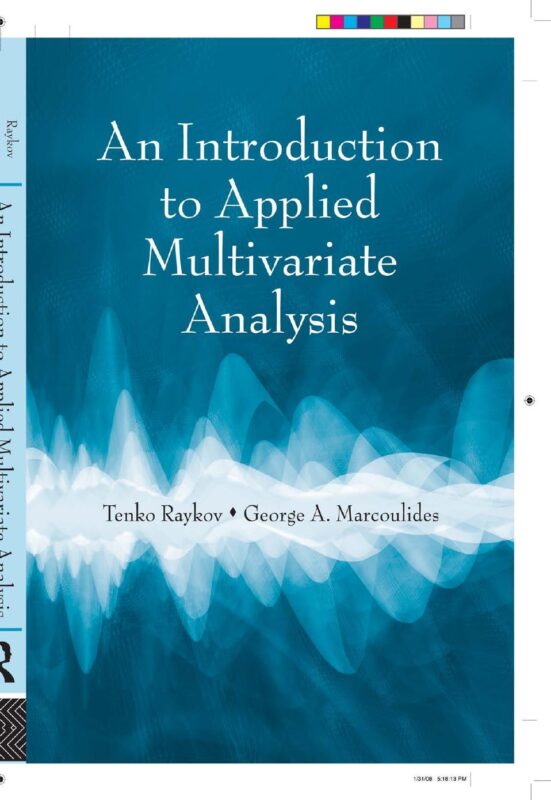
An Introduction to Applied Multivariate Analysis, 1st Edition By Tenko Raykov, George A. Marcoulides
$45.00
Secure checkout
Instant digital download
PDF document
Document details
- Pages
- 498
- File size
- 2.29 MB
- Format
- Digital PDF
- Course
- Behavioural Science
- Category
- eBook[PDF]
Sign in or create a free account to continue. Your purchase will be saved in My Downloads.
About this ebook
The 1st edition of An Introduction to Applied Multivariate Analysis by Tenko Raykov and George A. Marcoulides covers the following topics across 13 core chapters: [1]
Foundational Concepts & Data Preparation
- Chapter 1: Introduction to Multivariate Statistics — Outlines the basic principles of multivariate analysis, exploring the critical relationships between independent and dependent variables while drawing analogies to familiar univariate procedures. [1, 2, 3]
- Chapter 2: Elements of Matrix Theory — Provides the fundamental mathematical building blocks and matrix algebra necessary to understand how multivariate data is structured and processed. [1, 2]
- Chapter 3: Data Screening and Preliminary Analyses — Details essential, practical steps for assessing data quality, addressing statistical assumptions, and identifying potential pitfalls before launching into complex models. [1, 2]
Examining Group Differences & Variation
- Chapter 4: Multivariate Analysis of Group Differences — Focuses on techniques like MANOVA (Multivariate Analysis of Variance) to analyze how distinct groups differ across multiple continuous variables simultaneously. [1, 2]
- Chapter 5: Repeated Measure Analysis of Variance — Explores methods for handling data where measurements are taken repeatedly from the same subjects over time or under varying conditions. [1, 2]
- Chapter 6: Analysis of Covariance — Covers how to control for extraneous or concomitant variables (covariates) to better isolate group effects. [1, 2]
Dimensionality Reduction & Factor Models
- Chapter 7: Principal Component Analysis (PCA) — Examines data reduction techniques to streamline a high number of variables into a smaller set of uncorrelated components.
- Chapter 8: Exploratory Factor Analysis (EFA) — Looks at analyzing underlying relationships among survey or test items to discover the fundamental unobserved dimensions (constructs) driving the data.
- Chapter 9: Confirmatory Factor Analysis (CFA) — Introduces latent variable modeling to rigorously test and confirm whether a predefined structural hypothesis matches the data. [1, 2, 3, 4]
Classification & Association
- Chapter 10: Discriminant Function Analysis — Identifies how to predict group membership or classify observations based on a set of predictor variables.
- Chapter 11: Canonical Correlation Analysis — Examines structural connections and linear combinations that best predict relationships between two entire sets of variables. [1, 2, 3]
Advanced & Contemporary Topics
- Chapter 12: An Introduction to the Analysis of Missing Data — Expands beyond traditional textbook scope by detailing modern approaches to missingness mechanisms and how to statistically navigate missing records safely.
- Chapter 13: Multivariate Analyses of Change Processes — Discusses longitudinal analysis and modeling transformations over extended intervals, explicitly tailored for behavioral, educational, and social sciences. [1, 2, 3]
File included
tmpphppJyBCm
2.29 MB
Related ebooks