
Attacking Web Applications with Ffuf: Hack The Box Module 54
$13.00
Secure checkout
Instant digital download
PDF document
Document details
- Pages
- 20
- File size
- 2.46 MB
- Format
- Digital PDF
- Course
- Computer Networking
- Category
- EXAM
Sign in or create a free account to continue. Your purchase will be saved in My Downloads.
About this ebook
Attacking Web Applications with Ffuf:
Link to challenge: https://academy.hackthebox.com/module/54
(log in required)
Class: Tier 0 | Easy | Offensive
Before we begin: in the pwnbox, the wordlists we will use are in default located in the directory ‘/usr/share/seclists/Discovery/Web-Content’. it will be true throughout the module, unless specified otherwise.
Basic Fuzzing
Directory Fuzzing:
Question: In addition to the directory we found above, there is another directory that can be found. What is it?
Answer: forum
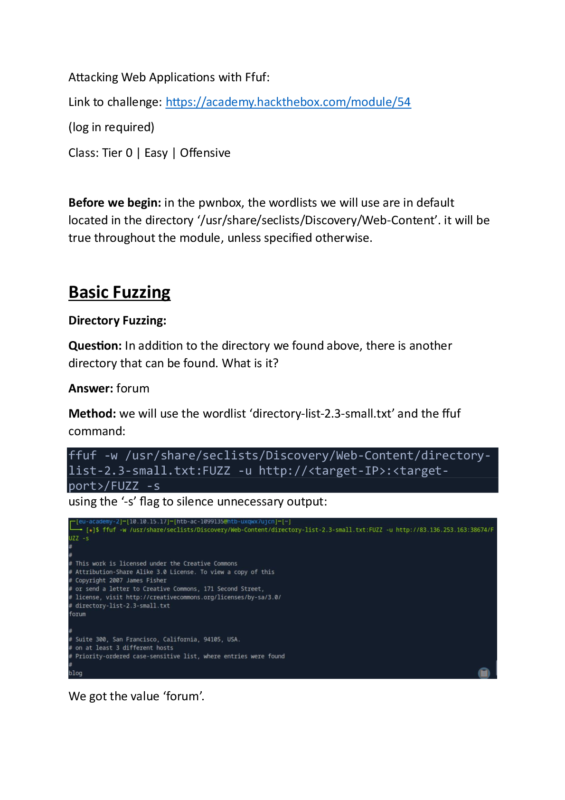
Method: we will use the wordlist ‘directory-list-2.3-small.txt’ and the ffuf command:
ffuf -w /usr/share/seclists/Discovery/Web-Content/directorylist-2.3-small.txt:FUZZ -u http://:/FUZZ -s
using the ‘-s’ flag to silence unnecessary output:
We got the value ‘forum’.
Page Fuzzing:
Question: Try to use what you learned in this section to fuzz the '/blog' directory and find all pages. One of them should contain a flag. What is the flag?
Answer: HTB{bru73_f0r_c0mm0n_p455w0rd5}
Method: Method 1: we will use the wordlist ‘web-extensions.txt’ which contains extensions for webpages, on the parameter ‘index’ to see what extensions are out there:
ffuf -w /usr/share/seclists/Discovery/Web-Content/webextensions.txt:FUZZ -u http://:/indexFUZZ
*we assume here the path-name is ‘index’. *
The extension ‘php’ returned status code 200 (success), lets make another scan for php pages in ‘/blog’:
ffuf -w /usr/share/seclists/Discovery/Web-Content/directorylist-2.3-small.txt:FUZZ -u http://:/blog/FUZZ.php -s
Going for the discovered URL on browser:
http://:/blog/home.php
Method 2: we can also combine the 2 commands above to a single command, bruteforcing both the path-name and the extension simultaneously, negating the need to assume the path-name ‘/index’ in the original technique. However, due to the nature of 2 word-lists, the bruteforcing of this method is a far more lengthy process, taking approximately 10 minutes:
ffuf -w /usr/share/seclists/Discovery/Web-Content/directorylist-2.3-small.txt:FUZZ1 -w /usr/share/seclists/Discovery/Web-Content/webextensions.txt:FUZZ2 -u http://:/blog/FUZZ1FUZZ2 -mc 200 -fs 0
Recursive Fuzzing:
Question: Try to repeat what you learned so far to find more files/directories. One of them should give you a flag. What is the content of the flag?
Answer: HTB{fuzz1n6_7h3_w3b!}
Method: lets run recursive search for php files using the command:
ffuf -w /usr/share/seclists/Discovery/Web-Content/directorylist-2.3-small.txt:FUZZ -u http://:/FUZZ -recursion -recursion-depth 1 -e .php -v -mc 200 -fs 0
using death-1
File included
Attacking_Web_Applications_with_Ffuf.pdf.pdf
2.46 MB
Related ebooks