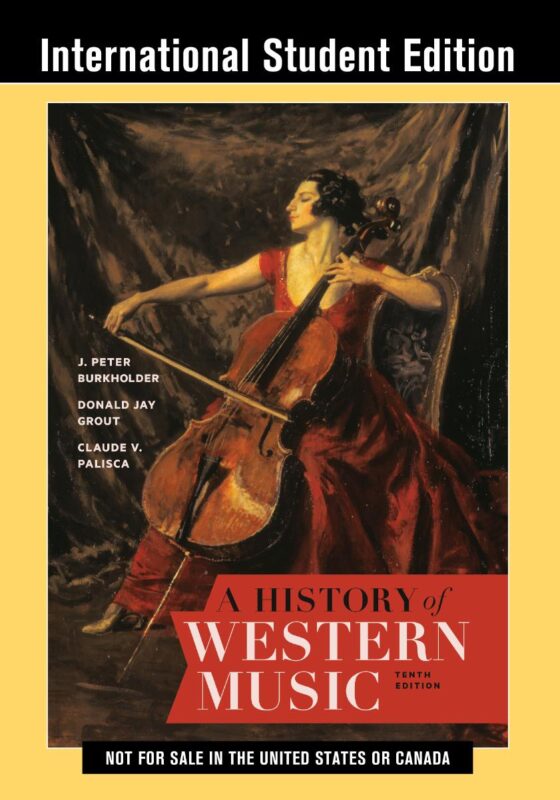
A History of Western Music 10th International Student Edition By Burkholder, J. Peter Grout
$30.00
Secure checkout
Instant digital download
PDF document
Document details
- Pages
- 1,121
- File size
- 41.17 MB
- Format
- Digital PDF
- Course
- Education
- Category
- eBook[PDF]
Sign in or create a free account to continue. Your purchase will be saved in My Downloads.
About this ebook
A History of Western Music (10th International Student Edition) by J. Peter Burkholder, Donald Jay Grout, and Claude V. Palisca covers the complete evolution of Western art music from ancient Greece through the modern era and into hip-hop. [1, 2]
The textbook is organized chronologically into major historical parts and thematic chapters:
Part One: The Ancient and Medieval Worlds
- Music in Antiquity: Ancient Greece, Rome, and early foundational theories.
- The Christian Church in the Early Middle Ages: Chant, liturgy, and the spread of plainchant.
- Romanesque and Gothic Music: The rise of polyphony, organum, and the Notre Dame school.
- 14th-Century French and Italian Music: Ars Nova, ars subtilior, and secular polyphony (Guillaume de Machaut, Francesco Landini). [1]
Part Two: The Renaissance
- Invention of the Renaissance Style: English and Burgundian influences (John Dunstable).
- The Age of Ockeghem and Josquin: Late 15th- and early 16th-century sacred and secular styles (Josquin des Prez).
- New Currents in the 16th Century: The Reformation, Counter-Reformation (Palestrina), and the madrigal (Monteverdi, Gesualdo).
- Instrumental Music and Late Renaissance Styles: Rise of idiom-specific instruments and consort music.
Part Three: The Baroque Era
- The New Style of the Early 17th Century: Invention of opera (Monteverdi, Florentine Camerata) and early monody.
- The Mid-Baroque: Expansion of cantata, oratorio, and instrumental genres.
- The Late Baroque: High-baroque synthesis in the works of J.S. Bach, George Frideric Handel, and Antonio Vivaldi.
Part Four: The Classical Era
- Mid-18th-Century Transition: The galant style, empfindsamer Stil, and early symphony (Gluck, C.P.E. Bach).
- The Late 18th Century: Haydn, Mozart, and the formal crystallization of the classical style (sonata form, string quartet, classical opera).
Part Five: The Nineteenth Century
- Revolution and Romanticism: Beethoven as the bridge and titan of romantic ideals.
- Romanticism in the Early 19th Century: Art song (Lied), character piano pieces (Schubert, Schumann, Chopin, Mendelssohn).
- Romanticism in the Mid-19th Century: Opera (Verdi, Wagner) and programmatic orchestral music (Berlioz, Liszt).
- Late Romanticism: Nationalism, Brahms, Tchaikovsky, and turn-of-the-century symphonic traditions (Mahler, Strauss). [1]
Part Six: The Twentieth Century and Beyond
- Modernism and the Avant-Garde (Pre-WWI): Impressionism (Debussy), early modernism (Stravinsky, Schoenberg's atonality).
- Between the World Wars: Neoclassicism, experimentalism, and political/social music (Bartók, Copland, Shostakovich).
- Post-1945 Developments: Serialism, electronic music, minimalism (Reich, Glass), and postmodern eclecticism.
- Into the 21st Century: Contemporary classical directions, vernacular crossovers, and the integration of popular styles like hip-hop. [1]
File included
tmpphpmRKrwS
41.17 MB
Related ebooks