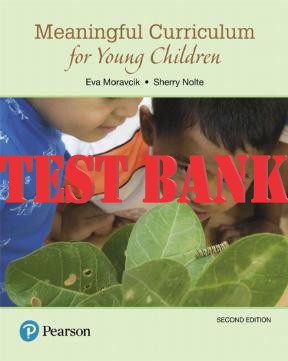
Test Bank for Meaningful Curriculum for Young Children 2nd Edition By Eva Moravcik, Sherry Nolte
$30.00
Secure checkout
Instant digital download
PDF document
Document details
- Pages
- 47
- File size
- 905.45 KB
- Format
- Digital PDF
- Course
- Education
- Category
- TEST BANKS
Sign in or create a free account to continue. Your purchase will be saved in My Downloads.
About this ebook
Test Bank for Meaningful Curriculum for Young Children (2nd Edition) by Eva Moravcik and Sherry Nolte is a comprehensive, child-centered guide for designing and implementing developmentally appropriate practices in preschool and primary grades. [1, 2]
The textbook is divided into 15 specific chapters that cover foundational design principles, core development areas, and distinct subject matter domains: [1]
Foundations & Curriculum Design
The opening chapters introduce the progressive pedagogy, design frameworks, and step-by-step methods required to establish engaging early learning environments. [1, 2]
-
- Chapter 1: Curriculum that Engages – Explores what early childhood curriculum is, its historical and cultural sources, and the essential process of designing engaging learning plans. [1]
- Chapter 2: Planning, Implementing, and Assessing Curriculum – Outlines the foundational cycle of scheduling, delivering, and gathering assessment data on young learners. [1]
- Chapter 3: Integrated Curriculum – Focuses on weaving multiple subject areas together to support realistic, inquiry-based learning experiences. [1, 2]
Physical & Sensory Development
These topics evaluate how physical milestones and bodily awareness map directly to active curriculum design. [1]
-
- Chapter 4: Large Motor Curriculum – Focuses on gross motor skills, outdoor play, physical coordination, and spatial awareness.
- Chapter 5: Fine Motor Curriculum – Focuses on manual dexterity, hand-eye coordination, and functional muscle control.
- Chapter 6: Sensory Development Curriculum – Explores how children interact with their physical environment through sight, touch, taste, sound, and smell. [1]
Language, Literacy, & Expression
This block details communication skills, reading preparedness, and creative artistic expression. [1]
-
- Chapter 7: Language Curriculum – Examines listening, vocal articulation, conversational structures, and vocabulary development.
- Chapter 8: Literacy Curriculum – Outlines foundational reading and writing skills, print awareness, and decoding.
- Chapter 9: Literature Curriculum – Explores introducing storytelling, high-quality picture books, and creative narratives to young learners.
- Chapter 10: Art Curriculum – Details understanding artistic development, planning art-making processes, and teaching art to all children.
- Chapter 11: Music Curriculum – Explores how music integrates with child development and methods for planning early music-making.
- Chapter 12: Creative Movement Curriculum – Connects developmental physical expression, rhythm, and structural movement-based play. [1, 2]
Core Academic Disciplines
The final chapters cover how traditional academic competencies are uniquely introduced through hands-on, progressive early childhood methodologies. [1, 2]
-
- Chapter 13: Math Curriculum – Introduces early mathematical concepts (sorting, counting, geometry, patterns) aligned with early learning stages. [1]
- Chapter 14: Science Curriculum – Focuses on nurturing natural curiosity, scientific inquiry, observation, and understanding the natural world. [1, 2]
- Chapter 15: Social Studies Curriculum – Explores civic identity, family structures, communities, and basic geographic or historical relationships. [1]
Key 2nd Edition Updates
The second edition also embeds unique themes consistently within every curriculum chapter: [1]
-
- Two-Year-Olds Integration: Specific sections in every chapter detailing how to scale and apply concepts to toddler-aged groups.
- Play-Based Pedagogy: Dedicated play breakdowns added across all disciplinary chapters.
- Dual Language Learners (DLLs): Expanded guidance for teaching young children learning English as a second language.
- "Some Things to Say" Blocks: Practical conversational examples to provide teachers with precise phrases to use with children. [1]
File included
ScholarFriends.com-tb-ready.pdf
905.45 KB
Related ebooks