
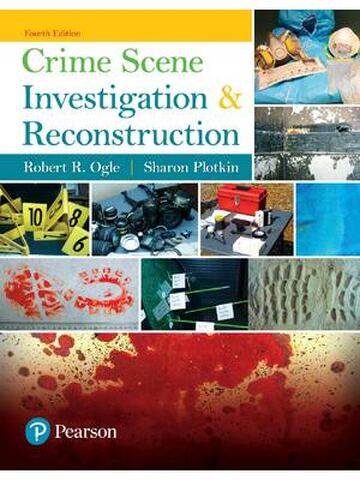
Crime Scene Investigation and Reconstruction 4th Edition By Robert R. Ogle, Sharon Plotkin
$25.00
Secure checkout
Instant digital download
PDF document
Document details
- Pages
- 433
- File size
- 12.37 MB
- Format
- Digital PDF
- Course
- Education
- Category
- eBook[PDF]
Sign in or create a free account to continue. Your purchase will be saved in My Downloads.
About this ebook
The Crime Scene Investigation and Reconstruction (4th Edition) by Robert R. Ogle and Sharon Plotkin is systematically organized around the actual workflow of processing a crime scene. It covers a comprehensive blend of core documentation techniques, specific evidence types, specialized investigations, and forensic analysis. [1, 2, 3]
The primary topics and chapters covered in this edition include: [1]
Part 1: Introduction to Investigations & Documentation
- Chapter 1: Introduction to Physical Evidence – Fundamentals of recognizing, collecting, and interpreting physical evidence.
- Chapter 2: Crime Scene Search Principles – Systematic approaches and methodologies for conducting efficient crime scene searches.
- Chapter 3: Crime Scene Photography – Essential photographic techniques, updated to focus on digital cameras and scene capture.
- Chapter 4: Crime Scene Sketches – Principles of accurate field measurements, mapping, and rendering crime scene diagrams. [1, 2, 3, 4, 5]
Part 2: Processing Specific Evidence Types
- Chapter 5: Latent Fingerprint Evidence – Methods for locating, developing, and preserving latent print impressions.
- Chapter 6: Trace Evidence – Procedures for handling microscopic materials such as hair, fibers, glass, and paint.
- Chapter 7: Biological Fluid Stain Evidence – The handling, preservation, and analysis of DNA, blood, semen, and saliva.
- Chapter 8: Firearms Evidence – Documentation of ballistic elements, weapons, and ammunition component retrieval.
- Chapter 9: Impression Evidence – Techniques for documenting and casting footwear, tire tracks, and toolmarks.
- Chapter 10: Drug and Alcohol Evidence – Identifying, securing, and testing controlled substances and toxicity markers.
- Chapter 11: Document Evidence – Processing questioned documents, handwriting, and paper-based tracking. [1, 2, 3, 4, 5]
Part 3: Practical Crime Scene Investigations
- Chapter 12: Vehicle Scene Investigations – Unique challenges and steps required to process automobiles and transport vessels.
- Chapter 13: Sexual Assault Investigations – Specialized response parameters categorized around evidence from the scene, victim, and suspect.
- Chapter 14: Homicide Crime Scene Investigations – The full workflow for investigating death scenes and complex murder cases. [1, 2, 3]
Part 4: Reconstruction & Special Applications
- Chapter 15: Crime Scene Reconstruction – Methodologies for analyzing sequence, bullet trajectories, bloodstain patterns, and computer-aided reconstructions.
- Chapter 16: Entomology – A detailed chapter on tracking insect activity and lifecycle data to determine the post-mortem interval (PMI). [1, 2, 3]
File included
ScholarFriends.com-crime-scene-investigation-and-reconstruction-4th-edition-by-robert-r-ogle-sharon-plotkin.pdf
12.37 MB
Related ebooks



