
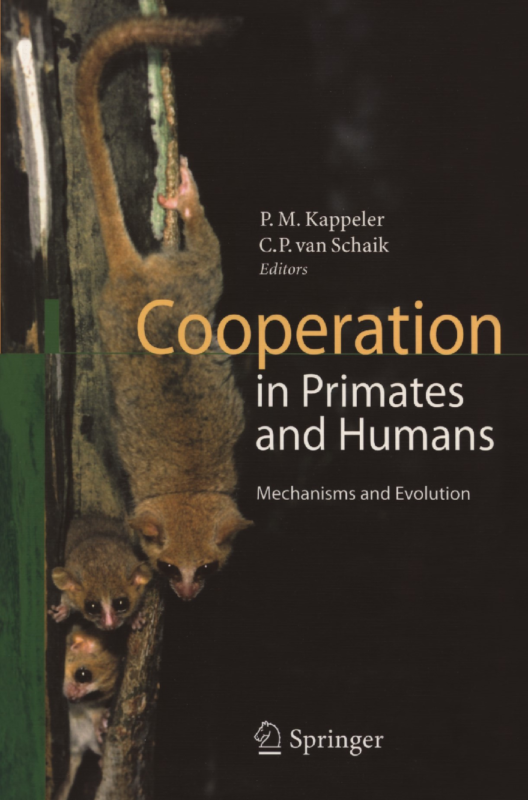
Cooperation in Primates and Humans Mechanisms and Evaloution By Peter Kappeler, Carel P van Schaik
$30.00
Secure checkout
Instant digital download
PDF document
Document details
- Pages
- 345
- File size
- 5.35 MB
- Format
- Digital PDF
- Course
- Education
- Category
- eBook[PDF]
Sign in or create a free account to continue. Your purchase will be saved in My Downloads.
About this ebook
The Cooperation in Primates and Humans: Mechanisms and Evolution, edited by Peter M. Kappeler and Carel P. van Schaik, is a seminal interdisciplinary volume that bridges primatology and anthropology to explore how cooperative behaviors evolved. [1, 2, 3, 4]
The book is structured into sections based on the classic evolutionary models of cooperation—kinship, reciprocity, and mutualism—and covers the following primary topics: [1]
1. Kin Selection and Kinship
- Hamilton’s Rule in Action: Chapters evaluate how genetic relatedness drives altruistic and cooperative actions within primate groups.
- Constraints of Kin Selection: Contributions (such as by Joan Silk and Bernard Chapais) analyze how resource competition among relatives can counteract kin selection, exploring alternative mechanisms that generate kin-biased behaviors. [1, 2]
2. Reciprocity and Alliances
- Evolution of Reciprocity Theory: A prominent section headlined by Robert Trivers reviews the development of reciprocity theory beyond the constraints of the classic Prisoner's Dilemma. [1]
- Calculated vs. Symmetry-Based Reciprocity: Frans de Waal and Sarah Brosnan map a behavioral continuum ranging from simple, emotionally/symmetry-driven reciprocity to cognitively complex, calculated "score-keeping" reciprocity. [1]
- Coalition Formation: Analysis of coordinated attacks and defensive alliances among primates to manage social rank, protect group members, and secure resources. [1]
3. Mutualism and Specific Cooperative Behaviors
- The volume synthesizes field data and experimental paradigms regarding:
- Social Grooming: Used as a currency for building trust and trade.
- Cooperative Hunting and Food Sharing: How groups coordinate to capture prey and distribute resources.
- Alloparenting and Cooperative Breeding: Non-parental group members assisting in infant care and provisioning.
- Conflict Management and Reconciliation: The role of post-conflict resolution in preserving valuable cooperative partnerships. [1, 2]
4. Human Uniqueness and Group-Level Cooperation
- Bridging the Primate-Human Gap: The final sections focus on cognitive and emotional mechanisms unique to humans that allow for large-scale, high-risk group cooperation. [1, 2]
- Stabilizing Fragile Systems: Contributions (such as by Gächter and Hermann) look at mechanisms like selective association, moral sentiments, aversion to inequity, and punishment that prevent defection and stabilize cooperation among unrelated individuals. [1, 2]
File included
eBook-PDF-Cooperation-in-Primates-and-Humans-Mechanisms-and-Evaloution-By-Peter-Kappeler-Carel-P-van-Schaik.pdf
5.35 MB
Related ebooks



