
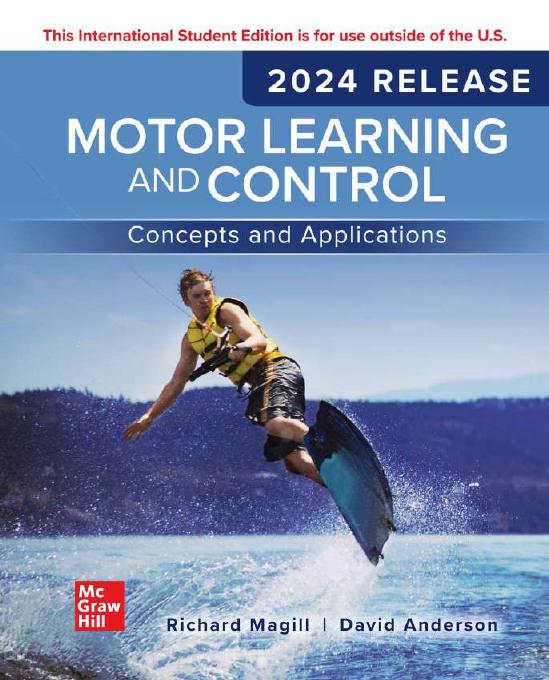
ISE Motor Learning and Control Concepts and Applications 2024 Release By Richard Magill, David Anderson
$28.00
Secure checkout
Instant digital download
PDF document
Document details
- Pages
- 623
- File size
- 4.88 MB
- Format
- Digital PDF
- Course
- Education
- Category
- eBook[PDF]
Sign in or create a free account to continue. Your purchase will be saved in My Downloads.
About this ebook
The ISE Motor Learning and Control Concepts and Applications 2024 Release By Richard Magill, topics covered
1. Introduction to Motor Skills and Abilities
- Classification of Motor Skills: Categorising skills based on precise parameters (e.g., fine vs. gross motor skills, open vs. closed environments).
- Measurement of Motor Performance: Methods, metrics, and error measures used to evaluate performance.
- Motor Abilities: Identifying individual talent profiles and genetic vs. learned traits. [1]
2. Introduction to Motor Control
- Neuromotor Basis: The underlying neurological systems and physiological mechanisms that drive human movement.
- Theories of Motor Control: Overview of motor program theories and dynamic pattern perspectives.
- Sensory Components: The pivotal roles of vision, proprioception, and touch in guiding movement.
- Functional Skills: Performance characteristics of daily, athletic, or clinical motor functions.
- Action Preparation: The physiological and cognitive steps the central nervous system takes before initiating a movement. [1]
3. Attention and Memory
- Attention Capacity: Focus limitations, selective attention, and multitasking during physical actions.
- Memory Structure: Processes regarding working memory, long-term memory, and mechanisms of forgetting.
- Memory Strategies: Techniques designed to enhance memory storage, consolidation, and retrieval of motor skills. [1]
4. Introduction to Motor Skill Learning
- Defining and Assessing Learning: Distinguishing temporary performance fluctuations from permanent skill acquisition.
- Stages of Learning: Cognitive, associative, and autonomous phases of movement mastery.
- Transfer of Learning: How practicing one skill or condition influences performance in another context. [1, 2]
5. Instruction and Augmented Feedback
- Demonstration and Observational Learning: The impact of visual modeling on skill acquisition.
- Verbal Instructions: Using cues, explicit rules, and attentional focus to guide learners.
- Augmented Feedback: Structuring knowledge of results (KR) and knowledge of performance (KP) to optimize improvement. [1]
6. Practice Conditions
- Practice Variability and Specificity: Balancing diverse practice environments against exact context replication.
- Amount and Distribution of Practice: Managing overall practice volume and navigating massed vs. distributed schedules.
- Whole vs. Part Practice: Determining when to break down a skill into smaller components vs. practicing it in its entirety.
- Mental Practice: Utilizing imagery and cognitive rehearsal to enhance physical performance outcomes. [1]
File included
ScholarFriends.com-ise-motor-learning-and-control-concepts-and-applications-2024-release-by-richard-magill-da.pdf
4.88 MB
Related ebooks



