
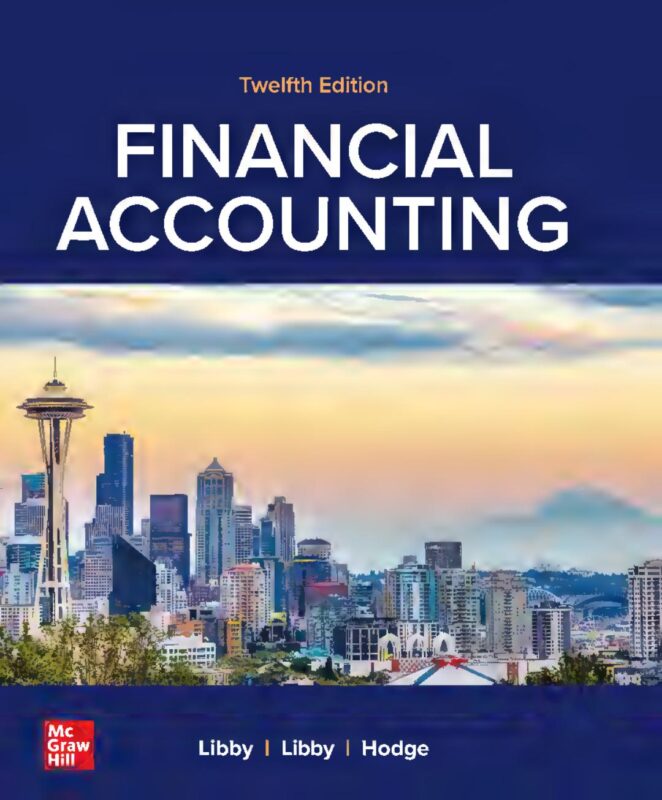
Financial Accounting 12th Edition By Robert Libby, Patricia A. Libby
$30.00
Secure checkout
Instant digital download
PDF document
Document details
- Pages
- 921
- File size
- 25.58 MB
- Format
- Digital PDF
- Course
- Accounting
- Category
- eBook[PDF]
Sign in or create a free account to continue. Your purchase will be saved in My Downloads.
About this ebook
The 12th Edition of Financial Accounting by Robert Libby, Patricia A. Libby, and Frank Hodge (published by McGraw-Hill Education) spans 13 chapters. The book organizes introductory and intermediate financial accounting principles around a signature "Focus Company Approach," teaching core elements of the accounting cycle alongside real-world corporate financial reporting. [1, 2, 3]
The comprehensive list of chapters and specific topics covered in this edition includes:
1. The Accounting Cycle & Financial Statements
- Chapter 1: Financial Statements and Business Decisions – Introduction to the four primary financial statements (Balance Sheet, Income Statement, Statement of Retained Earnings, Statement of Cash Flows), the basic accounting equation (Assets = Liabilities + Stockholders' Equity), and the role of accounting information in managerial choices. [1, 2]
- Chapter 2: Investing and Financing Decisions and the Accounting System – Transaction analysis focusing strictly on balance sheet accounts, implementing a building-block approach to debits, credits, journal entries, and ledger postings. [1, 2, 3]
- Chapter 3: Operating Decisions and the Accounting System – How business operations generate revenues and expenses, exploring income statement transaction tracking. [1, 2, 3]
- Chapter 4: Adjustments, Financial Statements, and the Closing Process – Completing the accounting cycle, including accrual adjustments, deferrals, preparing finalized corporate reports, and closing temporary accounts. [1, 2]
2. Financial Disclosure & Reporting Context
- Chapter 5: Communicating and Analyzing Accounting Information – The regulatory framework of financial reporting, corporate governance, earnings press releases, and understanding corporate transparency. [1, 2]
3. Detailed Assets Management
- Chapter 6: Sales Revenue, Receivables, and Cash – Revenue recognition rules, internal controls for cash safeguarding, accounts receivable, and bad debt estimations.
- Chapter 7: Cost of Goods Sold and Inventory – Inventory valuation methods (FIFO, LIFO, Weighted Average Cost), cost of goods sold calculations, and lower of cost or market adjustments.
- Chapter 8: Property, Plant, and Equipment; Intangibles; and Natural Resources – Acquisition and operational tracking of long-lived assets, depreciation strategies, asset impairment, and amortization of intangibles. [1, 2, 3]
4. Liabilities & Stockholders' Equity
- Chapter 9: Liabilities – Accounting for current obligations, payroll-related liabilities, contingencies, and introducing the foundational principles of the Time Value of Money (TVM).
- Chapter 10: Bond Securities – Long-term liabilities, coupon vs. market interest rates, bond issuances at premiums or discounts, and amortization tracking.
- Chapter 11: Stockholders' Equity – Issuing common and preferred stock, treasury stock purchases, cash and stock dividends, and statement calculations. [1, 2]
5. Advanced Analysis
- Chapter 12: Statement of Cash Flows – Methods (indirect and direct) used to detail cash inflows and outflows across operating, investing, and financing business practices. [1, 2]
- Chapter 13: Analyzing Financial Statements – Utilizing vertical, horizontal, and comprehensive ratio analyses to dissect liquidity, solvency, and profitability trends. [1, 2]
File included
tmpphpHxVxbi
25.58 MB
Related ebooks



![Financial Accounting for Managers 2024 Release By Wayne Thomas [ebook] [PDF]](https://greatpricebooks.com/wp-content/uploads/2026/09/PPIJJu0X2025-05-02-06-136814e11c1ca18-768x983.png)