
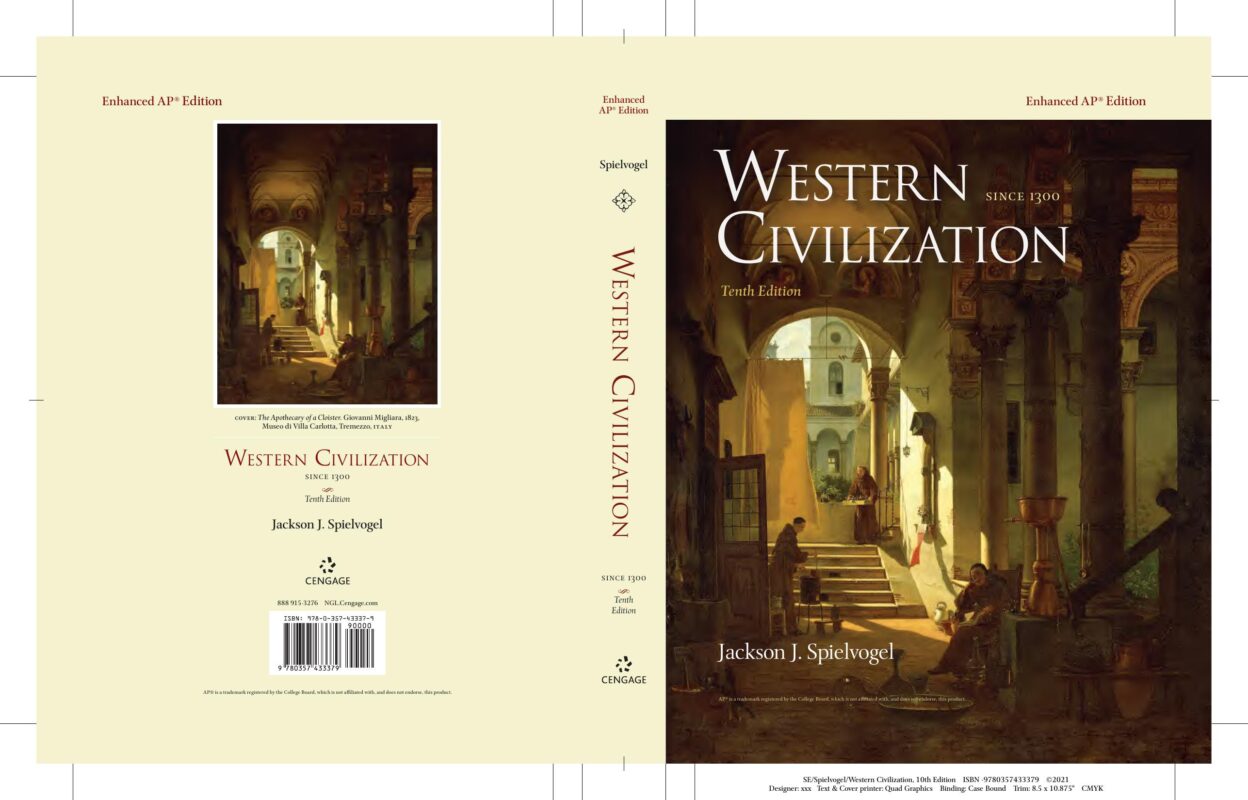
Western Civilization Since 1300 10th Edition By Jackson Spielvogel
$30.00
Secure checkout
Instant digital download
PDF document
Document details
- Pages
- 4
- File size
- 452.72 KB
- Format
- Digital PDF
- Course
- History
- Category
- eBook[PDF]
Sign in or create a free account to continue. Your purchase will be saved in My Downloads.
About this ebook
The Western Civilization Since 1300, 10th Edition by Jackson J. Spielvogel comprehensively covers European history from the Late Middle Ages to the contemporary global era. The text is structurally designed to align seamlessly with the AP European History framework, chronicling political, economic, social, religious, intellectual, cultural, and military developments. [1, 2, 3]
Chapter-by-Chapter Topic Breakdown
The book contains Chapters 11 through 30 of the broader Western Civilization series, organized into the following distinct chronological periods: [1, 2]
- Chapter 11: The Later Middle Ages: Focuses on the crisis and disintegration of the 14th century, covering the Black Death, the Hundred Years' War, and the decline of the Catholic Church's temporal authority.
- Chapter 12: Recovery and Rebirth: Details the Italian and Northern Renaissance, the emergence of humanism, new artistic movements (Machiavelli, Michelangelo, Da Vinci), and the consolidation of new monarchies.
- Chapter 13: Reformation and Religious Warfare: Explores the Protestant Reformation (Martin Luther, John Calvin), the Catholic Counter-Reformation, and the resulting European wars of religion in the 16th century.
- Chapter 14: Europe and the World: Examines the Age of Exploration, transatlantic trade, early global encounters, and colonization from 1500 to 1800.
- Chapter 15: State Building and the Search for Order: Contras_ts the rise of Absolute Monarchy (e.g., Louis XIV's France) against Constitutionalism (e.g., England's Glorious Revolution) during the 17th century.
- Chapter 16: Toward a New Heaven and a New Earth: Focuses on the Scientific Revolution, mapping out breakthroughs in mathematics, physics, and astronomy that birthed modern science.
- Chapter 17 & 18: The Eighteenth Century: Covers the Enlightenment, the expansion of the public sphere, international dynamic shifts, global trade wars, and structural changes in European society.
- Chapter 19: A Revolution in Politics: Deeply addresses the causes and consequences of the French Revolution and the subsequent Napoleonic Era.
- Chapter 20 & 21: The Industrial Revolution and Institutional Changes: Covers early industrialization, its massive social impacts on the working class, and the battle between conservative restoration and new ideologies like liberalism, nationalism, and socialism.
- Chapter 22 & 23: Mass Society and the Age of Progress: Explores late 19th-century urbanization, changing class dynamics, the expansion of the state, and the rise of consumer culture.
- Chapter 24: Imperialism and Modernity Anxiety: Explores "New Imperialism" in Africa and Asia, diplomatic alliance webs, and shifts in cultural thought leading up to 1914.
- Chapter 25 & 26: World War I and Between the Wars: Covers the political devastation of World War I, the Russian Revolution, and the economic instability and rise of totalitarianism during the 1920s and 1930s.
- Chapter 27: World War II: Details the expansion of Nazi Germany, the Holocaust, and the global progression of the Second World War.
- Chapter 28 & 29: The Cold War Era: Maps out the polarization of Europe, the collapse of colonial empires, social protest movements, and economic stagnation up to 1985.
- Chapter 30: After the Fall (The Global Age): Discusses the collapse of the Soviet Union, European integration, the rise of the digital age, global terrorism, and the modern relationship between the West and the rest of the world. [1, 2, 3, 4, 5, 6, 7, 8, 9]
Core Historical Themes Covered
Throughout these chapters, Spielvogel integrates specific recurring core frameworks: [1]
- Interactions with Non-Western Peoples: The 10th edition features expanded material showing how global trade, migration, and terrorism have uniquely defined and influenced the boundaries of the West. [1, 2]
- Social and Women’s History: Rather than isolating minority narratives, the text systematically integrates the daily lives of everyday citizens, family structures, and changing gender roles into the main chronological story. [1, 2]
- Primary Source Analysis: The material features interactive excerpts from historical literature, official treaties, and artwork to foster critical thinking and prepare students for Document-Based Questions (DBQs). [1, 2]
File included
tmpphpcgcaKq
452.72 KB
Related ebooks



