
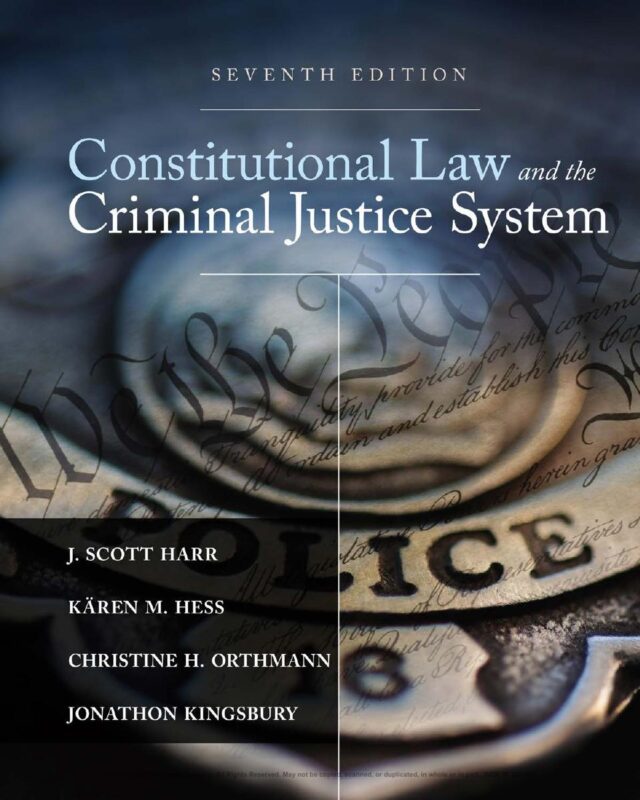
Constitutional Law and the Criminal Justice System 7th Edition By Scott Harr, Kären Hess, Christine Orthmann, Jonathon Kingsbury
$30.00
Secure checkout
Instant digital download
PDF document
Document details
- Pages
- 546
- File size
- 9.56 MB
- Format
- Digital PDF
- Course
- Social Sciences
- Category
- eBook[PDF]
Sign in or create a free account to continue. Your purchase will be saved in My Downloads.
About this ebook
The Constitutional Law and the Criminal Justice System (7th Edition) by Scott Harr, Kären Hess, Christine Orthmann, and Jonathon Kingsbury breaks down the complexities of the U.S. Constitution into highly relevant, actionable concepts for criminal justice students and professionals. The book balances the historical foundations of law with modern police procedures and includes summaries of over 200 foundational Supreme Court cases. [1, 2, 3]
The textbook is structurally organized into five major sections containing the following core topics: [1, 2]
Section I: A Foundation for Understanding Constitutional Law
- Historical Overview: The origins of American law, the framing of the Constitution, and the concepts of federalism. [1, 2]
- The U.S. Legal System: The overall structure of the American judiciary, the division of federal and state powers, and reading legal citations. [1, 2]
- The U.S. Supreme Court: How the nation's highest court functions as "the final word," its jurisdiction, judicial review, and the process of selective incorporation. [1]
Section II: The Guarantees of the Constitution: Civil Rights and Civil Liberties
- Equal Protection under the Law: Balancing individual rights with federal and state authority.
- The First Amendment: Constitutional boundaries surrounding the freedom of speech, freedom of religion, peaceful assembly, and freedom of the press.
- The Second Amendment: The historic and modern legal controversies surrounding gun control, weapon regulations, and citizen rights. [1, 2]
Section III: The Fourth Amendment: Governing Constitutional Searches and Seizures
- The Fourth Amendment Principles: Core definitions of "reasonable" vs. "unreasonable" intervention and the Exclusionary Rule.
- Conducting Constitutional Seizures: Guidelines for lawful stops, frisks, detentions, and formal criminal arrests.
- Conducting Constitutional Searches: Warrant requirements, exceptions to the warrant requirement (such as plain view, automobile exceptions, and exigent circumstances), and bodily searches. [1, 2, 3]
Section IV: Due Process: The Fifth, Sixth, and Eighth Amendments
- The Fifth Amendment: Protecting individuals against double jeopardy, guaranteeing due process, and defining rules for obtaining confessions legally without forced self-incrimination. [1, 2]
- The Sixth Amendment: The absolute right to counsel, a speedy and public trial, impartial juries, and the right to confront witnesses. [1]
- The Eighth Amendment: Constitutional limits on pre-trial bail, excessive fines, and the legal parameters governing cruel and unusual punishment. [1]
Section V: Contemporary Issues & Technology
The 7th edition heavily emphasizes how constitutional protections evolve alongside cutting-edge technology and modern societal shifts, specifically covering: [1, 2]
- Digital Evidence & Surveillance: Electronic wiretapping, the use of drones, and the legal standards for searching smartphones or computer data.
- National Security: The intersection of constitutional protections with immigration policies, terrorism investigations, and homeland security mandates.
- Police Practices: Constitutional limitations regarding the police use of force during detentions and arrests. [1, 2]
File included
tmpphpWLkJDY
9.56 MB
Related ebooks