
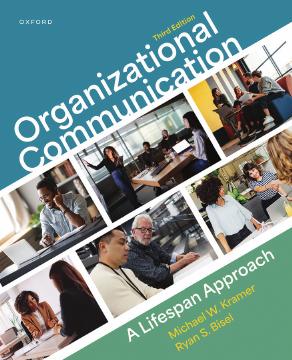
Organizational Communication A Lifespan Approach 3rd Edition By Michael Kramer, Ryan Bisel
$30.00
Secure checkout
Instant digital download
PDF document
Document details
- Pages
- 537
- File size
- 32.32 MB
- Format
- Digital PDF
- Course
- Communication
- Category
- eBook[PDF]
Sign in or create a free account to continue. Your purchase will be saved in My Downloads.
About this ebook
The Organizational Communication: A Lifespan Approach (3rd Edition) by Michael W. Kramer and Ryan S. Bisel uses a distinct developmental framework to teach organizational communication theories. Instead of organizing the material by abstract paradigm, the text structures chapters according to when individuals naturally encounter these communication experiences throughout their personal and professional lifetimes. [1, 2, 3]
The primary topics, stages, and core components covered in the 3rd edition include:
1. Introduction and Core Frameworks
- Defining Communication & Organizations: Introduction to classical communication models, including Information Transfer, Shared Meaning, and Transactional Meaning Creation. It explores legal, communicative, and social definitions of what constitutes an organization. [1, 2]
- Research Perspectives: Foundational concepts covering post-positivist, interpretive, and critical communication research methods. [1]
- Strategic Ambiguity & Nonverbal Communication: Examining how nonverbal cues (such as symbolic identification and security) and intentional ambiguity affect meaning-making in workplace settings. [1, 2]
2. The Socialization and Entry Stages
- Anticipatory Role and Organizational Socialization: Focuses on pre-career communication experiences—how family, education, peers, and media shape expectations and career choices before a person even enters the workforce. [1, 2]
- Organizational Encounter: The communication dynamics that occur when a newcomer first joins a group or company, including onboarding processes, Realistic Job Previews (RJPs), and active information-seeking behaviors. [1, 2]
3. Structural and Theoretical Foundations
- Communication and Management Theories: Traditional workflows mapped to core frameworks like Scientific Management, Bureaucracy, and the Human Relations school of thought.
- Communication Channels and Structures: A thorough dive into traditional hierarchy-defined channels, including formal downward, upward, lateral/horizontal, and integrative paths. It also covers informal "grapevine" channels and emerging organic communication networks.
- Communicative Constitution of Organizations (CCO): Expanded in the 3rd edition, this section teaches how communication doesn't just happen inside an organization, but actually constitutes and builds the organization itself. [1, 2, 3, 4]
4. Workplace Relationships and Cultural Dynamics
- Workplace Relationships: Explores communication dynamics between managers and direct reports (updated from "supervisor-subordinate" in older editions) as well as peer-to-peer workplace friendships.
- Sensemaking Theory: Explores how individuals mentally process and collectively construct understanding out of ambiguous or changing workplace events (moved to earlier chapters in this edition for better teaching flow).
- Power Dynamics, Diversity, and Inclusion: Integrated throughout the textbook, covering emotional intelligence, workplace resistance (including workplace silence), and addressing issues regarding Diversity, Equity, and Inclusion (DEI). [1, 2, 3]
5. Transition, Crisis, and Exit Stages
- Communicative Theory of Resilience (CTR): A brand new addition to Chapter 14 for the 3rd edition. It covers the five sub-processes individuals use to rebuild routines, affirm identity anchors, and create a "new normal" during major disruptions (such as remote-work shifts or sudden organizational changes).
- Organizational Exit: The final phase of the lifespan timeline, examining the communication surrounding voluntary or involuntary separation, career changes, transfers, and retirement. [1, 2, 3, 4]
File included
tmpphpEwCFqm
32.32 MB
Related ebooks