
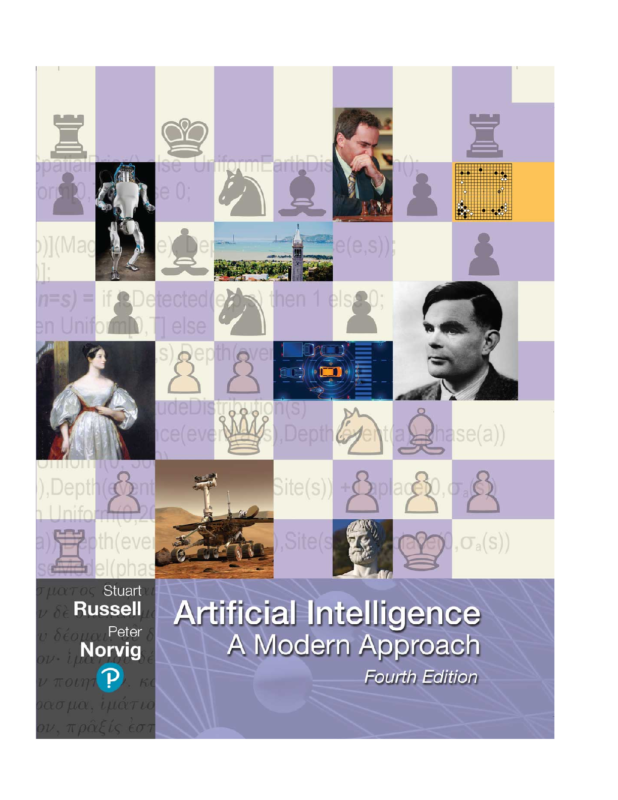
eBook Artificial Intelligence A Modern Approach 4th Edition By Norvig, Peter_Russell, Stuart Jonathan
$30.00
Secure checkout
Instant digital download
PDF document
Document details
- Pages
- 2,145
- File size
- 37.62 MB
- Format
- Digital PDF
- Course
- Artificial Intelligence
- Category
- eBook[PDF]
Sign in or create a free account to continue. Your purchase will be saved in My Downloads.
About this ebook
The Artificial Intelligence: A Modern Approach (4th Edition), co-authored by Stuart Russell and Peter Norvig, is structured into 7 major parts spanning 28 chapters. The core framework of the text anchors on the unified theme of the intelligent agent. [1, 2, 3, 4]
The extensive range of topics covered across the 4th edition includes: [1]
Part I: Artificial Intelligence
- Introduction: Definitional foundations of AI, historical milestones, and the philosophical underpinnings of building rational systems.
- Intelligent Agents: Defining the nature of task environments, agent structures, and mapping perception sequences into actions. [1, 2, 3]
Part II: Problem-Solving
- Solving Problems by Searching: Uninformed search strategies (e.g., Breadth-First, Depth-First) and informed/heuristic methods like \(A^{*}\) search. [1, 2]
- Search in Complex Environments: Local search algorithms (e.g., genetic algorithms, hill-climbing), continuous space navigation, and searching under partial observability. [1, 2]
- Adversarial Search and Games: Game theory, optimal decisions in multi-player games, minimax algorithms, alpha-beta pruning, and evaluation functions. [1, 2]
- Constraint Satisfaction Problems (CSPs): Backtracking search, constraint propagation, and structures for solving highly restricted environments. [1, 2]
Part III: Knowledge, Reasoning, and Planning
- Logical Agents & First-Order Logic: Knowledge-based systems, propositional logic, syntax/semantics of first-order logic, and engineering concepts.
- Inference in First-Order Logic: Unification, forward and backward chaining, resolution, and completeness proofs.
- Knowledge Representation: Ontological engineering, categories, objects, events, reasoning systems, and semantic networks.
- Automated Planning: Classical planning systems, planning graphs, and hierarchical task networks. [1, 2]
Part IV: Uncertain Knowledge and Reasoning
- Quantifying Uncertainty & Probabilistic Reasoning: Basics of probability theory, axioms, and constructing Bayesian networks. [1, 2]
- Probabilistic Reasoning over Time: Hidden Markov Models (HMMs), Kalman filters, and dynamic Bayesian architectures. [1]
- Probabilistic Programming: (Expanded Chapter) Using code-driven frameworks to handle complex statistical uncertainties. [1, 2]
- Decision Theory & Making Decisions: Utility theory, decision networks, Markov Decision Processes (MDPs), and Partially Observable MDPs (POMDPs). [1]
- Multiagent Decision Making: (Expanded Chapter) Strategic interactions, Nash equilibrium, and game theory among multiple self-interested or cooperative agents. [1, 2]
Part V: Machine Learning
- Learning from Examples: Supervised learning paradigms, decision trees, linear models, and computational learning theory.
- Knowledge in Learning: Inductive learning, explanation-based learning, and combining prior knowledge with data.
- Probabilistic Models: Statistical learning methods, Naive Bayes, EM algorithms, and unsupervised learning patterns.
- Deep Learning: (New Dedicated Chapter) Neural networks, convolutional networks (CNNs), recurrent neural networks (RNNs), and training mechanics.
- Reinforcement Learning: Passive and active reinforcement learning, Q-learning, policy search, and deep reinforcement learning architectures. [1, 2, 3]
Part VI: Communicating, Perceiving, and Acting
- Natural Language Processing: Text analysis, language models, grammar parsing, and statistical methods for translation.
- Deep Learning for Natural Language Processing: (New Dedicated Chapter) Modern transformer architectures, large language processing setups, and word embeddings.
- Computer Vision: Image formation, edge detection, object recognition, and deep learning implementations for sensory classification.
- Robotics: Hardware configuration, kinematics, perception integration, and safe human-robot interactions. [1, 2, 3]
Part VII: Philosophy, Ethics, and the Future of AI
- Weak and Strong AI: Definitions of consciousness, limits of artificial intellect, and standard model critiques.
- AI Safety, Fairness, and Trust: (Expanded Section) Algorithmic bias, data privacy, transparency metrics, and inverse reinforcement learning for ethical goal alignment. [1, 2]
Key Focus Shifts in the 4th Edition
If you are transitioning from an older version, the authors specifically rebalanced the content to emphasize data-driven machine learning over traditional knowledge engineering. Key changes include: [1]
- Brand New Chapters dedicated strictly to Deep Learning, Probabilistic Programming, Multiagent Systems, and Deep Learning for NLP.
- AI Alignment Re-evaluation, shifting from systems that maximize absolute expected human utility to systems that actively navigate uncertainty regarding what human goals actually are. [1, 2, 3]
File included
eBook-PDF-Artificial-Intelligence-A-Modern-Approach-4th-Edition-By-Norvig-Peter_Russell-Stuart-Jonathan.pdf
37.62 MB
Related ebooks