
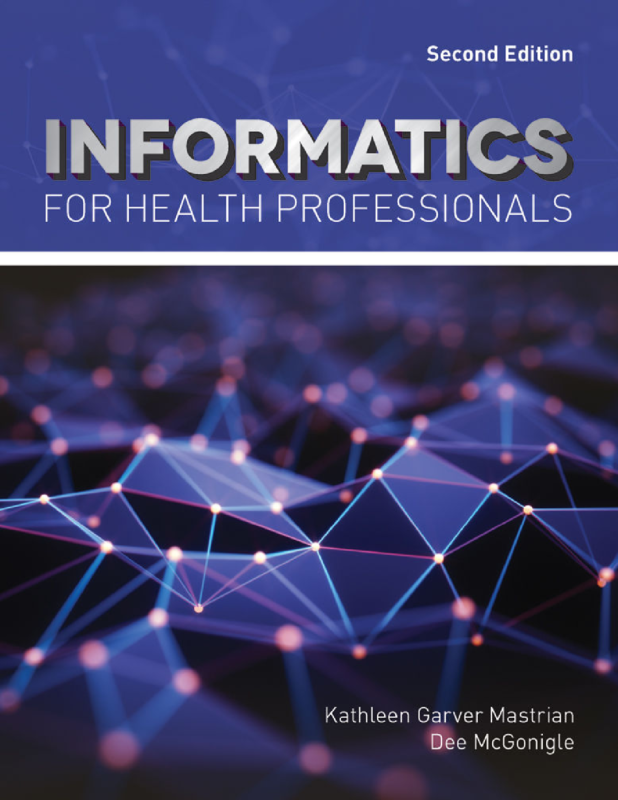
eBook Informatics for Health Professionals 2nd Edition By Kathleen Mastrian & Dee McGonigle
$30.00
Secure checkout
Instant digital download
PDF document
Document details
- Pages
- 1,119
- File size
- 12.34 MB
- Format
- Digital PDF
- Course
- Health Care
- Category
- eBook[PDF]
Sign in or create a free account to continue. Your purchase will be saved in My Downloads.
About this ebook
The Informatics for Health Professionals (2nd Edition) by Kathleen Mastrian and Dee McGonigle covers health informatics principles, systems, and tools structured around the authors' proprietary Foundation of Knowledge model. Designed specifically for allied health students and professionals, the textbook spans 20 chapters divided into distinct sections. [1, 2, 3]
The major sections and thematic topics covered across the 20 chapters include: [1]
Section I: Building Blocks of Health Informatics
This section introduces the foundational scientific disciplines that intersect to create health informatics. [1]
- The Foundation of Knowledge Model: Introduction to the core framework of the book—how healthcare workers acquire, process, generate, and disseminate knowledge. [1, 2]
- Information Science & Systems: The basics of data, information retrieval, and structural information systems. [1]
- Computer Science: The technical components of hardware, software, and computer systems used in health information technology. [1, 2]
- Cognitive Science & Cognitive Informatics: Exploring human thought processes, decision-making, and how mind-and-machine interactions impact healthcare technology. [1]
- Ethical and Legal Aspects: Navigating privacy laws, legislative guidelines, regulations, and moral dilemmas in the information age. [1]
Section II: Choosing and Using Information Systems
This section explores the administrative lifecycles, operations, and backend requirements of healthcare technology systems. [1, 2]
- Systems Development Life Cycle (SDLC): The phases involved in planning, designing, implementing, and maintaining healthcare IT platforms.
- Administrative Information Systems: Exploring core operational software used for scheduling, billing, and organizational management.
- The Human–Technology Interface: The ergonomics, design usability, and practical utility of tech applications for frontline clinical staff.
- Electronic Security: Cybersecurity, protecting patient health information (PHI), and access controls.
- Workflow & Meaningful Use: Analysis of clinical operations, performance metrics, and compliance standards surrounding electronic clinical setups. [1, 2, 3]
Section III: Informatics Applications for Care Delivery
Focuses directly on point-of-care tools and methods that allied health specialists use to manage patients. [1, 2]
- Electronic Health Records (EHRs): The execution, utility, and standard management of patient charts across clinical settings.
- Telehealth & Care Coordination: Transition technologies, remote monitoring, and managing patient care journeys at a distance.
- Patient Safety & Quality Outcomes: Utilizing clinical decision support systems (CDSS), bar-code medication administration, and minimizing alarm fatigue.
- Interdisciplinary Collaboration: Harnessing technology to streamline communication across diverse healthcare teams.
- Community and Population Health: Informatics applications scaled to monitor, promote, and treat larger communities. [1, 2, 3, 4, 5]
Section IV & V: Advanced Concepts and Future Trends
Covers the progressive analytical tools shaping the future landscape of clinical practice. [1]
- Healthcare Data Analytics & Data Mining: Tools for sorting massive datasets to find clinical patterns and build best practices.
- Bioinformatics & Computational Biology: Understanding how genomic, molecular, and biological data integrate into clinical settings.
- Health Professional Education: Informatics tools tailored for academic programs, simulation learning, and ongoing professional development. [1, 2, 3, 4]
Key Updates Unique to the Second Edition
Compared to the first edition, this revision introduces specific updates tailored to modern medicine: [1]
- Principles of Interoperability: A brand new framework detailing how different software platforms safely share data across networks.
- Social Media Integration: Deepened focus on social channels as essential communication tools between patients and medical systems.
- Artificial Intelligence & Machine Learning: New text segments evaluating how AI platforms assist diagnostics, predictions, and automated care workflows. [1]
File included
eBook-PDF-Informatics-for-Health-Professionals-2nd-Edition-By-Kathleen-Mastrian-Dee-McGonigle.pdf
12.34 MB
Related ebooks



