
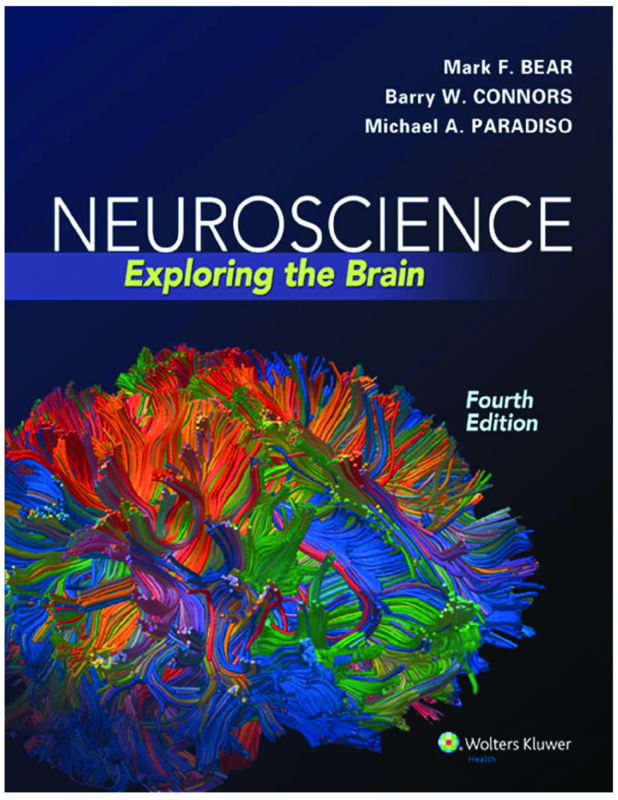
eBook Neuroscience Exploring the Brain 4th Edition By Mark F. Bear, Barry W. Connors, Michael A. Paradiso
$30.00
Secure checkout
Instant digital download
PDF document
Document details
- Pages
- 1,019
- File size
- 27.71 MB
- Format
- Digital PDF
- Course
- Neuroscience
- Category
- eBook[PDF]
Sign in or create a free account to continue. Your purchase will be saved in My Downloads.
About this ebook
The fourth edition of Neuroscience: Exploring the Brain by Mark F. Bear, Barry W. Connors, and Michael A. Paradiso is broadly organized into four main structural parts spanning 24 chapters and a dedicated neuroanatomy atlas. [1, 2]
Part I: Foundations
This section covers the basic cellular and chemical building blocks of the nervous system. [1]
- Introduction to Neuroscience: The history of brain research and modern neuroscience paradigms. [1]
- Neurons and Glia: The cellular structure of the brain, including neuronal membranes and supporting glial cells. [1]
- The Neuronal Membrane at Rest: The chemical and ionic basis of the resting membrane potential. [1]
- The Action Potential: The mechanisms of electrical signaling, depolarization, conduction velocity, and myelin. [1, 2]
- Synaptic Transmission: Principles of chemical and electrical synapses, neurotransmitter release, and synaptic integration. [1, 2]
- Neurotransmitter Systems: Detailed chemistry of specific neurotransmitter systems (cholinergic, catecholaminergic, serotonergic, amino acidergic) and receptor functions. [1, 2]
- Neuroanatomy: Gross structure of the nervous system, including the cerebral cortex, limbic system, brainstem, and cerebellum. Includes an Illustrated Guide to Human Neuroanatomy atlas. [1, 2, 3]
Part II: Sensory and Motor Systems
This part focuses on how the brain interacts with the environment by processing sensory inputs and executing physical movements. [1]
- The Chemical Senses: Extended coverage of gustation (taste) and olfaction (smell).
- The Eye and Vision: Structure of the eye, photoreception, and retinal processing.
- The Central Visual System: Neural pathways underlying visual perception and cortical processing.
- Auditory and Vestibular Systems: The neurobiology of hearing and biological balance.
- The Somatosensory System: Mechanisms of touch, pain, temperature, and body position.
- Spinal Control of Movement: Reflexes and the neural circuits of the spinal cord governing muscles.
- Brain Control of Movement: Cortical and subcortical (basal ganglia, cerebellum) management of voluntary movement. [1, 2]
Part III: The Brain and Behavior
This section investigates the neurobiological architecture that underpins complex behaviors, state shifts, and psychological processes. [1]
- Chemical Control of the Brain and Behavior: The role of diffuse modulatory systems, the hypothalamus, and the autonomic nervous system.
- Motivation: Biological drives, homeostasis, and eating behavior.
- Sex and the Brain: Sexual dimorphism, hormones, and the neurobiology of sexual behavior.
- Brain Mechanisms of Emotion: The limbic system, fear (amygdala), aggression, and emotional regulation.
- Brain Rhythms and Sleep: Circadian rhythms, EEG patterns, sleep stages, and underlying neural loops.
- Language: Brain areas responsible for speech, comprehension, and aphasias.
- Attention: The neural mechanisms of visual attention and mental focus.
- Mental Illness: The neurobiological basis and treatments for anxiety disorders, mood disorders (depression, bipolar), and schizophrenia. [1, 2, 3, 4]
Part IV: The Changing Brain
The final part explores neuroplasticity—how experience, time, and learning remodel neural connections. [1]
- Wiring the Brain: Neurogenesis, axon guidance, and synapse formation during development.
- Learning and Memory: Different types of memory, amnesia, and the role of the hippocampus and prefrontal cortex.
- Molecular Mechanisms of Memory Storage: Synaptic plasticity, long-term potentiation (LTP), long-term depression (LTD), and memory consolidation. [1, 2]
File included
eBook-PDF-Neuroscience-Exploring-the-Brain-4th-Edition-By-Mark-F.-Bear-Barry-W.-Connors-Michael-A.-Paradiso.pdf
27.71 MB
Related ebooks