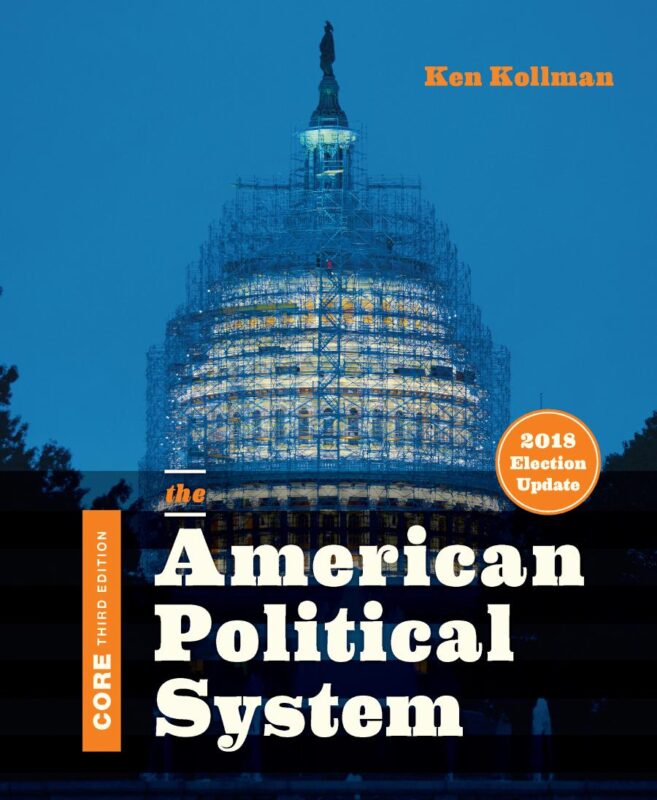
The American Political System 2018 election update Core 3rd Edition By Ken Kollman
$28.00
Secure checkout
Instant digital download
PDF document
Document details
- Pages
- 673
- File size
- 38.18 MB
- Format
- Digital PDF
- Course
- Education
- Category
- eBook[PDF]
Sign in or create a free account to continue. Your purchase will be saved in My Downloads.
About this ebook
The American Political System (Core Third Edition, 2018 Election Update) by Ken Kollman focuses on a core conceptual framework in political science: politics is driven by collective dilemmas and the institutions that solve them. Published by W. W. Norton & Company, this edition condenses the foundational dynamics of American government and updates them with empirical evidence and analysis through the 2018 midterm elections. [1, 2, 3]
Because it is the Core Edition, it contains all the foundational chapters on American institutions and political behavior but omits the extensive standalone public policy chapters found in the full edition.
The primary topics and thematic categories covered in the textbook include:
1. Foundations of American Politics
- Collective Dilemmas and Democratic Governance: The overarching analytical lens of the book. It introduces how collective action problems, free-rider situations, and coordination dilemmas shape political life and why institutions are necessary to resolve them. [1]
- The Constitution: The structural foundations of the United States, analyzing how the framers designed a system to tackle collective dilemmas while balancing power. [1]
- Federalism: The institutional relationship, tensions, and division of power between national and state governments.
- Civil Rights and Civil Liberties: The legal protections and constitutional rights of citizens, exploring the evolution of judicial interpretation regarding equality and personal freedoms.
2. Institutional Frameworks
- Congress: How the legislative branch functions, detailing the committee system, lawmaking processes, and the hurdles of getting 535 members to achieve collective goals.
- The Presidency: The powers of the executive branch, including formal constitutional authorities and informal tools, such as the use of executive orders to shape policy.
- The Federal Bureaucracy: The implementation of laws, administrative governance, and the challenges of bureaucratic oversight.
- The Judiciary: The structure of the federal court system, the power of judicial review, and the courts' role in resolving political and constitutional conflict. [1]
3. Political Behavior and Democratic Participation
- Public Opinion: How citizens form political preferences, the influence of socialization, and the impact of public opinion on governance.
- Interest Groups and Social Movements: How collective organizations lobby the government and influence public policy from the outside.
- Political Parties: The development and role of the two-party system in organizing elections and government actions.
- Elections and Voting: Campaigns, voter behavior, and the strategies behind voter mobilization. This section specifically integrates data, voter turnout trends, and outcomes from the 2018 midterm elections, evaluating shifts in congressional control and polarization.
- The Media: The role of journalism and mass communication in shaping political discourse and informing the electorate. [1, 2]
File included
tmpphpv1u84c
38.18 MB
Related ebooks