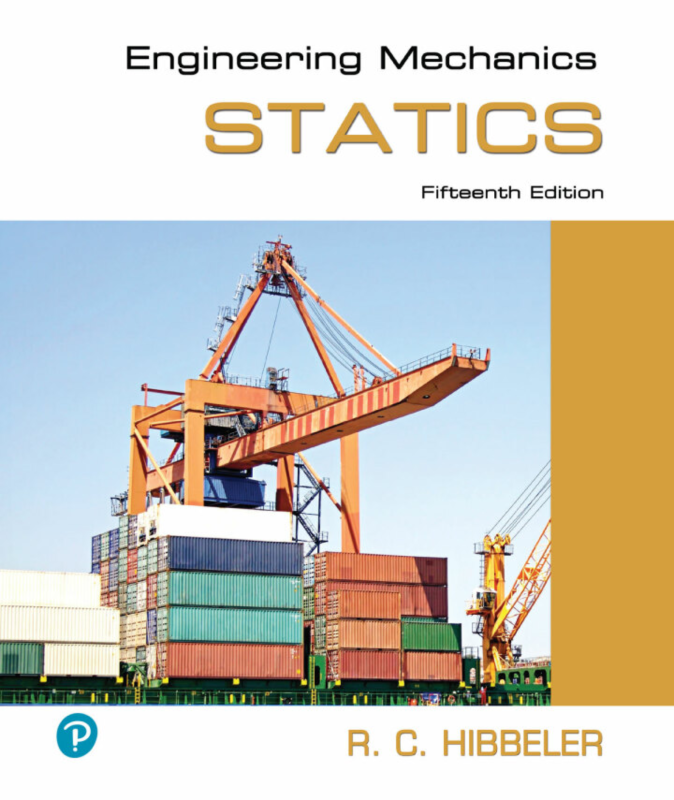
[eBook] [PDF] Engineering Mechanics Statics, 15th Edition By R.C. Hibbeler
$30.00
Secure checkout
Instant digital download
PDF document
Document details
- Pages
- 673
- File size
- 99.05 MB
- Format
- Digital PDF
- Course
- Engineering
- Category
- eBook[PDF]
Sign in or create a free account to continue. Your purchase will be saved in My Downloads.
About this ebook
The Engineering Mechanics: Statics, 15th Edition by R.C. Hibbeler covers the fundamental principles of mechanics involving bodies at rest. The textbook is structured systematically, beginning with basic particle mechanics and expanding into complex three-dimensional rigid body systems. [1, 2]
According to the official Pearson Table of Contents, the book is divided into 11 core chapters: [1]
1. Foundations & Vector Mechanics
- Chapter 1: General Principles – Introduction to the basic quantities and idealizations of mechanics, Newton's Laws of Motion, and the SI and U.S. Customary systems of units. [1, 2]
- Chapter 2: Force Vectors – Vector operations, addition of co-planar forces, Cartesian force vectors, position vectors, and the dot product. [1]
- Chapter 3: Equilibrium of a Particle – Introduction to the concept of the free-body diagram (FBD) and condition for the equilibrium of a particle in both 2D and 3D space. [1, 2]
2. Rigid Body Systems & Equilibrium
- Chapter 4: Force System Resultants – Moment of a force (scalar and vector formulations), cross products, principle of moments, moment of a couple, and the simplification and reduction of force/couple systems and distributed loadings. [1]
- Chapter 5: Equilibrium of a Rigid Body – Conditions for rigid-body equilibrium, constructing complex free-body diagrams, and solving two- and three-dimensional equilibrium problems. [1]
3. Structural Analysis & Internal Forces
- Chapter 6: Structural Analysis – The analysis of forces acting on engineering structures, focusing specifically on the Method of Joints and Method of Sections for trusses, frames, and machines.
- Chapter 7: Internal Forces – Determining internal forces developed in structural members, creating shear and moment diagrams for beams, and the analysis of cables. [1, 2]
4. Geometric & Surface Properties
- Chapter 8: Friction – Characteristics of dry friction, wedges, screws, belt friction, collar bearings, pivot bearings, and disk friction.
- Chapter 9: Center of Gravity and Centroid – Determining the center of gravity, center of mass, and centroid for composite bodies, along with Theorems of Pappus and Guldinus and fluid pressure.
- Chapter 10: Moments of Inertia – Area moment of inertia, parallel-axis theorem, radius of gyration, product of inertia, and mass moments of inertia. [1]
5. Advanced Virtual Work
- Chapter 11: Virtual Work – The principle of virtual work, efficiency, and the application of potential energy and stability of equilibrium configurations
File included
eBook-PDF-Engineering-Mechanics-Statics-15th-Edition-By-R.C.-Hibbeler.pdf
99.05 MB
Related ebooks