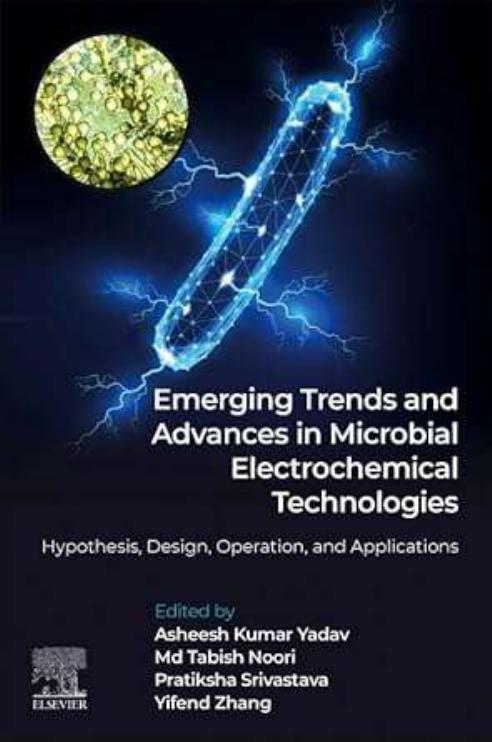
Emerging Trends and Advances in Microbial Electrochemical Technologies: Hypothesis, Design, Operation, and Application 1st Edition by Asheesh Kumar Yadav Pratiksha Srivastava Md Tabish Noori Yifeng Zhang
$45.00
Secure checkout
Instant digital download
PDF document
Document details
- Pages
- 849
- File size
- 7.06 MB
- Format
- Digital PDF
- Course
- Biotechnology
- Category
- eBook[PDF]
Sign in or create a free account to continue. Your purchase will be saved in My Downloads.
About this ebook
"Emerging Trends and Advances in Microbial Electrochemical Technologies: Hypothesis, Design, Operation, and Applications" (1st Edition), edited by Asheesh Kumar Yadav, focuses on a comprehensive "lab-to-field" approach to microbial electrochemical technologies (METs). [1, 2]
The textbook bridges foundational scientific theories with scalable real-world engineering, primarily covering the following key themes and topics:
🔬 Core Scientific Fundamentals & Hypotheses
- Basics of Microbial Electrochemical Technologies: Core principles governing electron transfer between electroactive bacteria and solid electrode surfaces. [1, 2]
- Microbial Catalysts and Interfacial Interactions: The molecular-level interplay between diverse electroactive microbes and organic/inorganic pollutant substrates. [1]
- Electrode Material Science: Recent breakthroughs in developing durable, highly efficient, and cost-effective electrode materials (such as using granular-activated carbon or GAC) to improve system conductivity and optimize microbial interactions. [1, 2]
⚙️ System Design, Up-scaling, and Operation Modes
- Reactor Engineering & Configuration: Practical design frameworks for distinct MET setups, specifically contrasting the advantages and constraints of fixed-bed and fluidized-bed reactors.
- Operation Modes: Analysis of performance outputs under continuous vs. intermittent operational modes to address current density limitations.
- System Up-scaling: Engineering strategies, economic viability evaluations, and practical limitations encountered when transitioning laboratory prototypes to large-scale, field-ready applications.
- Technology Integration: The coupling of METs with established ecotechnologies, such as Constructed Wetlands coupled Microbial Electrochemical Technology (CW-MET). [1, 2, 3]
🌍 Environmental and Commercial Applications
- Wastewater and Waste Treatment: Low-cost energy-generating and energy-saving setups for handling complex urban and industrial waste.
- Resource Recovery: Systems designed to recapture valuable resources, nutrients, and sub-products alongside water circularity and sustainability frameworks.
- Usable Electricity Generation: Optimizing the performance of Microbial Fuel Cells (MFCs) for continuous bio-electricity production.
- Bioremediation: Strategies to isolate and break down targeted contaminants and inorganic pollutants at contaminated field sites.
- Greenhouse Gas Mitigation & Bio-synthesis: Utilizing Microbial Electrolysis Cells (MECs) and Microbial Electrosynthesis Cells (MES) for carbon reduction, chemical synthesis, and greenhouse gas emission controls.
- Advanced Bio-sensing: Integrating sensor technology into MECs to accurately detect and quantify specific inorganic water pollutants with high sensitivity. [1, 2, 3]
File included
tmpphpf4HPEk
7.06 MB
Related ebooks