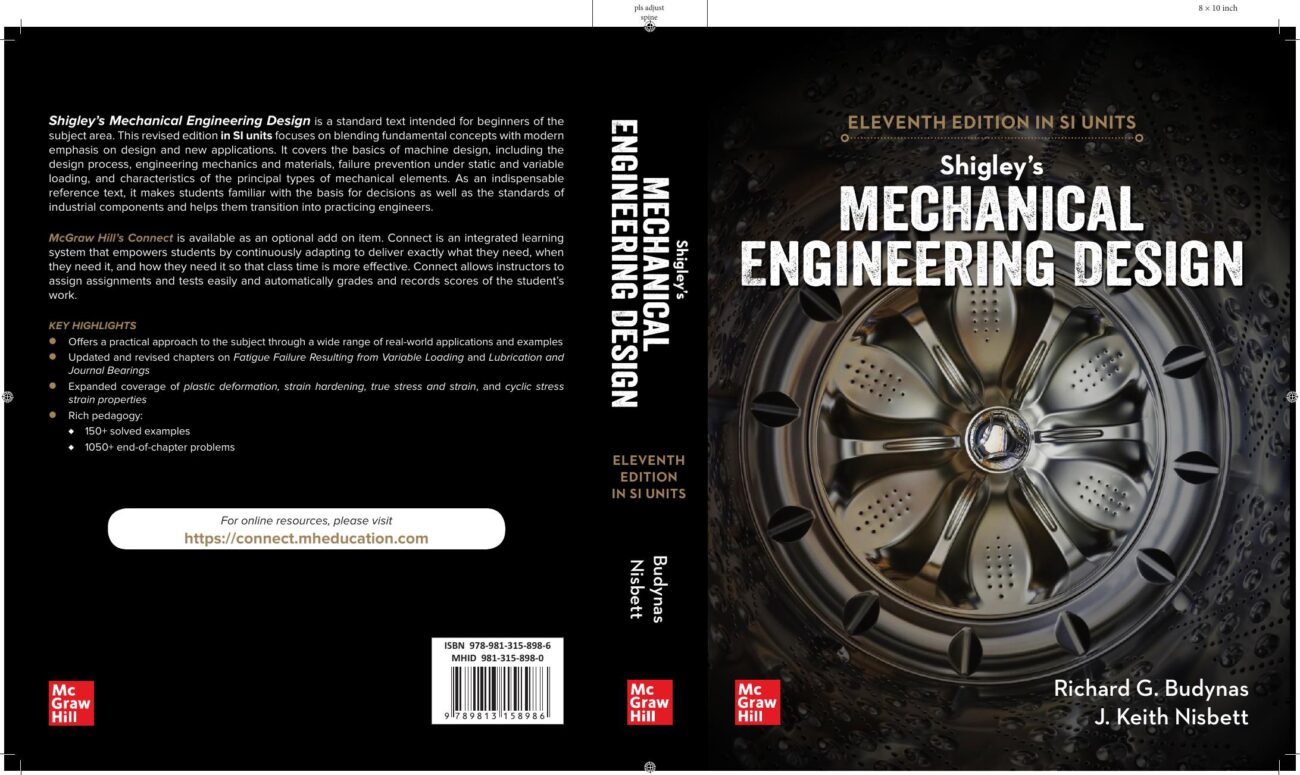
Shigley’s Mechanical Engineering Design 11th Edition Si Units By Richard Budynas, Keith Nisbett
$30.00
Secure checkout
Instant digital download
PDF document
Document details
- Pages
- 1,114
- File size
- 33.01 MB
- Format
- Digital PDF
- Course
- Engineering
- Category
- eBook[PDF]
Sign in or create a free account to continue. Your purchase will be saved in My Downloads.
About this ebook
The Shigley's Mechanical Engineering Design, 11th Edition (SI Units) by Richard Budynas and Keith Nisbett is systematically organized into four main parts across 20 distinct chapters. It builds foundational knowledge in engineering design, addresses failure methodologies, and applies those concepts to standard machine components. [1, 2, 3, 4]
The comprehensive table of contents and topics covered include: [1]
Part 1: Basics
- Chapter 1: Introduction to Mechanical Engineering Design – Overview of the design process, design considerations, safety factors, codes, standards, and unit systems. [1, 2]
- Chapter 2: Materials – Mechanical properties, material selection, heat treatment, cold-work processing, and database utilization. [1, 2]
- Chapter 3: Load and Stress Analysis – Critical review of equilibrium, stress states (axial, torsion, bending), stress concentration factors, contact stresses, and press/shrink fits. [1, 2]
- Chapter 4: Deflection and Stiffness – Deflection analysis using methods like superposition, singularity functions, and energy techniques (e.g., Castigliano's theorem). [1, 2]
Part 2: Failure Prevention
- Chapter 5: Failures Resulting from Static Loading – Yielding and fracture criteria for ductile and brittle materials (e.g., Distortion Energy and Maximum Shear Stress theories). [1, 2, 3]
- Chapter 6: Fatigue Failure Resulting from Variable Loading – High-cycle fatigue, S-N diagrams, endurance limit modifying factors, and fluctuating stresses. [1, 2]
Part 3: Design of Mechanical Elements
- Chapter 7: Shafts and Shaft Components – Structural layout, design for stress, deflection constraints, critical speeds, limits, and fits.
- Chapter 8: Screws, Fasteners, and the Design of Nonpermanent Joints – Thread mechanics, bolted joints, preloading, and tension/torque relationships.
- Chapter 9: Welding, Bonding, and the Design of Permanent Joints – Welded joints under axial, bending, and torsional loads, as well as adhesive bonding parameters.
- Chapter 10: Mechanical Springs – Stresses and deflections in helical extension, compression, torsion, and leaf springs.
- Chapter 11: Rolling-Contact Bearings – Bearing life, load ratings, selection protocols, and mounting structures.
- Chapter 12: Lubrication and Journal Bearings – Viscosity mechanics, hydrodynamic lubrication theory, and journal bearing design variables.
- Chapter 13: Gears – General – Kinematics, nomenclature, conjugate action, tooth systems, and gear trains.
- Chapter 14: Spur and Helical Gears – AGMA stress and strength equations, geometry factors, and dynamic design considerations.
- Chapter 15: Bevel and Worm Gears – Mechanics, forces, and AGMA rating formulations specific to bevel and worm gearing.
- Chapter 16: Clutches, Brakes, Couplings, and Flywheels – Analysis of internal expanding, external contracting, disc, and cone friction elements.
- Chapter 17: Flexible Mechanical Elements – Layout and design of belts (flat, V-belts, synchronous), roller chains, and wire ropes.
- Chapter 18: Power Transmission Case Study – Integrated synthesis of machine elements designed to work cooperatively within a transmission system. [1, 2, 3]
Part 4: Special Topics
File included
tmpphpI0z9mL
33.01 MB
Related ebooks