
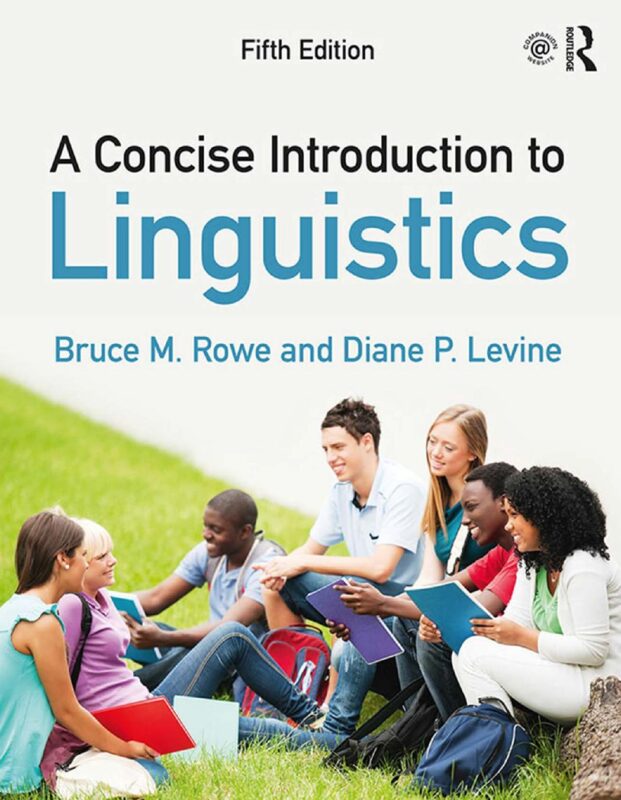
A Concise Introduction to Linguistics 5th Edition By Bruce M. Rowe, Diane P. Levine
$30.00
Secure checkout
Instant digital download
PDF document
Document details
- Pages
- 432
- File size
- 5.68 MB
- Format
- Digital PDF
- Course
- Education
- Category
- eBook[PDF]
Sign in or create a free account to continue. Your purchase will be saved in My Downloads.
About this ebook
The 5th edition of A Concise Introduction to Linguistics by Bruce M. Rowe and Diane P. Levine explores the scientific study of language with a heavy emphasis on linguistic anthropology and how communication intersects with human culture. The textbook is divided into 14 chapters, mapping out both the foundational structural components of language and its broader cultural, cognitive, and social applications. [1, 2, 3]
Chapter-by-Chapter Core Topics
- Chapter 1: Introduction: The Nature of Communication – Introduces the basics of linguistic competence, features of human language, and compares human language against nonhuman communication (such as the dance of the honeybee).
- Chapter 2: Phonetics: The Sounds Used in Languages – Covers articulatory phonetics, the human speech apparatus, vowels, consonants, and how sounds are produced across different languages.
- Chapter 3: Phonology: The Sound Patterns Used in Languages – Discusses phonemes, allophones, phonetics vs. phonemics, and how sound contrasts affect word meaning using minimal pairs.
- Chapter 4: Morphology: Words and How They Are Formed – Breaks down the concept of the morpheme, free vs. bound morphemes, allomorphs, and morphological typologies.
- Chapter 5: Syntax: The Larger Patterns of Language – Analyzes structural rules, phrase structure, grammatical categories, and how words are arranged hierarchically into sentences.
- Chapter 6: Semantics: The Study of Meaning – Explores how words, expressions, and full sentences convey structural and conceptual meaning.
- Chapter 7: Pragmatics: How Language Is Used and the Effect of Context on Meaning – Focuses on language performance, speech acts, and how environmental, situational, and conversational contexts shift interpretation.
- Chapter 8: Sociolinguistics: Language and Society – Investigates language variation, dialects, and social identity, with an expanded 5th-edition section detailing gender and language.
- Chapter 9: Linguistic Anthropology: Language and Culture – Unpacks the historical and cultural significance of language, emphasizing the field methods used to trace human communication patterns.
- Chapter 10: Language Acquisition: How Children (and Others) Learn Language – Looks at child language development, cognitive milestones, and the primary stages of learning a first or second language.
- Chapter 11: Sign Language: The Language of the Deaf Community – Evaluates the rich structural and grammatical features of visual-gestural languages.
- Chapter 12: Writing Systems – Traces the history, emergence, and evolution of graphic symbols used to permanently record spoken or signed language.
- Chapter 13: Nonverbal Communication – Looks at kinesics, proxemics, and non-spoken cues (such as body language and physical space) that complement linguistic interaction.
- Chapter 14: Historical Linguistics – Covers language families, the processes of linguistic change over time, and the evolution of modern tongues from ancestral roots. [1, 2, 3, 4, 5, 6, 7, 8, 9, 10, 11]
File included
tmpphp1QZ4dC
5.68 MB
Related ebooks