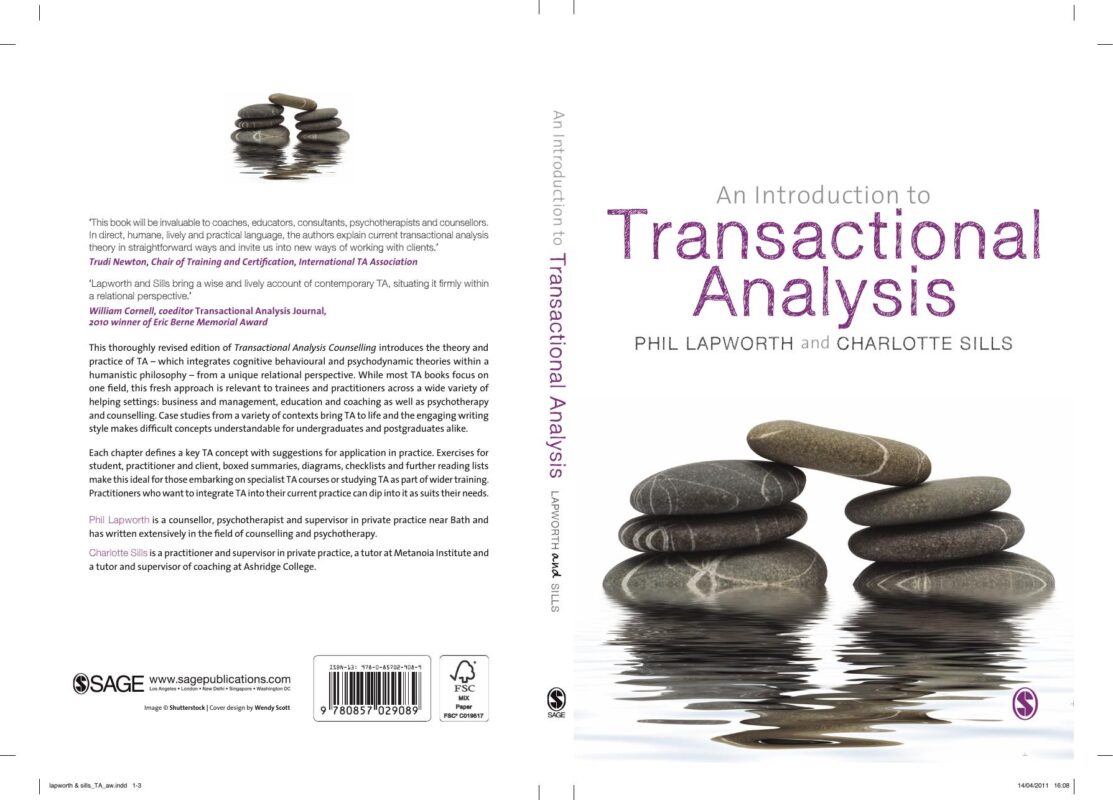
An Introduction to Transactional Analysis Helping People Change 1st Edition By Phil Lapworth, Charlotte Sills
$28.00
Secure checkout
Instant digital download
PDF document
Document details
- Pages
- 225
- File size
- 6.16 MB
- Format
- Digital PDF
- Course
- Education
- Category
- eBook[PDF]
Sign in or create a free account to continue. Your purchase will be saved in My Downloads.
About this ebook
The An Introduction to Transactional Analysis: Helping People Change (1st Edition), written by Phil Lapworth and Charlotte Sills, introduces the theory and practice of Transactional Analysis (TA) from a distinct relational perspective. The textbook integrates cognitive-behavioral, psychodynamic, and humanistic philosophies, structured explicitly so that each chapter focuses on a singular concept containing definitions, case studies, and practical applications. [1, 2, 3, 4]
The primary topics and core foundational modules covered in the book include:
1. Foundational History and Principles
- Evolution of TA: A brief history of Transactional Analysis, tracking its development from Eric Berne's original principles to modern 21st-century adaptations. [1, 2]
- Humanistic Philosophy: Understanding the underlying core assumptions of TA, notably the "I'm OK, You're OK" baseline framework.
- Multi-Setting Applications: How TA operates outside traditional psychotherapy, specifically its utility in coaching, business management, education, and counseling. [1]
2. Ego States (Theory of Personality)
- The Structural and Functional Models: Detailed exploration of the Parent, Adult, and Child ego states.
- Parent Ego State: Internalized behaviors, attitudes, and prejudices from parental figures (including Nurturing and Controlling/Critical variations).
- Adult Ego State: Objective data processing, logic, and reality-testing based on the here-and-now.
- Child Ego State: Relived behaviors, thoughts, and feelings from childhood (including Natural/Free Child and Adapted/Rebellious Child variations).
- Diagnosis of Ego States: Utilizing behavioral, social, historical, and phenomenological clues to identify active ego states. [1, 2, 3, 4]
3. Interpersonal Dynamics and Transactions
- Analyzing Transactions: How communication loops occur between the ego states of different individuals (Complementary, Crossed, and Ulterior transactions).
- Strokes and Stimulus Hunger: The psychological need for recognition and how people exchange positive or negative "strokes" to satisfy it.
4. Psychological Games and Rackets
- Life Scripts: The unconscious life plans made in childhood, reinforced by parental reactions, and played out in adulthood.
- Psychological Games: Repetitive, dysfunctional communication patterns that lead to predictable, negative emotional payoffs (using frameworks like the Drama Triangle).
- Rackets and Racket Feelings: Exploitative emotional reactions that substitute for genuine feelings or are used to manipulate environments to match a person's life script. [1, 2]
5. The Relational Turn and the Process of Change
- Relational TA & Intersubjectivity: A core emphasis on the therapeutic alliance, recognizing that healing happens dynamically through the relationship between the practitioner and the client.
- Transference and Countertransference: Reworking past projections and subjective behavioral loops live in the present moment.
- Assessment and Contracting: Establishing concrete goals for behavioral change and personal transformation. [1, 2, 3]
File included
tmpphplXfEPr
6.16 MB
Related ebooks