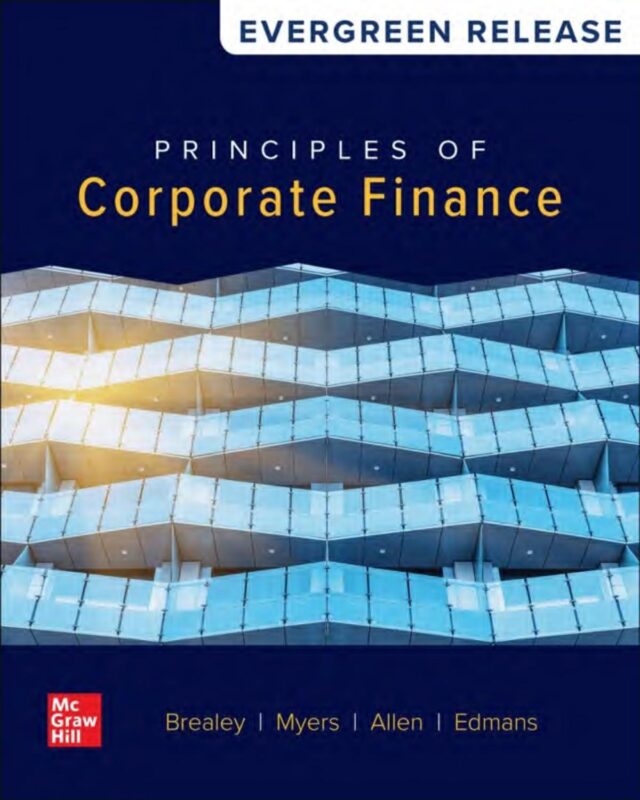
Principles of Corporate Finance 2025 Evergreen Release By Richard Brealey, Stewart Myers, Franklin Allen, Alex Edmans
$30.00
Secure checkout
Instant digital download
PDF document
Document details
- Pages
- 1,153
- File size
- 16.17 MB
- Format
- Digital PDF
- Course
- Business
- Category
- eBook[PDF]
Sign in or create a free account to continue. Your purchase will be saved in My Downloads.
About this ebook
The Principles of Corporate Finance (2025 Evergreen Release) by Richard Brealey, Stewart Myers, Franklin Allen, and Alex Edmans is structured into 12 parts containing 34 chapters. [1, 2]
The text undergoes its most substantial pedagogical rewrite in this edition, focusing on clear definition of terms, intuitive everyday analogies rather than pure formulas, and dedicated "Principle", "Common Confusion", and "Sense Check" framework boxes. [1, 2, 3]
The complete list of parts and topics covered in this release includes: [1]
➡️ Part One: Value
- Chapter 1: Introduction to Corporate Finance — Investment/financing decisions, financial goals, and agency problems.
- Chapter 2: How to Calculate Present Values — Future/present values, perpetuities, annuities, and compounding intervals.
- Chapter 3: Valuing Bonds — Yield to maturity, duration, interest rate sensitivity, term structure, and default risk.
- Chapter 4: Valuing Stocks — Trading mechanics, market vs. book value, dividend discount models, growth opportunities (PVGO), and Free Cash Flow (FCF) valuation.
- Chapter 5: Net Present Value and Other Investment Criteria — Review of NPV vs. Payback, Accounting Rate of Return, IRR pitfalls, and capital rationing.
- Chapter 6: Making Investment Decisions with the Net Present Value Rule — Incremental cash flows, inflation treatment, depreciation tax shields, and project replacement/timing decisions.
➡️ Part Two: Risk
- Chapter 7: Risk, Diversification, and Portfolio Selection — Historical returns/risks, variance, unique vs. systematic risk, and the efficient frontier.
- Chapter 8: The Capital Asset Pricing Model — Measuring beta, the Security Market Line, empirical evidence of CAPM, Arbitrage Pricing Theory (APT), and multi-factor models.
- Chapter 9: Risk and the Cost of Capital — Asset costs of capital (levered vs. unlevered), comparable companies analysis, and divisional hurdles.
➡️ Part Three: Best Practices in Capital Budgeting
- Chapter 10: Project Analysis — Sensitivity, scenario, and break-even analysis; operating leverage; and introduction to real options/decision trees.
- Chapter 11: How to Ensure That Projects Truly Have Positive NPVs — Behavioral biases (optimism and overconfidence), avoiding forecast errors, and competitive advantage translation. [1]
➡️ Part Four: Financing Decisions and Market Efficiency
- Chapter 12: Efficient Markets and Behavioral Finance — Substantially rewritten to explore the levels of the Efficient Market Hypothesis (EMH), market anomalies, corporate implications, and investor sentiment/limits to arbitrage.
- Chapter 13: An Overview of Corporate Financing — Modernized coverage of common/preferred equity, global debt patterns, and a look at the Fintech Revolution (P2P lending, blockchain, credit scoring).
- Chapter 14: How Companies Issue Securities — Venture capital, the mechanics/underpricing of Initial Public Offerings (IPOs), seasoned public offers, and private placements. [1, 2]
➡️ Part Five: Payout Policy and Capital Structure
- Chapter 15: Payout Policy — Dividends vs. share repurchases, informational content of payouts, tax clienteles, and life-cycle dynamics.
- Chapter 16: Capital Structure in Perfect Capital Markets — Modigliani and Miller (MM) Proposition 1 and 2, leverage impacts on risk, and home-made leverage.
- Chapter 17: How Much Should a Company Borrow? — Interest tax shields, financial distress/bankruptcy costs, agency costs of debt/equity, trade-off theory, and pecking order theory.
- Chapter 18: Financing and Valuation — Post-tax Weighted-Average Cost of Capital (WACC), valuation of entire businesses, unlevering/relevering betas, and Adjusted Present Value (APV). [1]
➡️ Part Six: Corporate Objectives and Governance
- Chapter 19: Corporate Governance — Heavily revised to evaluate global agency issues, management compensation controversies, board/shareholder monitoring, and legal protection regimes.
- Chapter 20: Stakeholder Capitalism and Responsible Business — A brand-new addition exploring the role of multi-stakeholders (employees, environment, community), the economic cases for and against shareholder primacy, ESG-linked pay, and Benefit Corporations. [1, 2]
➡️ Part Seven: Options
- Chapter 21: Understanding Options — Calls, puts, payoff diagrams, financial engineering, and put-call parity.
- Chapter 22: Valuing Options — Replicating portfolios, risk-neutral approaches, binomial trees, and the Black-Scholes formula.
- Chapter 23: Real Options — Expansion, abandonment, timing, and production flexibility options applied directly to corporate asset valuation. [1, 2]
➡️ Part Eight: Debt Financing
- Chapter 24: Credit Risk and the Value of Corporate Debt — Promised vs. expected yields, default probabilities, credit ratings, and structural models.
- Chapter 25: The Many Different Kinds of Debt — Bonds provisions, seniority, covenants, convertibles, syndicated bank loans, and commercial paper.
- Chapter 26: Leasing — Operating vs. financial leases, lease-or-buy decisions, accounting changes, and leveraged lease structures. [1]
➡️ Part Nine: Risk Management
- Chapter 27: Managing Risk — Mechanics and rationale for hedging using insurance, forwards, futures, interest rate options, and swaps.
- Chapter 28: International Financial Management — Foreign exchange relations (PPP, interest rate parity), hedging currency exposure, and international investment discounting. [1]
➡️ Part Ten: Financial Planning and Working Capital Management
- Chapter 29: Financial Analysis — Balance sheets, income statements, Efficiency/DuPont formulas, Economic Value Added (EVA), and ratio parsing.
- Chapter 30: Financial Planning — Cash flow tracing/forecasting, short-term and long-term financial modeling, and internal vs. sustainable growth.
- Chapter 31: Working Capital Management — The cash cycle, inventory trade-offs (JIT strategies), credit analysis, collection policy, and short-term investing. [1]
➡️ Part Eleven: Mergers, Corporate Control, and Governance
- Chapter 32: Mergers — Value-creating vs. value-destroying combinations, synergy calculation, acquisition mechanics, antitrust law, and takeover defenses.
- Chapter 33: Corporate Restructuring — Leveraged Buyouts (LBOs), private equity partnership structures, divestitures (spin-offs/carve-outs), and Chapter 11 bankruptcy dynamics. [1]
➡️ Part Twelve: Conclusion
- Chapter 34: Conclusion: What We Do and Do Not Know about Finance — Summation of the core concepts (NPV, CAPM, Capital Structure) and a look at ongoing unsolved paradoxes in market history. [1]
File included
tmpphp8pSLPo
16.17 MB
Related ebooks