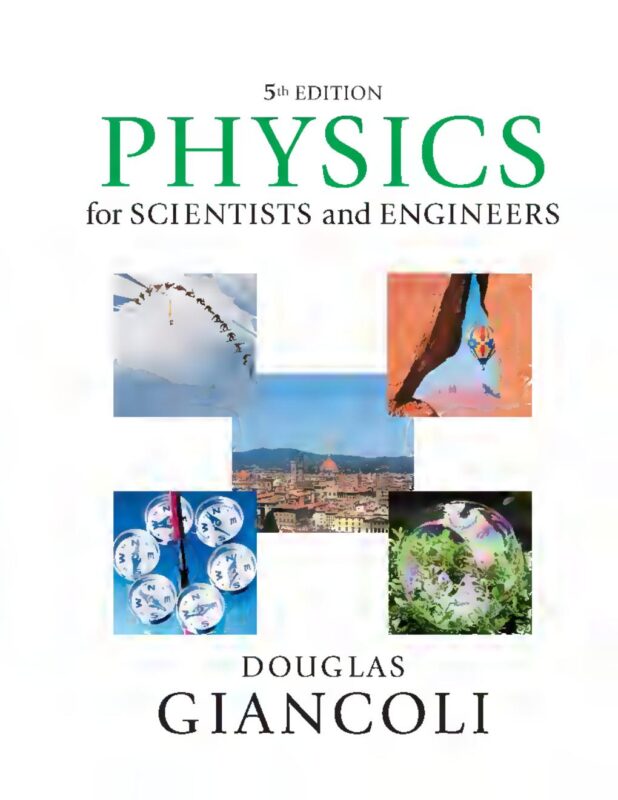
Physics for Scientists & Engineers 5th Edition By Douglas Giancoli
$30.00
Secure checkout
Instant digital download
PDF document
Document details
- Pages
- 1,468
- File size
- 45.88 MB
- Format
- Digital PDF
- Course
- Physics
- Category
- eBook[PDF]
Sign in or create a free account to continue. Your purchase will be saved in My Downloads.
About this ebook
The Physics for Scientists & Engineers 5th Edition By Douglas Giancoli topics covered
The Complete Version of Physics for Scientists & Engineers (5th Edition) by Douglas Giancoli contains 44 chapters mapping out a rigorous, calculus-based curriculum. It is structured into three primary volumes or main thematic sections: [1]
⚙️ Volume 1: Mechanics, Waves, and Thermodynamics (Chapters 1–20)
This volume lays the core mathematical and physical foundation for tracking motion, forces, energy transfers, and wave behaviors. [1, 2]
- Kinematics & Dynamics: Introduction and measurements, one-dimensional motion, vectors, 2D/3D projectile motion, and Newton’s Laws of Motion. [1]
- Applications of Forces: Friction, uniform/nonuniform circular motion, drag forces, and Newton's universal gravitation. [1]
- Energy & Momentum: Work and energy, conservation of mechanical energy, linear momentum, impulses, and collisions. [1]
- Rotation & Equilibrium: Rotational motion, angular momentum, static equilibrium, elasticity, fracture, and fluid mechanics. [1, 2]
- Oscillations & Waves: Simple harmonic motion, wave mechanics, and the physics of sound. [1, 2]
- Thermodynamics: Temperature, kinetic theory of gases, heat transfer, the First and Second Laws of Thermodynamics, heat engines, and entropy. [1]
⚡ Volume 2: Electricity, Magnetism, Light, and Optics (Chapters 21–35)
This section targets the behaviors of fields, electrical components, and the foundational equations governing modern communication and technology. [1, 2]
- Electrostatics & Fields: Electric charge, electric fields (and how they form), Coulomb’s Law, and electric potential energy.
- Capacitance & Currents: Capacitors, dielectrics, electric currents, resistance, and direct current (DC) circuits.
- Magnetism: Magnetic fields, magnetic forces on moving charges, sources of magnetic fields, and Ampere’s Law.
- Electromagnetic Induction: Faraday’s Law, electromotive force (emf), inductance, and alternating current (AC) circuits.
- Maxwell's Equations & Waves: Formulating Maxwell's equations and tracking electromagnetic waves.
- Optics: Light propagation, reflection, refraction, lenses, mirrors, optical instruments, wave nature of light, interference, and diffraction. [1, 2, 3]
⚛️ Volume 3: Modern Physics (Chapters 36–44)
The final chapters venture past classical limits to evaluate the universe at extremely fast speeds, minuscule scales, and cosmic distances. [1]
- Relativity: Einstein’s Special Theory of Relativity and its impacts on time, length, and mass.
- Quantum Mechanics: The early quantum theory, wave-particle duality, models of the atom, and the Schrödinger equation.
- Atomic & Molecular Physics: Quantum mechanics applied to atoms, molecular bonds, and condensed matter physics (solids/semiconductors).
- Nuclear Physics: Nuclear structure, radioactivity, nuclear energy options, fusion, and fission.
- Particle Physics & Cosmology: Elementary particles, fundamental forces, astrophysics, and the evolution of the universe. [1]
File included
tmpphpLMbwBG
45.88 MB
Related ebooks