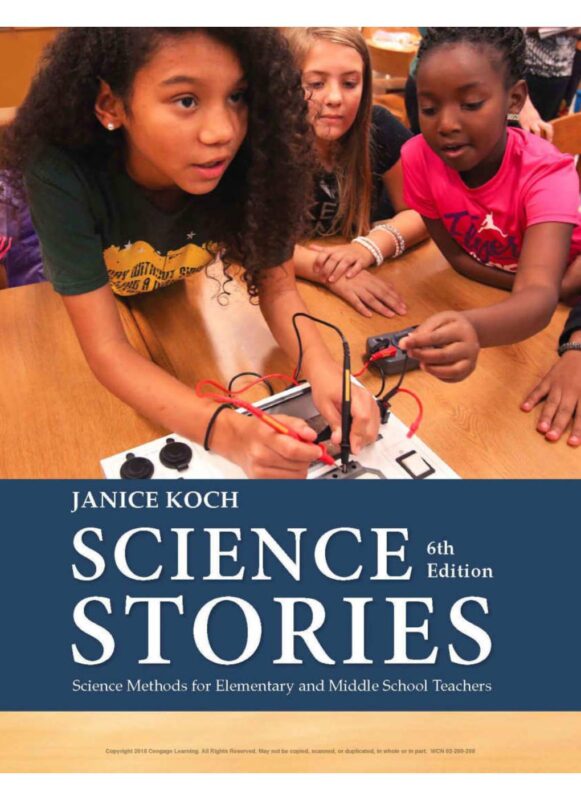
Science Stories: Science Methods for elementary and middle school teachers 6th Edition By Koch, Janice
$30.00
Secure checkout
Instant digital download
PDF document
Document details
- Pages
- 386
- File size
- 20.38 MB
- Format
- Digital PDF
- Course
- Education
- Category
- eBook[PDF]
Sign in or create a free account to continue. Your purchase will be saved in My Downloads.
About this ebook
Science Stories: Science Methods for Elementary and Middle School Teachers (6th Edition) by Janice Koch is organized into three primary parts spanning 14 total content chapters. The textbook relies on a constructivist framework, using real-world classroom narratives ("stories") paired with "Expanding Meanings" sections to break down pedagogy, scientific concepts, and educational frameworks. [1, 2, 3]
The specific topics covered are divided into three core categories:
Part 1: The Scientist Within (Teacher Metacognition & Background)
- Locating Your "Scientific Self": Examining personal beliefs, fears, and past experiences with science to build self-confidence as an educator. [1, 2]
- Understanding Children’s Scientific Selves: Exploring how young learners naturally think, perceive, and construct scientific meaning. [1]
- The Constructivist Approach: Implementing student-centered classrooms where learners build on prior knowledge via discovery, open-ended questioning, and active experimentation. [1]
Part 2: Doing Science with Students: Inquiry in Practice (Disciplinary Core Ideas)
This section uses narratives to teach core science disciplines, aligning each with the Next Generation Science Standards (NGSS): [1, 2]
- Physical Sciences:
- Explorations of Matter: Understanding physical states, properties, and changes in matter ("Science is not neat").
- Explorations of Electricity: Creating circuits, modeling currents, and analyzing energy transfer.
- Light, Sound, and Force: Designing active inquiry lessons around waves, forces, and physical motions. [1]
- Life Sciences:
- Earth and Space Sciences:
- Engineering and Applied Practices:
- Engineering Design: Incorporating technological problem-solving and the Science and Engineering Practices (SEPs) directly into daily lessons. [1]
Part 3: Creating the Science Experience in Your Classroom (Pedagogy & Management)
- The Teacher as Mediator: Shifting roles from a lecturer to a learning facilitator who prompts critical dialogue.
- The "Science Circus": Setting up student rotations and interactive stations to practice core processing skills like observing, measuring, and classifying.
- Assessment Strategies: Creating formal, informal, and student self-assessment frameworks tailored to active inquiry learning.
- Curriculum Integration: Connecting science lessons to reading, writing, mathematics, art, and modern technology.
- Environment Management: Structuring real-world environments safely, organizing collaborative student groups, and handling messy classroom layouts. [1, 2, 3, 4]
File included
tmpphpj981TJ
20.38 MB
Related ebooks