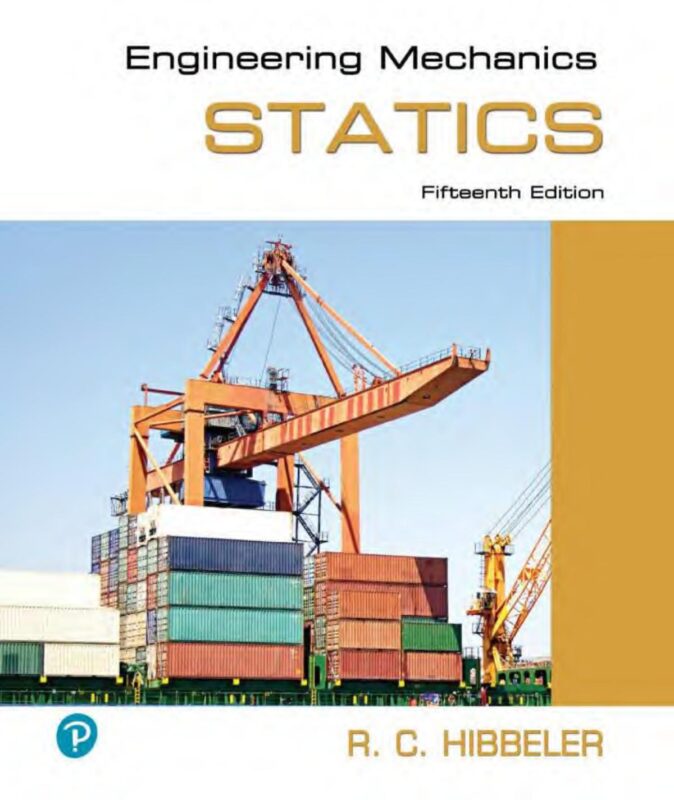
Engineering Mechanics Statics 15th Edition By Russell Hibbeler
$30.00
Secure checkout
Instant digital download
PDF document
Document details
- Pages
- 673
- File size
- 47.31 MB
- Format
- Digital PDF
- Course
- Education
- Category
- eBook[PDF]
Sign in or create a free account to continue. Your purchase will be saved in My Downloads.
About this ebook
The Engineering Mechanics: Statics (15th Edition) by Russell C. Hibbeler is divided into 11 chapters. The text covers foundational principles of vector mechanics and equilibrium, scaling systematically from simple particles to complex rigid bodies. [1]
The detailed breakdown of the topics covered in each chapter includes:
Foundational Principles & Particle Mechanics
- Chapter 1: General Principles – Introduction to the basic concepts of mechanics, Newton’s Laws of Motion, gravitational attraction, and numerical calculation procedures using the International System of Units (SI) and US Customary units. [1, 2, 3]
- Chapter 2: Force Vectors – Operations with scalars and vectors. Covers 2D/3D vector addition, Cartesian vectors, position vectors, force vectors directed along a line, and the dot product. [1, 2]
- Chapter 3: Equilibrium of a Particle – Conditions for the equilibrium of a particle, constructing Free-Body Diagrams (FBDs), and solving coplanar (2D) and three-dimensional (3D) force systems. [1, 2, 3]
Rigid Body Systems & Equilibrium
- Chapter 4: Force System Resultants – Concept of a moment of a force (2D and 3D scalar/vector formulations), principle of moments, moment of a couple, and simplifying a force and couple system to a single equivalent resultant. It also covers distributed loads. [1, 2, 3, 4]
- Chapter 5: Equilibrium of a Rigid Body – Conditions for rigid-body equilibrium. Detailed execution of free-body diagrams for rigid bodies, support reactions, and solving problems involving 2D and 3D equilibrium equations. [1, 2, 3]
Structural Analysis & Internal Mechanics
- Chapter 6: Structural Analysis – Analysis of simple engineering structures. This covers determining forces in trusses using the Method of Joints and Method of Sections, identifying zero-force members, and analyzing the forces acting on frames and machines.
- Chapter 7: Internal Forces – Internal forces developed in structural members. Focuses on finding internal shear forces and bending moments, drawing shear and moment diagrams for beams, and analyzing cables under concentrated or distributed loads. [1, 2, 3, 4]
Friction & Geometric Properties
- Chapter 8: Friction – Theory of dry friction, wedges, screws, journal bearings, thrust bearings, and belt friction. Includes problem-solving steps for systems undergoing impending motion or tipping.
- Chapter 9: Center of Gravity and Centroid – Determining the center of gravity, center of mass, and the centroid of a volume, area, or line via mathematical integration. Also covers composite bodies and theorems of Pappus-Guldinus. [1, 2, 3]
File included
tmpphpsmzOHQ
47.31 MB
Related ebooks