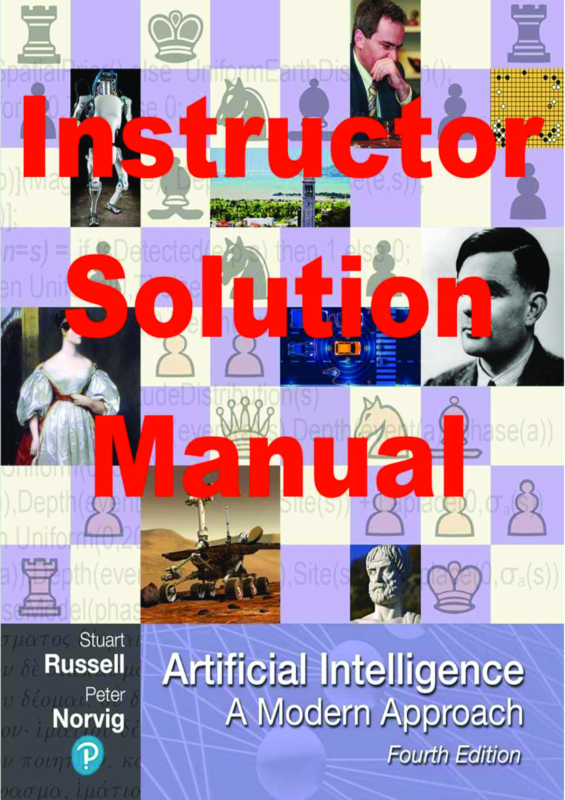
Instructor Solution Manual for Artificial Intelligence: A Modern Approach,4th Edition, US Edition |2020, Stuart J Russell; Peter Norvig
$25.00
Secure checkout
Instant digital download
PDF document
Document details
- Pages
- 586
- File size
- 7.83 MB
- Format
- Digital PDF
- Course
- Artificial Intelligence
- Category
- INSTRUCTOR MANUALS
Sign in or create a free account to continue. Your purchase will be saved in My Downloads.
About this ebook
The Instructor Solution Manual for Artificial Intelligence: A Modern Approach, 4th Edition (US Edition) by Stuart Russell and Peter Norvig provides comprehensive, step-by-step solutions and pedagogical guidance for all exercises found in the textbook. [1, 2]
The manual is divided into 7 core parts spanning 28 chapters, mirroring the exact breakdown of topics covered in the standard 4th edition curriculum: [1, 2]
🏢 Part I: Artificial Intelligence
- Chapter 1: Introduction – Definitions of AI, foundational fields (philosophy, mathematics, economics, neuroscience, psychology, computer engineering, control theory, and linguistics), history of AI, and current state of the art. [1]
- Chapter 2: Intelligent Agents – Rationality, the nature of task environments (PEAS: Performance, Environment, Actuators, Sensors), and the structural design of agents (simple reflex, model-based, goal-based, and utility-based). [1, 2]
🔍 Part II: Problem-Solving
- Chapter 3: Solving Problems by Searching – Formulating problems, uninformed search strategies (BFS, DFS, Uniform-cost), and informed/heuristic search strategies (\(A^{*}\) search, greedy best-first). [1, 2]
- Chapter 4: Search in Complex Environments – Local search algorithms (hill-climbing, simulated annealing, genetic algorithms), searching with non-deterministic actions, and online search agents. [1]
- Chapter 5: Adversarial Search and Games – Game theory, minimax algorithm, alpha-beta pruning, evaluation functions, and state-of-the-art game-playing programs (e.g., chess, Go). [1, 2]
- Chapter 6: Constraint Satisfaction Problems (CSPs) – Constraint propagation, backtracking search for CSPs, and local search for CSPs. [1, 2]
🧠 Part III: Knowledge, Reasoning, and Planning
- Chapter 7: Logical Agents – Knowledge-based agents, propositional logic, syntax/semantics, and propositional theorem proving.
- Chapter 8: First-Order Logic (FOL) – Syntax and semantics of FOL, engineering knowledge, and software engineering with logic.
- Chapter 9: Inference in First-Order Logic – Propositionalization, forward and backward chaining, resolution, and unification.
- Chapter 10: Knowledge Representation – Ontological engineering, categories, objects, events, reasoning systems for categories, and semantic networks.
- Chapter 11: Automated Planning – Classical planning, state-space search for planning, planning graphs, and hierarchical task networks. [1, 2, 3, 4]
🎲 Part IV: Uncertain Knowledge and Reasoning
- Chapter 12: Quantifying Uncertainty – Acting under uncertainty, basic probability notation, inference using full joint distributions, and Bayes' rule.
- Chapter 13: Probabilistic Reasoning – Bayesian networks, exact and approximate inference in belief networks, and causal networks.
- Chapter 14: Probabilistic Reasoning over Time – Time and uncertainty, inference in temporal models, Hidden Markov Models (HMMs), and Kalman filters.
- Chapter 15: Probabilistic Programming – Relational probability models, open-universe probability models, and inference languages (New dedicated chapter for the 4th edition).
- Chapter 16: Making Simple Decisions – Combining beliefs and desires, utility theory, multiattribute utility functions, and decision networks.
- Chapter 17: Making Complex Decisions – Sequential decision problems, value iteration, policy iteration, and Partially Observable MDPs (POMDPs).
- Chapter 18: Multiagent Decision Making – Spatial and game-theoretic environments, Nash equilibrium, collective intent, mechanism design, and auctions (New dedicated chapter). [1, 2, 3]
📈 Part V: Learning
- Chapter 19: Learning from Examples – Forms of learning, supervised learning, decision trees, evaluating model performance, and linear regression.
- Chapter 20: Learning Probabilistic Models – Statistical learning, maximum likelihood parameter learning, naive Bayes models, and expectation-maximization (EM).
- Chapter 21: Deep Learning – Simple networks, convolutional neural networks (CNNs), recurrent neural networks (RNNs), and residual models (New dedicated chapter).
- Chapter 22: Reinforcement Learning – Passive and active RL, Q-learning, policy search, and deep reinforcement learning. [1, 2, 3]
💬 Part VI: Communicating, Perceiving, and Acting
- Chapter 23: Natural Language Processing – Language models, text classification, information retrieval, and information extraction.
- Chapter 24: Deep Learning for Natural Language Processing – Word embeddings, recurrent networks for NLP, attention mechanisms, and the Transformer architecture (New dedicated chapter).
- Chapter 25: Computer Vision – Image formation, early image processing, object recognition, and deep learning for computer vision.
- Chapter 26: Robotics – Robot hardware, perception, planning movements, planning uncertain movements, and reinforcement learning in robotics. [1, 2, 3, 4]
⚖️ Part VII: Conclusions
File included
Instructor-Solution-Manual-for-Artificial-Intelligence-A-Modern-Approach4th-Edition-US-Edition-2020-Stuart-J-Russell-Peter-Norvig.pdf
7.83 MB
Related ebooks