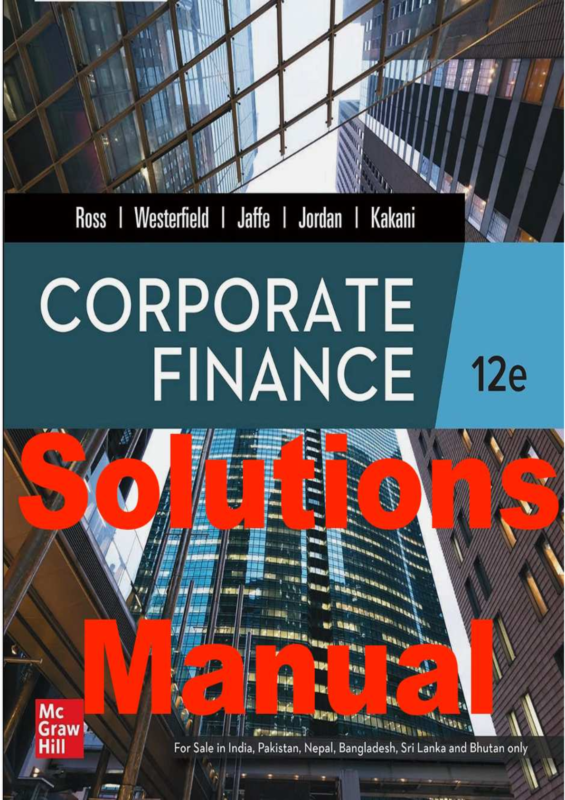
Solutions Manual For Essentials of Corporate Finance 12th Edition By (2025 Release) By Stephen Ross, Randolph Westerfield, Bradford Jordan
$26.00
Secure checkout
Instant digital download
PDF document
Document details
- Pages
- 302
- File size
- 3.82 MB
- Format
- Digital PDF
- Course
- Finance
- Category
- SOLUTIONS MANUAL
Sign in or create a free account to continue. Your purchase will be saved in My Downloads.
About this ebook
The solutions manual for the Essentials of Corporate Finance 12th Edition (2025 Release) by Ross, Westerfield, and Jordan provides comprehensive step-by-step answers structured across 18 chapters and 8 core financial parts. [1]
Here is the exact structural breakdown of the topics covered in the solutions manual to help map out your studies or grading criteria:
🗒 1. Overview of Corporate Finance
- Chapter 1: Introduction to Corporate Finance
- Analyzes the role of the financial manager
- Compares corporate forms of business organization
- Evaluates the agency problem and control
- Chapter 2: Financial Statements, Taxes, and Cash Flow
- Clarifies book value versus market value dynamics
- Breaks down the calculation of cash flow
- Reviews modern corporate tax rate applications [1, 2, 3, 4]
📊 2. Financial Statements and Long-Term Planning
- Chapter 3: Working with Financial Statements
- Guides the standardization of financial statements
- Examines ratio analysis and metrics
- Explores enterprise value and EBITDA
- Chapter 4: Long-Term Financial Planning and Growth
- Solves for internal and sustainable growth
- Models future financial planning parameters [1]
📈 3. Valuation of Future Cash Flows
- Chapter 5: Introduction to Valuation
- Computes present and future values
- Maps out compounding and discounting frequencies
- Chapter 6: Discounted Cash Flow Valuation
- Evaluates multiple annuity and perpetuity streams
- Compares effective annual interest rates [1]
🔍 4. Valuing Stocks and Bonds
- Chapter 7: Interest Rates and Bond Valuation
- Determines bond prices and yields
- Illustrates inflation and real interest rates
- Chapter 8: Stock Valuation
- Formulates dividend growth valuation models
- Analyzes stock market parameter metrics
💡 5. Capital Budgeting Decision Rules
- Chapter 9: Net Present Value and Other Criteria
- Identifies the net present value rule
- Tests the payback and internal rate
- Chapter 10: Making Capital Investment Decisions
- Projects incremental project cash flows
- Approximates operating cash flow calculations [1, 2]
📉 6. Risk and Return
- Chapter 11: Capital Market History Lessons
- Evaluates historical risk and return premium
- Measures market efficiency and volatility
- Chapter 12: Risk, Return, and the CAPM
- Quantifies systematic versus unsystematic risk
- Utilizes the capital asset pricing model [1]
🌟 7. Capital Structure and Payout Policy
- Chapter 13: Cost of Capital
- Determines the weighted average cost of capital
- Estimates individual component equity costs
- Chapter 14: Leverage and Capital Structure
- Models the impact of financial leverage
- Analyzes optimal capital structure choices
- Chapter 15: Dividends and Payout Policy
- Breaks down cash dividend payment mechanics
- Evaluates share repurchase program alternatives [1]
➡️ 8. Short-Term Finance and International Topics
- Chapter 16: Short-Term Financial Planning
- Reviews operating and cash cycles
- Outlines short-term financial policy options
- Chapter 17: Working Capital Management
- Details float and cash collection
- Manages inventory and credit parameters
- Chapter 18: International Corporate Finance
- Formulates foreign exchange rate calculations
- Evaluates international capital budgeting risks [1]
File included
Solutions-Manual-For-Essentials-of-Corporate-Finance-12th-Edition-By-2025-Release-By-Stephen-Ross-Randolph-Westerfield-Bradford-Jordan.pdf
3.82 MB
Related ebooks