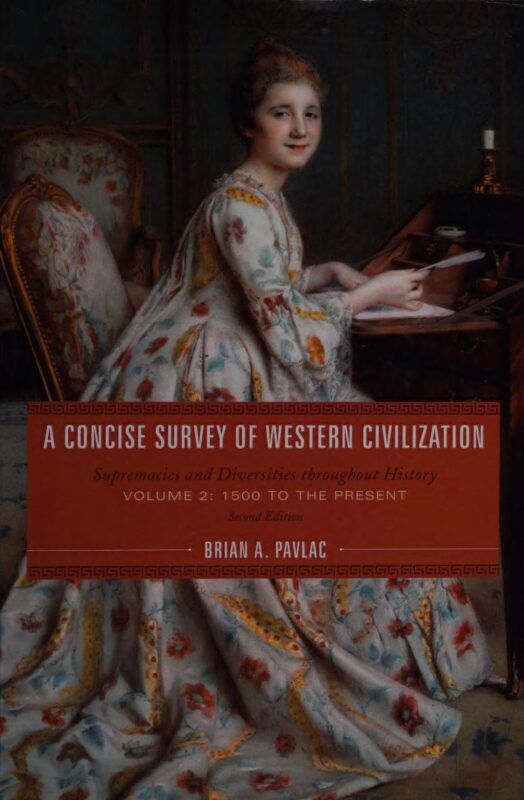
A Concise Survey of Western Civilization: Supremacies and Diversities throughout History 2nd Edition By Brian Pavlac
$20.00
Secure checkout
Instant digital download
PDF document
Document details
- Pages
- 362
- File size
- 29.3 MB
- Format
- Digital PDF
- Course
- History
- Category
- eBook[PDF]
Sign in or create a free account to continue. Your purchase will be saved in My Downloads.
About this ebook
A Concise Survey of Western Civilization: Supremacies and Diversities throughout History (2nd Edition) by Brian A. Pavlac covers the essential chronological history of the Western world through specific core analytical frameworks. [1, 2]
The Core Framing Principles
Rather than just listing dates, the book structures all historical topics around two opposing forces: [1]
- Supremacies: How elites use power, warfare, and ideologies to control societies, establish stability, and enforce order.
- Diversities: The creative impulses, alternative ideas, and efforts by minority groups to express individuality and resist conformity. [1, 2]
Chronological Eras & Topics Covered
The textbook spans from prehistory to the contemporary global era, typically split or combined across these major historical periods: [1]
1. The Ancient World
- The Dawn of Civilization: Mesolithic and Neolithic transitions, and the rise of early Mesopotamian and Egyptian empires.
- The Greek Experiment: Minoan and Mycenaean cultures, the development of the polis (city-state), Greco-Persian wars, Athenian democracy, and Hellenistic expansion.
- The Roman Republic and Empire: Roman expansionism, the shift from republic to principate, Roman law, Pax Romana, and the eventual collapse of the Western empire.
2. The Medieval Period
- The Triple Successors: The transformation of the Roman world into Byzantium, the Islamic Caliphates, and the Latin West.
- The Middle Ages: Feudalism, manorialism, monasticism, the Crusades, and the struggle for authority between popes and kings.
- Late Medieval Crisis: The devastation of the Black Death, the Hundred Years' War, and shifting social hierarchies.
3. Early Modern Europe
- Renaissance and Reformation: Cultural rebirth in Italy and Northern Europe, Martin Luther's challenge to the Catholic Church, and subsequent religious warfare.
- Global Exploration and Absolutism: European maritime empires, colonization, mercantilism, and the rise of absolute monarchs like Louis XIV.
- Scientific Revolution and Enlightenment: The transformation of science, empiricism, and philosophe critiques of traditional institutions.
4. The Age of Revolutions and the Modern Era
- Political and Economic Upheaval: The French Revolution, the Napoleonic Era, and the sweeping changes of the Industrial Revolution.
- Ideologies of the 19th Century: The battlegrounds of nationalism, liberalism, conservatism, and early socialism.
- Imperialism: The "Scramble for Africa" and Western hegemony across Asia.
5. The Twentieth Century to the Present
- The World Wars: Total war, the collapse of old European empires, and the horrors of the Holocaust.
- The Cold War: The ideological split between the West and the Soviet bloc, decolonization, and the rise of consumer culture.
- The Contemporary World: Globalization, regional conflicts, technological acceleration, and modern challenges to Western identity.
Five Recurring Topical Themes
Throughout each historical chapter, Pavlac tracks five explicit, intersecting sub-themes: [1]
- Technological Innovation: How tools, weapons, and manufacturing alter the balance of power.
- Migration and Conquest: The movement of populations and military dominance.
- Political and Economic Decision-Making: How leaders manage money, resources, and governance.
- Church and State: The historical friction between religious institutions and secular power.
- Disputes About the Meaning of Life: Philosophy, theology, and changing human worldviews over time. [1, 2]
File included
tmpphp18D9Qk
29.3 MB
Related ebooks