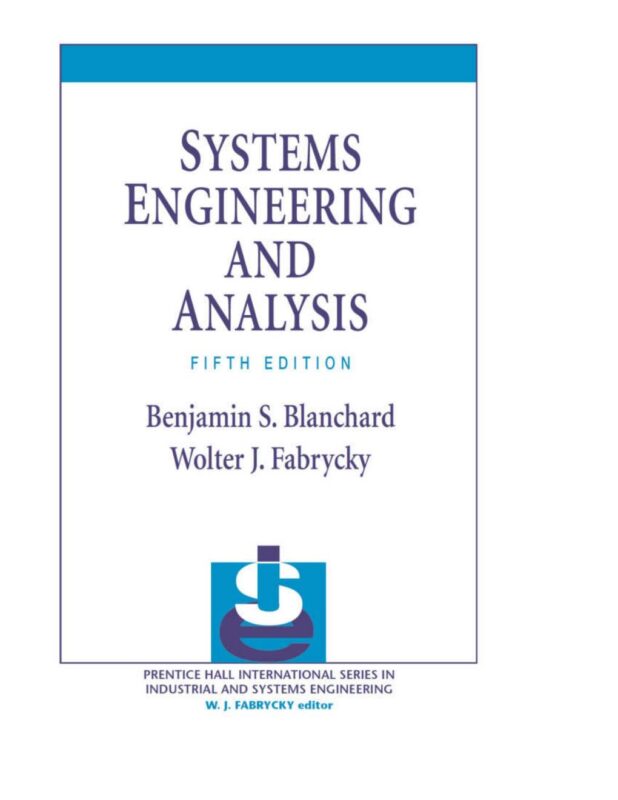
Systems Engineering and Analysis 5th Edition By Benjamin Blanchard, Wolter Fabrycky
$30.00
Secure checkout
Instant digital download
PDF document
Document details
- Pages
- 1,082
- File size
- 18.02 MB
- Format
- Digital PDF
- Course
- Engineering
- Category
- eBook[PDF]
Sign in or create a free account to continue. Your purchase will be saved in My Downloads.
About this ebook
The Systems Engineering and Analysis (5th Edition) by Benjamin Blanchard and Wolter Fabrycky provides a comprehensive, total life-cycle approach to the engineering and analysis of human-made systems. [1, 2, 3]
The topics covered in the book are structurally organized into the following major areas and chapters: [1]
1. Introduction to Systems & Lifecycle Engineering
- Systems Science and Engineering (Chapter 1): Fundamental system classifications, natural vs. human-made systems, and the transition into the "Systems Age". [1]
- Bringing Systems Into Being (Chapter 2): Introduction to the full lifecycle process, starting from consumer need identification through requirements, development, and eventual disposal. [1]
2. The Systems Engineering Design Process
- Conceptual System Design (Chapter 3): Defining feasibility, advanced functional analysis, allocation, and early-stage design criteria.
- Preliminary System Design (Chapter 4): Subsystem-level design engineering, specification development, and product-level analysis.
- Detail Design and Development (Chapter 5): Deep engineering design, prototyping, and integrating components into a cohesive system.
- System Test, Evaluation, and Validation (Chapter 6): Verifying that the developed system satisfies all initial stakeholder needs and functional requirements. [1]
3. Systems Analysis, Optimization, & Decision-Making
- Alternatives and Models in Decision Making (Chapter 7): Frameworks and analytical models for conducting trade-off studies.
- Models For Economic Evaluation (Chapter 8): Applying economic principles to systems, interest formulas, and financial feasibility.
- Optimization in Design and Operations (Chapter 9): Operations research techniques and constrained optimization to maximize efficiency.
- Queuing Theory and Analysis (Chapter 10): Mathematical modeling of waiting lines, bottlenecks, and flow dynamics.
- Control Concepts and Methods (Chapter 11): Feedback loops, statistical control, and system stabilization principles. [1]
4. Design for Ability (The "Ilities")
- Design for Reliability (Chapter 12): Failure analysis, redundancy, and ensuring long-term system uptime.
- Design for Maintainability (Chapter 13): Crafting systems to ensure easy troubleshooting, maintenance, and reduced downtime.
- Design For Usability / Human Factors (Chapter 14): Ergonomics, user-interface (UI) engineering, and optimizing the human-machine interface.
- Design for Logistics and Supportability (Chapter 15): Supply chain integration, spare parts provisioning, and ongoing lifecycle support.
- Design for Producibility and Disposability (Chapter 16): Manufacturing optimization and green engineering focus for environmentally friendly decommissioning and disposal.
- Design for Affordability / Life-cycle Costing (Chapter 17): Cost estimation techniques covering research, production, operational maintenance, and final system retirement. [1]
5. Systems Engineering Management
- Systems Engineering Planning and Organization (Chapter 18): Developing Systems Engineering Management Plans (SEMP) and organizing technical teams.
- Program Management, Control, and Evaluation (Chapter 19): Risk management, project tracking, quality control, and measuring system performance against milestones.
File included
tmpphpwWmPm8
18.02 MB
Related ebooks