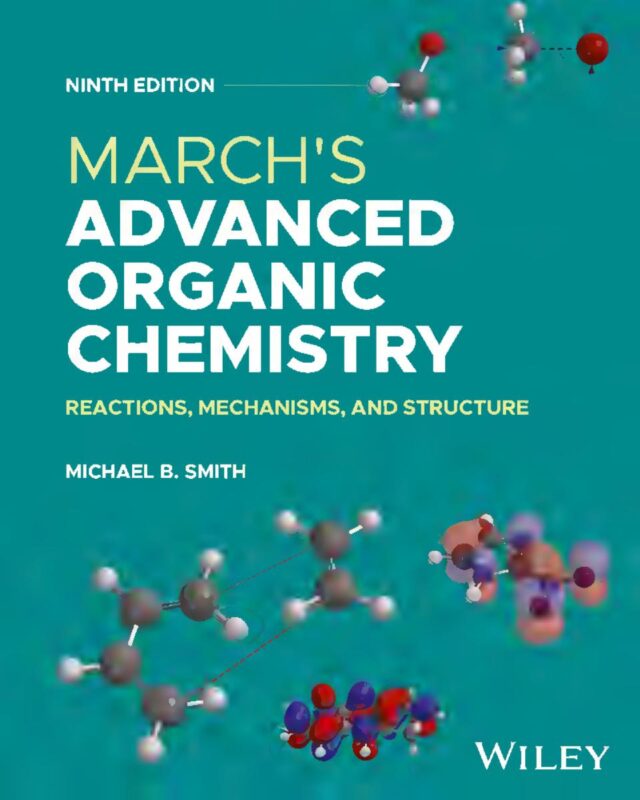
March’s Advanced Organic Chemistry Reactions, Mechanisms, and Structure, 9th Edition By Michael Smith
$30.00
Secure checkout
Instant digital download
PDF document
Document details
- Pages
- 1,677
- File size
- 17.64 MB
- Format
- Digital PDF
- Course
- Chemistry
- Category
- eBook[PDF]
Sign in or create a free account to continue. Your purchase will be saved in My Downloads.
About this ebook
The 9th Edition of March's Advanced Organic Chemistry: Reactions, Mechanisms, and Structure by Michael B. Smith balances fundamental organic chemistry principles across reactions, mechanisms, and structure. It integrates specialized topics like terpenes, steroids, and polymerization into its primary chapters and includes updated literature from 2018 through 2023. [1]
Part 1: Structure, Mechanisms, and Theory (Chapters 1–9)
The first nine chapters cover theoretical principles and the physical nature of organic molecules: [1]
- Chemical Bonding: Localized and delocalized chemical bonding, molecular orbitals, and bond energies. [1]
- Intermolecular Forces: Bonding weaker than covalent (e.g., hydrogen bonding, \(\pi \)-\(\pi \) interactions, and electron donor-acceptor complexes). [1]
- Stereochemistry: Conformational analysis, chirality, and stereochemical principles. [1, 2]
- Reactive Intermediates: The structures and properties of carbocations, carbanions, free radicals, carbenes, and nitrenes. [1, 2]
- Mechanistic Methodology: Methods for determining reaction mechanisms. [1, 2]
- Reaction Conditions & Energies: Physical organic chemistry frameworks including photochemistry, irradiation processes, acids and bases, and the effects of structure on reactivity. [1, 2]
- Modern Synthetic Methods: The integration of microwave chemistry, sonochemistry (ultrasound), mechanochemistry, and continuous flow chemistry conditions. [1, 2]
Part 2: Nature and Scope of Organic Reactions (Chapters 10–19)
The subsequent ten chapters break down organic transformations categorized by mechanism type: [1, 2]
- Substitution Reactions: Aliphatic nucleophilic, aromatic electrophilic, aliphatic electrophilic, aromatic nucleophilic, and free-radical substitutions.
- Addition Reactions: Additions to carbon-carbon multiple bonds and carbon-hetero multiple bonds.
- Elimination Reactions: Mechanisms and regiochemical profiles of elimination transformations.
- Rearrangements: Skeletal and molecular rearrangements.
- Redox Chemistry: Comprehensive coverage of organic oxidations and reductions. [1]
File included
tmpphpH8CJmQ
17.64 MB
Related ebooks