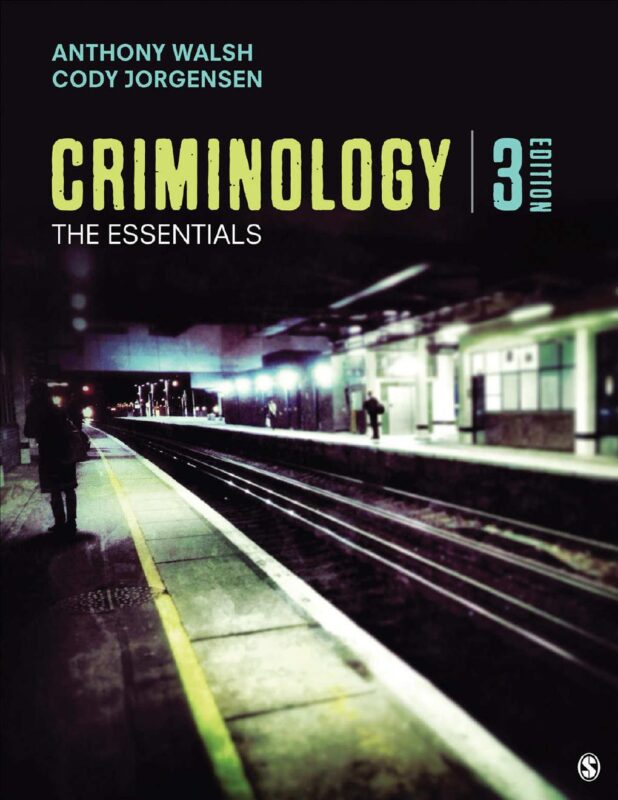
Criminology: The Essentials 3rd Edition By Anthony Walsh, Cody Jorgensen
$30.00
Secure checkout
Instant digital download
PDF document
Document details
- Pages
- 516
- File size
- 14.84 MB
- Format
- Digital PDF
- Course
- Social Sciences
- Category
- eBook[PDF]
Sign in or create a free account to continue. Your purchase will be saved in My Downloads.
About this ebook
Criminology: The Essentials (3rd Edition) by Anthony Walsh and Cody Jorgensen provides a comprehensive overview of fundamental criminological theories, modern research advancements, and various crime typologies. [1]
The textbook is structurally organized into the following major topics and thematic areas:
1. Foundations of Criminology
-
- Introduction to Criminology: Defining crime, deviance, and the scope of criminological inquiry.
- Measuring Crime: Analyzing crime data sources, including the Uniform Crime Reports (UCR), National Incident-Based Reporting System (NIBRS), and self-report surveys.
- Victimology: Exploring the patterns, risks, and theories surrounding criminal victimization. [1]
2. Criminological Theories (Core Perspectives)
-
- Classical and Neoclassical Schools: Examining rational choice theory, deterrence, and routine activities theory.
- Biological and Biosocial Theories: Investigating genetic, neurological, and evolutionary influences on behavior.
- Psychological Theories: Exploring personality traits, intelligence, and psychopathy in relation to crime.
- Social Structure Theories: Focusing on social disorganization, strain theory, and subcultural influences.
- Social Process Theories: Covering differential association, social learning, and social control theories.
- Critical and Conflict Theories: Analyzing labeling theory, Marxist criminology, and feminist perspectives.
- Developmental and Life-Course Theories: Looking at onset, acceleration, and desistance of criminal careers across a lifetime. [1, 2, 3]
3. Crime Typologies & Special Categories
-
- Violent Crime: Studying interpersonal violence, homicide, assault, and rape.
- Multiple Murders: Addressing serial killing, mass murder, and terrorism.
- Property Crimes: Exploring theft, burglary, arson, and vandalism.
- White-Collar and Organized Crime: Analyzing corporate malfeasance, political corruption, and criminal syndicates.
- Public Order Crimes: Discussing drug and alcohol addiction, prostitution, and gambling. [1, 2]
4. Practical Application & Policy
- Crime Policy and Prevention: Connecting theoretical principles to real-world criminal justice strategies and preventive measures. [1]
File included
tmpphp2l1zGw
14.84 MB
Related ebooks