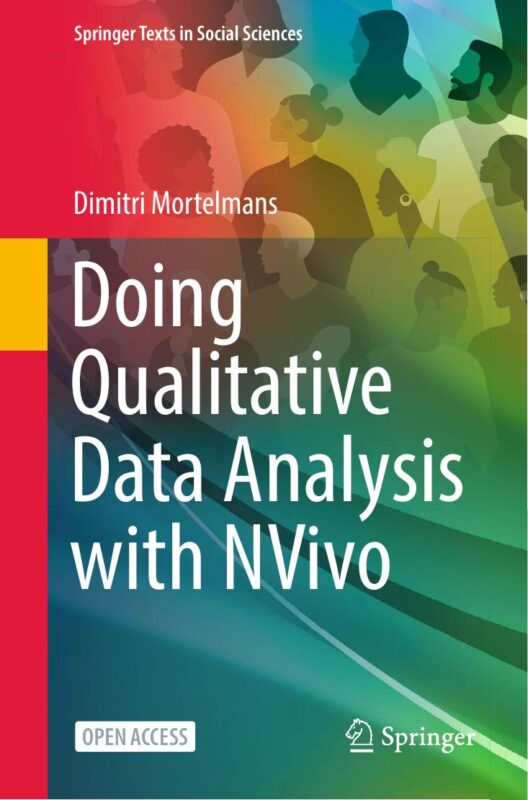
Doing Qualitative Data Analysis with NVivo By Dimitri Mortelmans
$30.00
Secure checkout
Instant digital download
PDF document
Document details
- Pages
- 289
- File size
- 7.95 MB
- Format
- Digital PDF
- Course
- DATA ANALYSIS
- Category
- eBook[PDF]
Sign in or create a free account to continue. Your purchase will be saved in My Downloads.
About this ebook
Doing Qualitative Data Analysis with NVivo" by Dimitri Mortelmans is an open-access textbook designed to bridge the gap between qualitative research practice and software utilization. Rather than acting as a simple button-by-button manual, it approaches NVivo from a researcher's perspective, focusing heavily on gaining workflow efficiency. [1, 2, 3, 4]
The book is structured around NVivo’s core strengths—data management, coding, and data retrieval/analysis—and covers the following key topics: [1]
📑 Methodological & Introductory Concepts
- The "Code-and-Retrieve" Principle: Understanding the foundational logic behind computer-assisted qualitative data analysis (CAQDAS) software. [1, 2]
- Critical Appraisal of Software: Examining misunderstandings, potential pitfalls (like conflating coding with analysis or distancing oneself from the data), and the true capabilities/limitations of NVivo. [1, 2]
- Paradigms in Qualitative Research: Navigating how NVivo seamlessly integrates into different methodologies such as Grounded Theory, thematic analysis, and framework analysis. [1, 2]
🛠️ Core & Basic Skills
- Data Management & Importation: Preparing and organizing diverse project data.
- Handling Multi-Media Formats: Working with standard textual transcripts (interviews, focus groups) as well as audiovisual materials (audio recordings, video, and images).
- Working with Memos: Documenting analytical ideas, creative reflections, and the evolution of the research process.
- Coding Qualitative Data: Practical pathways for assigning codes to segments of your data, including inductive coding practices. [1, 2, 3]
🚀 Advanced Analysis Tools
- Case Coding & Classifications: Structuring units of analysis (like individuals or sites) alongside demographic or attribute data.
- Queries: Harnessing NVivo's retrieval capabilities to explore patterns, including text search queries, coding queries, and matrix coding queries.
- Matrices and Frameworks: Utilizing cross-tabulation tools to spot relationships and synthesize cross-sections of data.
- Models and Maps: Conceptually mapping out relationships and developing visual frameworks directly inside the software.
- AI Tools: Leveraging contemporary artificial intelligence features embedded within NVivo for tasks like transcription and pattern exploration.
- Mixed Methods Integration: Working with survey data by isolating text variables (such as open-ended questions) and preparing data to link back with statistical software. [1, 2, 3, 4, 5]
File included
tmpphpWJRlKx
7.95 MB
Related ebooks