eBook[PDF]

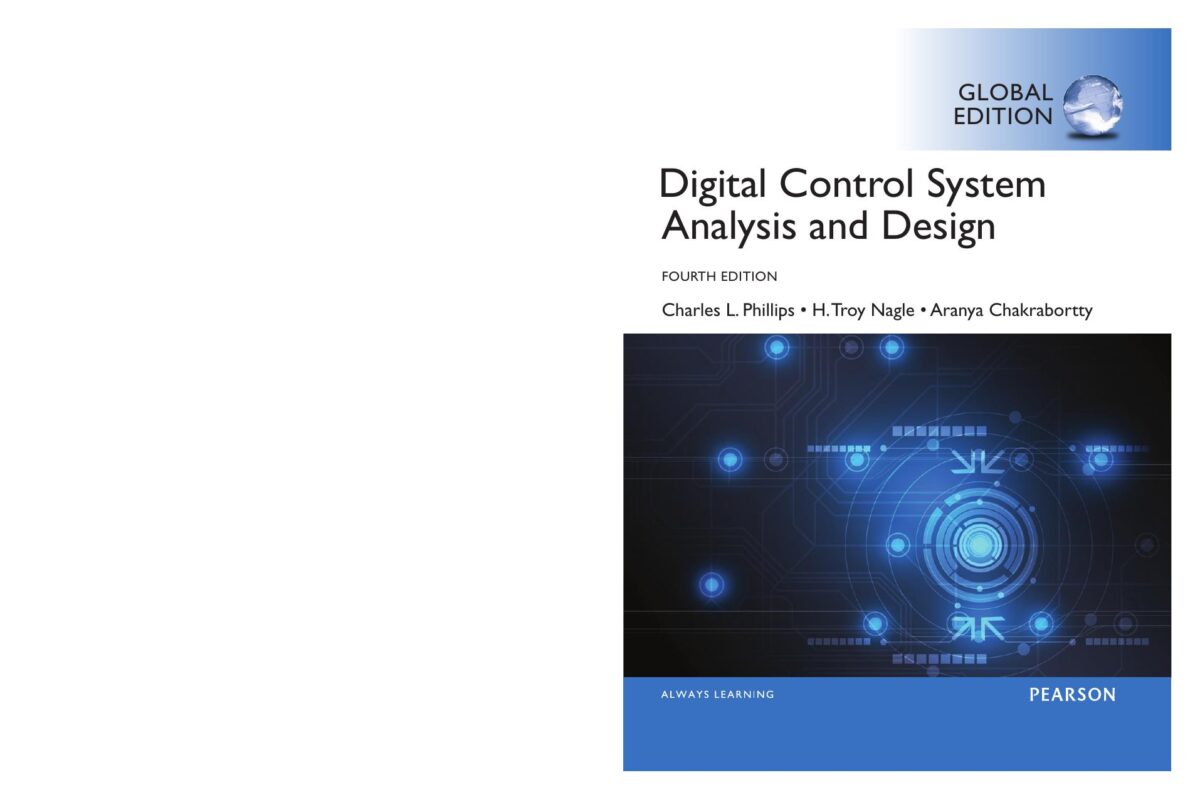
Digital Control System Analysis & Design 4th Global Edition By Charles Phillips, Troy Nagle, James Brickley, Aranya Chakrabortty

$30.00
✓ Secure checkout
✓ Instant digital download
✓ PDF document

Document details

Pages
529
File size
3.35 MB
Format
Digital PDF
Category
eBook[PDF]
About this ebook
Digital Control System Analysis & Design (4th Global Edition) by Charles Phillips, Troy Nagle, and Aranya Chakrabortty covers the analysis, design, and practical implementation of discrete-time linear control systems. [1, 2]
The textbook bridges the gap between classical z-transform methods and modern state-space techniques, incorporating MATLAB computer-aided design throughout its examples and problem sets. [1, 2]
Core Chapter Breakdown & Topics Covered
  • Chapter 1: Introduction
    • Overview of digital control systems and microprocessors.
    • Definition of the control problem.
    • Introduction to running application models used throughout the text (e.g., satellite control, antenna tracking, robotics, and temperature systems). [1, 2, 3, 4]
  • Chapter 2: Discrete-Time Systems and the z-Transform
    • Mathematical foundations for discrete-time systems.
    • The z-transform: definitions, theorems, and inverse z-transforms.
    • Vector-matrix difference equations. [1, 2, 3, 4]
  • Chapter 3: Sampling and Reconstruction
    • The mathematical model of the sampler and data hold (Zero-Order Hold).
    • Shannon's sampling theorem, aliasing, and frequency folding.
    • Practical mechanics of Analog-to-Digital (ADC) and Digital-to-Analog (DAC) converters. [1, 2, 3, 4, 5]
  • Chapter 4: Open-Loop Discrete-Time Systems
    • Pulse transfer functions for open-loop configurations.
    • Finding the response of discrete elements combined with continuous plants. [1, 2]
  • Chapter 5: Closed-Loop Systems
    • Block diagram reduction for systems containing samplers.
    • Signal flow graphs and derivation of closed-loop discrete transfer functions. [1]
  • Chapter 6: System Time-Response Characteristics
    • Transient and steady-state responses of digital control systems.
    • Relationships between continuous s-plane roots and discrete z-plane roots.
    • Steady-state error analysis and error constants. [1, 2]
  • Chapter 7: Stability Analysis Techniques
    • Definition of stability in the z-domain (inside the unit circle).
    • Bilinear transformations and the w-transform mapping.
    • Stability tests (Jury’s stability test and Routh-Hurwitz via transformation). [1, 2]
  • Chapter 8: Digital Controller Design (Classical Approach)
    • Root locus design techniques in the z-plane.
    • Frequency-response design utilizing Bode plots.
    • Phase-lag, phase-lead, and lag-lead compensation.
    • Digital PID controllers and the MATLAB pidtool application. [1, 2, 3, 4]
  • Chapter 9: Pole-Assignment Design and State Estimation (Modern Approach)
    • State-space representation of discrete systems.
    • Controllability and observability criteria.
    • Pole-placement (pole-assignment) control law design.
    • State estimator (observer) design. [1, 2]
  • Chapter 10: System Identification of Discrete-Time Systems
    • Mathematical modeling of physical systems from empirical input-output data.
    • Parameter estimation methods and least-squares techniques. [1]
  • Chapter 11: Linear Quadratic Optimal Control
    • Optimal control principles for discrete-time matrices.
    • Formulation and solving of the discrete Linear Quadratic Regulator (LQR) problem. [1, 2]
  • Chapter 12: Case Studies
    • Comprehensive design examples highlighting real-world implementation challenges and trade-offs. [1, 2, 3]

File included

PDF
tmpphpHaxeVq 3.35 MB

Topics