
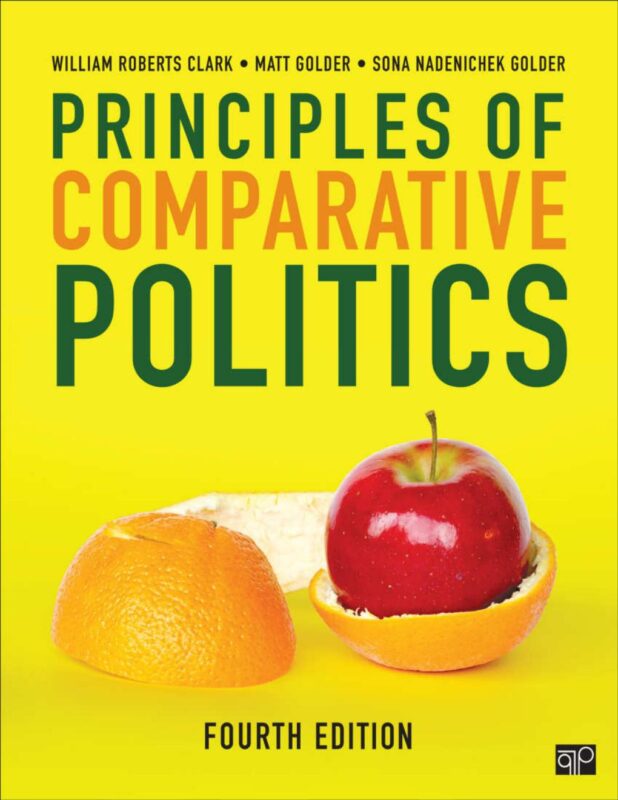
Principles of Comparative Politics 4th Edition By William Roberts Clark, Matt Golder, Sona Golder
$30.00
Secure checkout
Instant digital download
PDF document
Document details
- Pages
- 737
- File size
- 10.45 MB
- Format
- Digital PDF
- Course
- Education
- Category
- eBook[PDF]
Sign in or create a free account to continue. Your purchase will be saved in My Downloads.
About this ebook
The Fourth Edition of Principles of Comparative Politics (2024) by William Roberts Clark, Matt Golder, and Sona N. Golder covers the fundamental methodologies, theories, and institutional variations in comparative political science. The book has been streamlined significantly to emphasize scientific deduction, game-theoretic logic, and quantitative interpretation over mere country descriptions. [1, 2, 3]
The primary topics covered, organized chronologically by chapter according to the author's official lecture curriculum structure, include: [1]
Part I: Foundations of Comparative Research
- Chapter 1: Introduction – The scope of comparative inquiry, basic definitions, and the differences between comparative politics and international relations. [1, 2]
- Chapter 2: What is Science? – The scientific method, falsifiability, testing hypotheses, and a clarified framework for interpreting statistical regression results. [1, 2]
- Chapter 3: What is Politics? – Political power dynamics modeled through the Exit, Voice, and Loyalty (EVL) game-theoretic framework.
Part II: Regimes and the State
- Chapter 4: The Origins of the Modern State – State definition, state failure, contractarian vs. predatory views of state development, and the historical evolution of taxation and coercion. [1, 2]
- Chapter 5: Democracy and Dictatorship: Conceptualization and Measurement – Substantive vs. minimalist views of democracy, and evaluating major indices like Freedom House, Polity, and V-Dem. [1]
- Chapter 6: The Economic Determinants of Democracy and Dictatorship – Classic Modernization Theory vs. survival models, and how asset mobility and natural resources impact regime survival. [1]
- Chapter 7: The Cultural Determinants of Democracy and Dictatorship – Cultural modernization theory, civic culture, religious compatibility, and survey methods for sensitive political topics. [1, 2]
- Chapter 8: Democratic Transitions – Pathways to democracy, including bottom-up popular revolutions and top-down strategic liberalization modeled through game theory. [1, 2]
- Chapter 9: Varieties of Dictatorship – Authoritarian institutional designs covering the two core issues of autocracy: authoritarian power-sharing and authoritarian control. [1]
Part III: Institutional Design and Governance
- Chapter 10: Problems with Group Decision Making – Social choice theory, voting paradoxes, and the fundamental democratic tradeoffs highlighted by Arrow's Theorem.
- Chapter 11: Parliamentary, Presidential, and Semi-Presidential Democracies – Government classification, executive-legislative mechanics, and cabinet formation through principal-agent frameworks.
- Chapter 12: Elections and Electoral Systems – Majoritarian, proportional, and mixed voting systems, with an emphasis on electoral integrity.
- Chapter 13: Parties, Party Systems, and Party Competition – Origin of political parties, Duverger's law, and how social cleavages interact with electoral laws to shape party systems.
- Chapter 14: Institutional Veto Players – Federalism, bicameralism, constitutional structures, and how institutional veto players influence public policy stability and change. [1, 4, 5]
File included
eBook-EPUB-Principles-of-Comparative-Politics-4e-William-Roberts-Clark-Matt-Golder-Sona-Golder.pdf
10.45 MB
Related ebooks