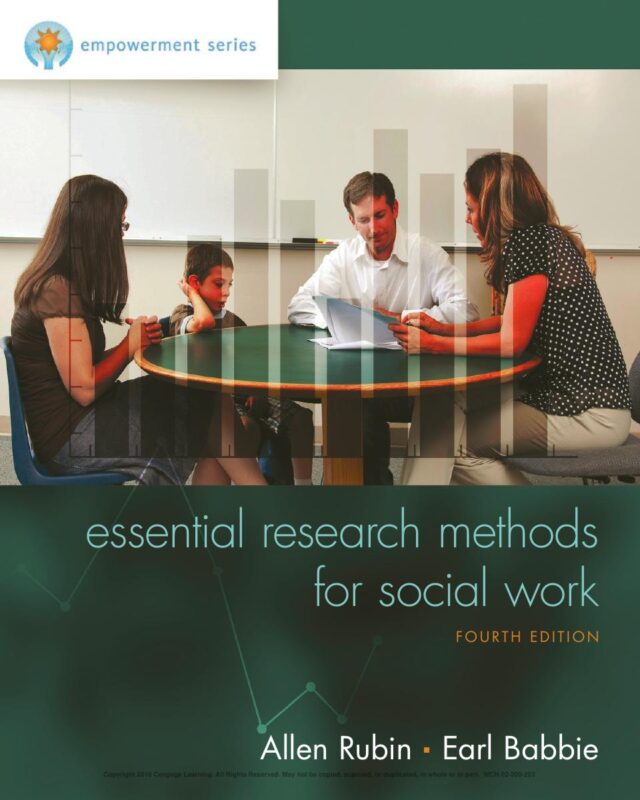
Essential research methods for social work 4th Edition By Rubin, Allen, Earl R. Babbie
$30.00
Secure checkout
Instant digital download
PDF document
Document details
- Pages
- 449
- File size
- 28.11 MB
- Format
- Digital PDF
- Course
- Social Sciences
- Category
- eBook[PDF]
Sign in or create a free account to continue. Your purchase will be saved in My Downloads.
About this ebook
fourth edition of "Essential Research Methods for Social Work" by Allen Rubin and Earl R. Babbie provides a concise, practice-oriented introduction to social work research. The textbook specifically aligns with the Council on Social Work Education (CSWE) core competencies and highlights evidence-based practice. [1, 2, 3]
The book is structured into 8 main parts containing 18 chapters, supplemented by specialized appendices: [1]
Part I: An Introduction to Scientific Inquiry in Social Work
- Chapter 1: Why Study Research? – Explores the relevance of research to effective clinical practice.
- Chapter 2: Evidence-Based Practice – Explains how to integrate scientific evidence into social work decision-making. [1, 2]
Part II: The Research Process
- Chapter 3: Quantitative, Qualitative, and Mixed Methods of Inquiry – Introduces the primary paradigms and how they complement each other.
- Chapter 4: Factors Influencing the Research Process – Examines organizational, political, and practical research constraints. [1, 2]
Part III: Ethical and Cultural Issues in Social Work Research
- Chapter 5: Ethical Issues in Social Work Research – Covers institutional review boards, voluntary participation, and protection of vulnerable populations.
- Chapter 6: Culturally Competent Research – Details practices for avoiding bias and executing culturally sensitive studies. [1, 2, 3]
Part IV: Problem Formulation and Measurement
- Chapter 7: Problem Formulation – Outlines selecting research topics and narrowing down research hypotheses.
- Chapter 8: Measurement in Quantitative and Qualitative Inquiry – Covers conceptualization and operationalization.
- Chapter 9: Quantitative and Qualitative Measurement Instruments – Focuses on reliability, validity, and creating data collection tools. [1, 2, 3]
Part V: Sampling and Surveys
- Chapter 10: Surveys – Discusses standard survey designs and administration.
- Chapter 11: Sampling: Quantitative and Qualitative Approaches – Breaks down probability and non-probability sampling techniques. [1]
Parts VI–VIII and Appendices Summary
The final sections of the textbook address evaluation, advanced methods, and data analysis:
- Parts VI & VII (Chapters 12–16): Cover program and practice evaluation (experiments, single-case designs, and program evaluation), as well as specific qualitative and quantitative methods including ethnography, secondary data, and content analysis.
- Part VIII (Chapters 17–18): Focuses on quantitative and qualitative data analysis techniques, from basic statistics to thematic coding.
- Appendices (A–E): Provide practical guides on library research, writing proposals and reports, random numbers, and effect sizes. [1, 2, 3, 4, 5]
File included
tmpphpCGVJEh
28.11 MB
Related ebooks