
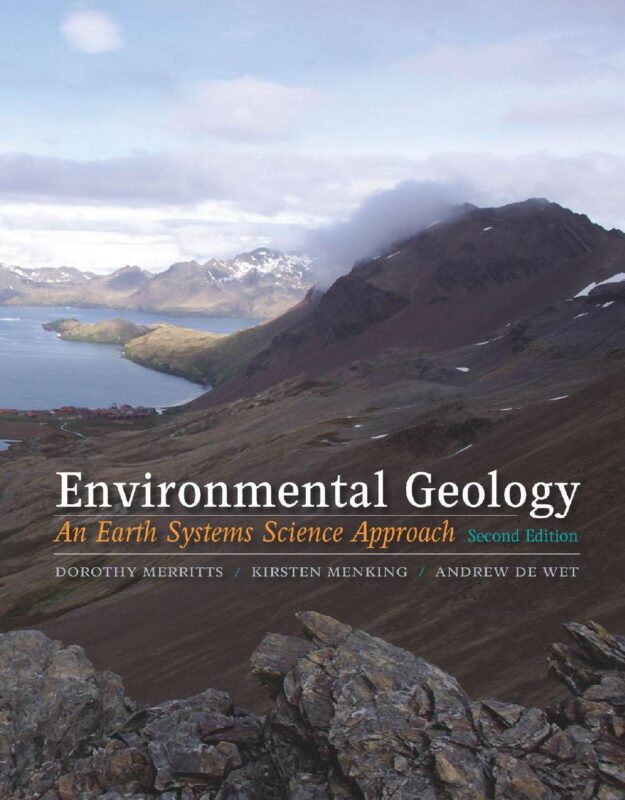
Environmental Geology: An Earth Systems Approach, 2nd Edition By Dorothy Merritts, Kirsten Menking, Andrew DeWet
$30.00
Secure checkout
Instant digital download
PDF document
Document details
- Pages
- 704
- File size
- 46.44 MB
- Format
- Digital PDF
- Course
- Geology
- Category
- eBook[PDF]
Sign in or create a free account to continue. Your purchase will be saved in My Downloads.
About this ebook
Environmental Geology: An Earth Systems Approach" (2nd Edition) by Dorothy Merritts, Andrew de Wet, and Kirsten Menking uses a holistic, interconnected perspective to explore how the solid Earth, atmosphere, hydrosphere, and biosphere interact with human activity. Published by W. H. Freeman, the textbook is structured into four overarching parts moving from foundational system concepts to individual fluid/solid spheres, and ultimately to global sustainability. [1, 2, 3, 4, 5]
The major topics and chapters covered in the text include:
Part I: Introduction to Earth Systems
- The Concept of Earth Systems: Defining open and closed systems, feedback loops, and how matter and energy cycle through the environment. [1, 2]
- Planetary Boundaries and Human Stressors: Examining exponential human population growth, resource depletion, and the capacity limits of our planet. [1, 2]
- Earth’s Energy Budgets: Analyzing external solar energy and internal geothermal heat engines powering physical geography. [1, 2]
Part II: Solid Earth Systems and Geologic Time
- Plate Tectonics: Examining lithospheric plate properties, motions, boundaries, and the driving mechanisms of the deep geosphere. [1]
- Earthquakes and Volcanism: Exploring tectonic hazards, fault mechanics, seismic risk mitigation, volcanic eruption styles, and geographic impact. [1]
- Rock and Mineral Cycles: Studying the formation, composition, structural properties, and physical weathering patterns of Earth materials. [1]
Part III: Fluid Earth Systems and Surficial Processes
- The Hydrologic Cycle: Tracking groundwater reservoirs, water tables, and surface water pathways.
- Streams, Rivers, and Flooding: Investigating river channel dynamics, flood plains, human engineering, and drainage basin management.
- Mass Wasting and Soil Dynamics: Analyzing landslides, slope stability factors, soil degradation, and erosion mechanics.
- Coastal Systems: Evaluating wave action, longshore drift, sea-level changes, and the vulnerabilities of coastal environments. [1, 2, 3]
Part IV: Global Environmental Change and Human Impact
- Climate Change and Glaciation: Tracing historical climate trends (using lake sediments and ice cores) alongside modern anthropogenic global warming. [1, 2]
- Energy and Mineral Resources: Assessing the environmental extraction costs, longevity, and sustainability of fossil fuels, metals, and renewable alternatives. [1, 2]
- Humans and the Whole Earth System: A dedicated capstone chapter exploring systemic environmental health, waste management, policy formulation, and sustainability practices. [1, 2, 3]
File included
tmpphpcpnb1m
46.44 MB
Related ebooks