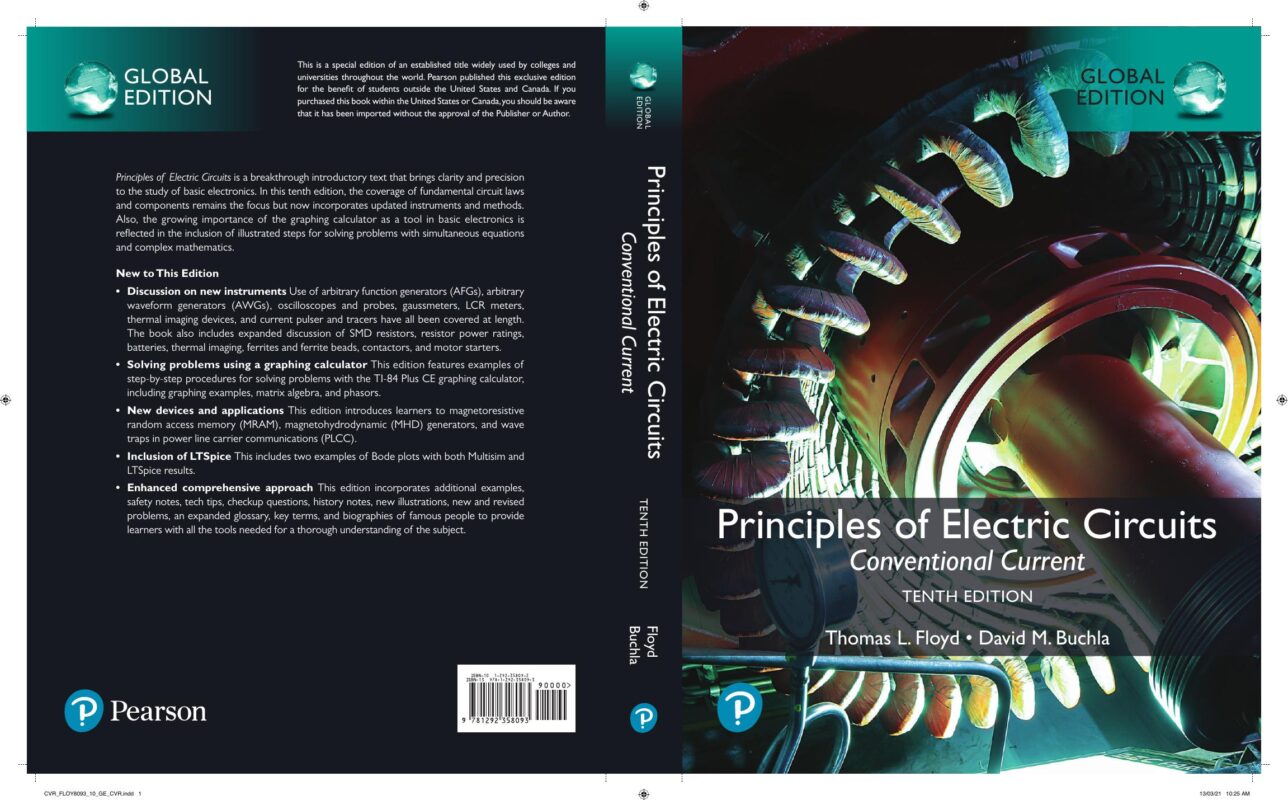
Principles of Electric Circuits: Conventional Current 10th Global Edition By Floyd Thomas, David M Buchla
$28.00
Secure checkout
Instant digital download
PDF document
Document details
- Pages
- 1,029
- File size
- 25.41 MB
- Format
- Digital PDF
- Course
- Education
- Category
- eBook[PDF]
Sign in or create a free account to continue. Your purchase will be saved in My Downloads.
About this ebook
Principles of Electric Circuits: Conventional Current (10th Global Edition) by Thomas L. Floyd and David M. Buchla provides a comprehensive introduction to DC and AC circuit fundamentals. The textbook explicitly uses conventional current flow (positive to negative) to teach core circuit laws, component behaviors, and practical engineering troubleshooting methods. [1, 2]
The primary chapters and topics covered across the 21 chapters of this text include:
Foundations & Direct Current (DC) Circuits
- Quantities and Units: Focuses on scientific and engineering notation, metric prefixes, unit conversions, and dimensional analysis.
- Voltage, Current, and Resistance: Introduces atomic structure, electrical charge, conductors, insulators, and basic circuit measurements using digital multimeters (DMMs).
- Ohm's Law: Explores the linear relationship between voltage, current, and resistance alongside basic circuit troubleshooting.
- Energy and Power: Covers power calculation formulas, energy units (kilowatt-hours), power ratings, and efficiency.
- Series Circuits: Analyzes current flow, total resistance, voltage dividers, and Kirchhoff's Voltage Law (KVL).
- Parallel Circuits: Analyzes branch current, total resistance, current dividers, and Kirchhoff's Current Law (KCL).
- Series-Parallel Circuits: Focuses on combining series and parallel networks, analyzing loaded voltage dividers, and isolating circuit faults.
- Circuit Theorems and Conversions: Covers advanced optimization using Thevenin’s, Norton’s, and Superposition theorems alongside source conversions.
- Branch, Loop, and Node Analyses: Delves into simultaneous loop equations, mesh analysis, and nodal network evaluation. [1, 2, 3, 4, 5, 6, 7]
Magnetism & Alternating Current (AC) Circuits
- Magnetism and Electromagnetism: Introduces magnetic fields, electromagnetic induction, relays, and basic stepper motor concepts.
- Introduction to Alternating Current and Voltage: Covers sinusoidal waveforms, frequency, period, phase shifts, oscilloscopes, and non-sinusoidal waves.
- Capacitors: Explores capacitive physical structure, total capacitance in networks, and energy storage behaviors.
- RC Circuits: Covers sinusoidal response, impedance, phase angles, and leading/lagging relationships in resistor-capacitor circuits.
- Inductors: Explores physical inductors, mutual inductance, and total series/parallel inductances.
- RL Circuits: Evaluates sinusoidal response, impedance, and reactive power constraints in resistor-inductor circuits.
- Transformers: Covers step-up/step-down principles, turns ratios, efficiency, magnetic isolation, and tapped transformer networks.
- RLC Circuits and Resonance: Details combination RLC systems, series/parallel resonant behaviors, and Q-factor calculations.
- Passive Filters: Introduces low-pass, high-pass, band-pass, and band-stop filter networks alongside decibel measurements.
- Circuit Theorems in AC Analysis: Re-evaluates DC network theorems (Thevenin, Maximum Power Transfer) specifically under reactive AC impedances.
- Time Response of Reactive Circuits: Delves into transient response curves, time constants (τ), and step-voltage behaviors for pulse networks.
- Three-Phase Systems in Power Applications: Introduces heavy power transmission configurations, delta/wye connections, and three-phase generation dynamics. [1, 2]
Supplementary Appendices
The textbook concludes with specialized reference guides covering standard resistor value charts, detailed mathematical derivations, capacitor value alphanumeric coding, and NI Multisim for Circuit Simulation tutorials.
File included
tmpphp5eqlBY
25.41 MB
Related ebooks