
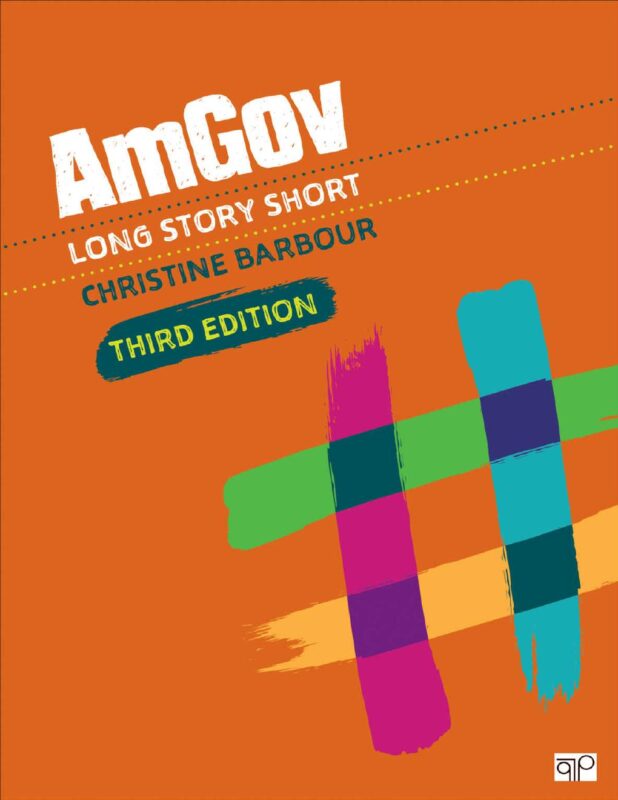
AmGov: Long Story Short 3rd Edition By Christine Barbour
$30.00
Secure checkout
Instant digital download
PDF document
Document details
- Pages
- 262
- File size
- 8.24 MB
- Format
- Digital PDF
- Course
- Social Sciences
- Category
- eBook[PDF]
Sign in or create a free account to continue. Your purchase will be saved in My Downloads.
About this ebook
The third edition of AmGov: Long Story Short by Christine Barbour breaks down the core fundamentals of American government into ten succinct chapters. The textbook focuses on concise, actionable overviews designed for quick skimming and studying. [1]
The primary topics covered include:
1. Politics and Citizenship
- Core concepts of politics, government, and economics.
- Comparative political-economic systems.
- American political culture, core values, and ideologies.
- Introduction to political narratives and mediated citizenship.
2. The United States' Founding
- Classical liberalism, social contract theory, and the Declaration of Independence.
- The Articles of Confederation and the Constitutional Convention.
- Ratification debates between Federalists and Anti-Federalists.
- Constitutional principles and the evolution of American federalism.
3. Civil Liberties and Civil Rights
- The Bill of Rights and First Amendment freedoms.
- Due process rights and the constitutional right to privacy.
- Civil rights history and ongoing battles against political inequality.
- Specific focus cases on race, gender, and the persistence of discrimination.
4. The Legislative Branch
- The constitutional structure and organization of Congress.
- The legislative process and how a bill becomes a law.
- Congressional roles in checks and balances, polarization, and gridlock.
- Congressional elections and party dynamics up through the 118th Congress.
5. The Executive Branch
- The roles, responsibilities, and constitutional powers of the U.S. President.
- The evolution of the modern presidency and relations with Congress.
- The purpose, organization, and power plays within the White House and federal bureaucracy.
6. The Judicial Branch
- Introduction to the types of laws and the structure of the American legal system.
- The dual court system (state vs. federal courts) and congressional influence.
- The mechanics, decision-making, and powers of the Supreme Court.
- Issues of systemic equality within the criminal justice system.
7. Parties and Interest Groups
- Definitions and roles of political parties in an American democracy.
- Modern party organization, identification, and current policy preferences.
- Interest group basics and the mechanics of lobbying and political influence.
8. Public Opinion and Elections
- The formation of public opinion, polling methods, and political socialization.
- Voter turnout trends and voting behavior in U.S. elections.
- The process of running for office, modern presidential campaigns, and the Electoral College.
9. Media and Political Communication
- Modern information sources and media ownership.
- Government regulation of broadcasting and digital communication.
- How media outlets and political stakeholders shape national narratives.
- Strategies for citizens to critically navigate and reclaim political narratives.
10. Domestic and Foreign Policy
- The baseline public policymaking process.
- Domestic social policy, safety nets, and healthcare infrastructure.
- Economic policymaking, taxation, and federal spending strategies.
- The goals, tools, and institutions behind U.S. foreign policy.
File included
tmpphpqMzRWa
8.24 MB
Related ebooks