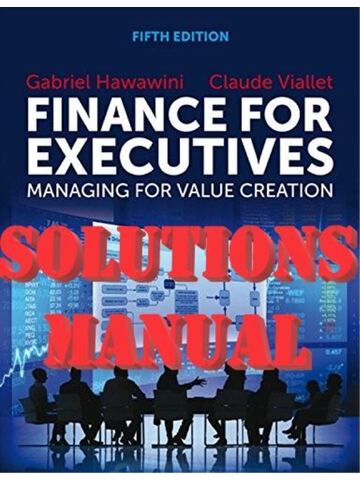
SOLUTIONS MANUAL for Finance for Executives 5th Edition by Claude Viallet and Gabriel Hawawini | All 2-17 Chapters
$26.00
Secure checkout
Instant digital download
PDF document
Document details
- Pages
- 463
- File size
- 54.98 KB
- Format
- Digital PDF
- Course
- Finance
- Category
- SOLUTIONS MANUAL
Sign in or create a free account to continue. Your purchase will be saved in My Downloads.
About this ebook
SOLUTIONS MANUAL for Finance for Executives: Managing for Value Creation (5th Edition) by Gabriel Hawawini and Claude Viallet is a highly regarded textbook used extensively in MBA and executive education programs. The core theme of the book focuses on how executives can interpret financial data to make decisions that maximize a firm’s value, avoiding overly dense formulas in favor of practical application. [1, 2, 3]
The topics covered are structured into five core areas: [1]
Part I: Financial Concepts and Techniques
-
- Financial Management and Value Creation: An overview of capital budgeting, payout policies, capital structure decisions, and the overarching goal of maximizing net present value (NPV). [1]
- The Managerial Balance Sheet: Translating conventional financial statements into an executive-oriented view focused on invested capital and operating performance. [1, 2]
- The Time Value of Money: Core compounding and discounting techniques used to value cash flows over time.
- Risk and Return: Portfolio diversification strategies, calculating firm-specific vs. market risk, and applying the Capital Asset Pricing Model (CAPM). [1]
Part II: Assessing Business Performance
-
- Financial Statement Analysis: Deep dives into diagnosing financial health using the income statement and balance sheet.
- Operational Efficiency and Liquidity: Analyzing working capital requirements, operating cycles, and liquidity status.
- Profitability and Growth: Measuring Return on Equity (ROE) and Return on Invested Capital (ROIC) to judge whether a firm is successfully creating value. [1, 2]
Part III: Making Investment Decisions
-
- The Net Present Value Rule: Utilizing NPV as the primary mechanism for resource allocation and capital budgeting.
- Alternative Investment Criteria: Evaluating alternative methods like Internal Rate of Return (IRR), Payback Period, and Profitability Index.
- Identifying and Estimating Cash Flows: Distinguishing relevant, incremental cash flows from accounting profits for project evaluation. [1]
Part IV: Making Financing Decisions
-
- Valuing Financial Instruments: Approaches to valuing corporate bonds and equity (common stock).
- Raising Capital and Payout Policy: Corporate fundraising alternatives and strategies surrounding dividends and share buybacks.
- The Cost of Capital: Estimating the Weighted Average Cost of Capital (WACC) as a hurdle rate for investments.
- Capital Structure Decisions: Exploring how the mix of debt and equity affects a firm's financial risk, cost of capital, and overall value. [1, 2, 3]
Part V: Making Business Decisions
- Business Valuation and M&A: Techniques for valuing entire enterprises and executing corporate mergers or acquisitions.
- Managing Corporate Risk: Strategies and risk-mitigation frameworks for high-stakes business environments.
- International Financial Decisions: Dealing with cross-border investments and foreign exchange complexities. [1, 2, 3, 4]
File included
SOLUTIONS-MANUAL-for-Finance-for-Executives-5th-Edition.pdf
54.98 KB
Related ebooks