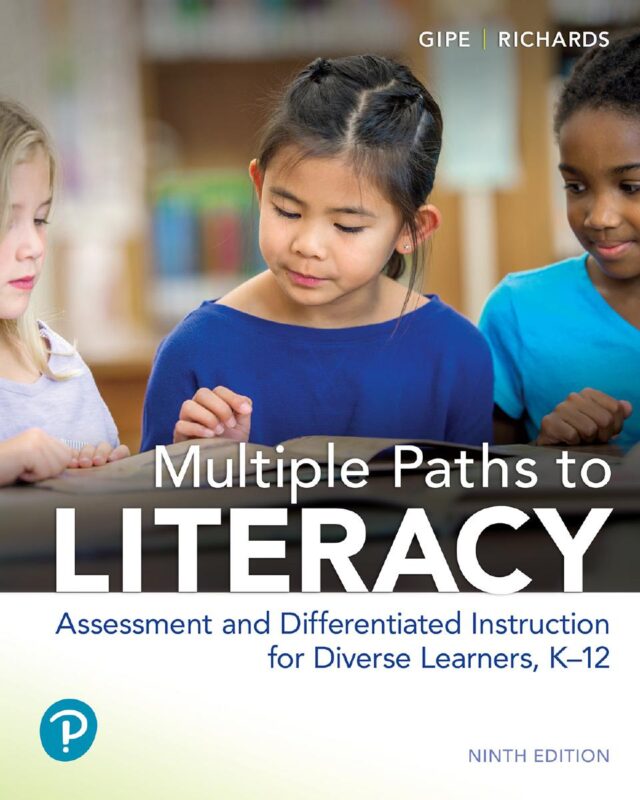
Multiple Paths to Literacy Assessment and Differentiated Instruction for Diverse Learners K-12 9th Edition By Joan Gipe, Janet Richards
$30.00
Secure checkout
Instant digital download
PDF document
Document details
- Pages
- 513
- File size
- 26.92 MB
- Format
- Digital PDF
- Course
- Education
- Category
- eBook[PDF]
Sign in or create a free account to continue. Your purchase will be saved in My Downloads.
About this ebook
Multiple Paths to Literacy: Assessment and Differentiated Instruction for Diverse Learners K-12 (9th Edition) by Joan Gipe and Janet Richards focuses on practical, analytical strategies for identifying student literacy strengths and tailoring instruction to meet diverse classroom needs. The textbook structures its content around Response to Intervention (RTI) and Universal Design for Learning (UDL) frameworks to make reading and writing accessible to every K-12 student. [1, 2, 3, 4]
Core Conceptual Frameworks
- The Analytic Process: Diagnostic teaching methods to analyze individual student profiles.
- Response to Intervention (RTI): Tiered intervention models linked directly with classroom assessment.
- Universal Design for Learning (UDL): Flexible learning environments designed for diverse learner capabilities.
- Multiple Intelligences (MI): Utilizing student strengths and unique talents to build strong literacy foundations. [1, 2, 3, 4, 5]
Key Topics Covered
- Differentiated Instruction: Strategies for modifying content, process, and product across primary and secondary grades. [1]
- Literacy Assessment: Methods to evaluate instructional environments, student reading attitudes, self-concept, and writing samples. [1]
- Reading Comprehension: Deep exploration of reading comprehension strategies distributed throughout five targeted book chapters. [1]
- Diverse & Special Needs Learners: Focused guidance on navigating neurological disorders, processing variations, and physical learning differences. [1]
- English Language Learners (ELLs): Specialized techniques and adaptations embedded via "Spotlight on English Language Learners" features. [1, 2]
- Disciplinary Literacy: New sections addressing reading and writing challenges specific to distinct content areas (e.g., science, history, math). [1, 2, 3]
- Early Literacy Development: Dedicated foundational content exploring initial reading acquisition, phonics, and spelling development. [1, 2]
New & Unique Elements in the 9th Edition
- Arts and Literacy Integration: A brand new chapter demonstrating how visual arts and performing arts support reading and writing engagement for all learners.
- Standards and Policy Alignment: Clear correlations showing how the arts align with Common Core State Standards and the Every Student Succeeds Act (ESSA).
- Democratic Values: Conceptual links demonstrating how respectful, democratic teaching practices value student uniqueness.
- Diagnostic Toolkit: Appendices (A through Z) providing reproducible resources to map word recognition, spelling stages, and contextual progress. [1, 2, 3, 4]
File included
tmpphpFdoD0R
26.92 MB
Related ebooks