Solutions Manual For Fundamentals of Corporate Finance 12th (Canadian Edition) By Bradford Jordan, Ari Pandes, Randolph Westerfield, Stephen Ross, Thomas Holloway
$30.00
Secure checkout
Instant digital download
PDF document
Document details
- Pages
- 445
- File size
- 9.94 MB
- Format
- Digital PDF
- Course
- Accounting
- Category
- SOLUTIONS MANUAL
Sign in or create a free account to continue. Your purchase will be saved in My Downloads.
About this ebook
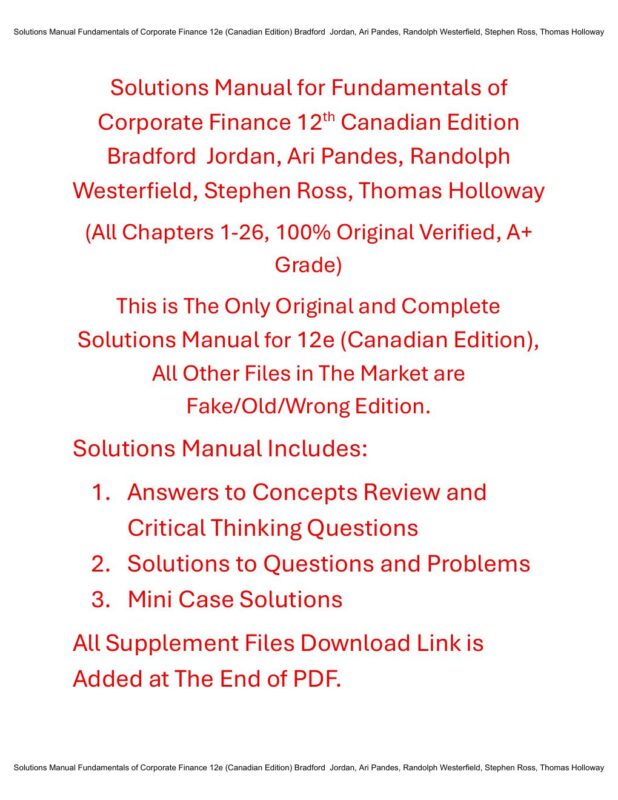
The Solutions Manual For Fundamentals of Corporate Finance, 12th Canadian Edition by Stephen Ross, Randolph Westerfield, Bradford Jordan, J. Ari Pandes, and Thomas Holloway—covers the foundational principles of financial decision-making. It frames corporate finance through three central themes: an emphasis on intuition, a unified net present value (NPV) valuation approach, and a managerial focus on decision-making. [1, 2, 3, 4]
The core topics and structural breakdown featured in the textbook include:
Part 1: Overview of Corporate Finance
- Introduction to Corporate Finance: The role of the financial manager, legal forms of business organization, the ultimate goal of financial management, and agency conflicts. [1]
- Financial Statements, Taxes, and Cash Flow: Reviewing balance sheets and income statements, understanding corporate taxes, and tracking cash flows generated from assets. [1, 2]
Part 2: Financial Statements and Long-Term Financial Planning
- Working with Financial Statements: Utilizing financial ratios, trend analysis, and benchmarking performance.
- Long-Term Financial Planning and Growth: Constructing pro forma financial statements, forecasting external financing needed (EFN), and calculating growth metrics. [1]
Part 3: Valuation of Future Cash Flows
- Introduction to Valuation: The time value of money, computing present value, future value, and basic compounding.
- Discounted Cash Flow (DCF) Valuation: Evaluating multi-period cash flows, calculating annuities, perpetuities, and loan amortization.
- Interest Rates and Bond Valuation: Pricing bond instruments, bond features, inflation impacts, and the term structure of interest rates.
- Equity Valuation: Pricing common and preferred stocks, using dividend discount models, and price-earnings multiples. [1, 2, 3, 4, 5]
Part 4: Capital Budgeting
- Net Present Value and Other Investment Criteria: Deciding on capital expenditures using NPV, Internal Rate of Return (IRR), Payback Period, and Profitability Index.
- Making Capital Investment Decisions: Projecting incremental cash flows, accounting for depreciation, and analyzing project performance.
- Project Analysis and Evaluation: Evaluating risk via scenario analysis, sensitivity analysis, break-even targets, and real options. [1, 2]
Part 5: Risk and Return
- Some Lessons from Capital Market History: Historical returns, financial market efficiency, and tracking market volatility.
- Return, Risk, and the Capital Asset Pricing Model (CAPM): Defining systematic vs. unsystematic risk, diversification, beta, and the Security Market Line (SML). [1, 2]
Part 6: Cost of Capital and Long-Term Financial Policy
- Cost of Capital: Calculating the Weighted Average Cost of Capital (WACC) and evaluating divisional costs of capital.
- Raising Capital: The process of issuing public securities, initial public offerings (IPOs), and venture capital.
- Financial Leverage and Capital Structure Policy: Modigliani-Miller theorems, optimal capital structures, and the effects of corporate tax and bankruptcy costs.
- Dividends and Other Payouts: Cash dividends, stock repurchases, and establishing corporate payout policies. [1]
Part 7: Short-Term Financial Planning and Management
- Short-Term Finance and Planning: Tracking the operating cycle, cash cycle, and short-term financial policy.
- Cash and Liquidity Management: Collecting and dispersing cash, managing floats, and cash budgeting.
- Credit and Inventory Management: Establishing credit terms, evaluating credit policy, and monitoring inventory. [1]
Part 8: Advanced Topics in Corporate Finance
- International Corporate Finance: Managing foreign exchange risk, purchasing power parity, and international capital budgeting.
- Leasing: Evaluating the financial decision to lease versus buy corporate equipment or real estate.
- Mergers and Acquisitions (M&A): Understanding corporate takeovers, synergies, and the mechanics of consolidation.
- Derivative Securities and Corporate Risk: Introductions to financial engineering, options pricing, and enterprise risk management. [1, 2, 3]
File included
tmpphpUZrwWr
9.94 MB
Related ebooks