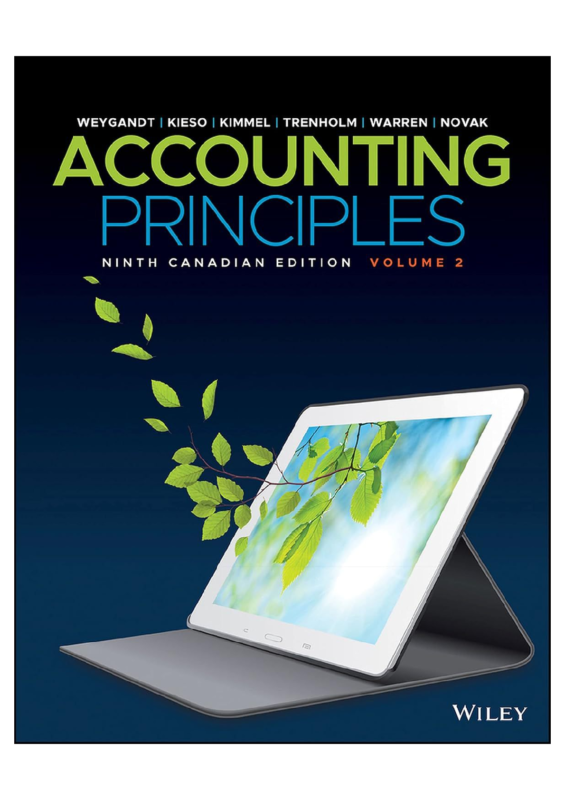
Solutions manual for Accounting Principles, Volume 2, 9th Canadian Edition by Jerry J. Weygandt, Donald E. Kieso, and Paul D
$25.00
Secure checkout
Instant digital download
PDF document
Document details
- Pages
- 10
- File size
- 4.65 MB
- Format
- Digital PDF
- Course
- Accounting
- Category
- SOLUTIONS MANUAL
Sign in or create a free account to continue. Your purchase will be saved in My Downloads.
About this ebook
Solutions manual for Accounting Principles, Volume 2, 9th Canadian Edition by Jerry J. Weygandt, Donald E. Kieso, and Paul D. Kimmel covers advanced introductory financial accounting topics, moving beyond the basic accounting cycle of a sole proprietorship covered in Volume 1. The textbook focuses on specific asset and liability classifications, various forms of business organizations, and financial statement analysis tailored to Canadian accounting frameworks (ASPE and IFRS). [1, 2, 3]
The specific chapters and topics covered in Volume 2 (Chapters 9–18) include: [1]
Asset and Liability Management
-
- Long-Lived Assets (Chapter 9): Accounting for property, plant, and equipment (PPE), intangible assets, and goodwill. It covers acquisition costs, depreciation methods (straight-line, declining-balance), asset impairments, and disposals. [1, 2, 3]
- Current Liabilities and Payroll (Chapter 10): Recording determinable and contingent liabilities, sales taxes, and comprehensive payroll accounting (deductions, fringes, and employer taxes). [1, 2, 3, 4]
- Non-Current Liabilities (Chapter 15): Bond issuances, accounting for bond interest (amortization using straight-line and effective-interest methods), and long-term notes payable. [1, 2, 3]
Business Structures and Frameworks
-
- Financial Reporting Concepts (Chapter 11): Overview of the conceptual framework for financial reporting, including qualitative characteristics of accounting information, foundational principles, and the differences between ASPE and IFRS. [1, 2]
- Accounting for Partnerships (Chapter 12): Formation of partnerships, allocation of profits and losses among partners, financial statements for partnerships, and procedures for the admission, withdrawal, or liquidation of partners. [1, 2]
- Introduction to Corporations (Chapter 13): Corporate organization, accounting for share issuances (common and preferred shares), cash dividends, stock dividends, and stock splits. [1, 2, 3]
- Corporations: Additional Topics and IFRS (Chapter 14): Retained earnings restrictions, prior period adjustments, comprehensive income reporting, and specialized International Financial Reporting Standards regulations. [1]
Financial Analysis and Reporting
-
- Investments (Chapter 16): Accounting for debt and equity investments, including the cost/amortized cost model, equity method, and fair value through profit or loss (FVTPL) tracking. [1, 2]
- The Cash Flow Statement (Chapter 17): Preparing the statement of cash flows using both the direct and indirect methods, classifying cash flows into operating, investing, and financing activities. [1]
- Financial Statement Analysis (Chapter 18): Evaluating corporate performance using horizontal analysis, vertical analysis, and liquidity, solvency, and profitability ratios. [1]
Integrated Features
Throughout these topics, the 9th Canadian Edition integrates modern data practices and insights via specific modules available on the publisher's platform, Wiley: [1]
- Data Analytics Insights: Real-world examples of data analysis in business environments.
- Analytics in Action: Dedicated end-of-chapter problems focusing on data-driven financial decision-making.
- Sustainability Emphasis: Case studies highlighting how accountants track, report, and assure corporate environmental and social metrics. [1, 2, 3]
File included
Solution-manual-for-Accounting-Principles-9e-Canadian-Volume-2-Weygandt.pdf
4.65 MB
Related ebooks


![Managerial Accounting 2026 Release by Ray H. Garrison Ebook [PDF]](https://greatpricebooks.com/wp-content/uploads/2026/08/paper-653314-page-001-pWlcWe2lCEJFAErM-768x929.jpg)